Play-Alongs, Pop Songs, and Copyright: What Every Music Teacher Should Understand
You’ve probably seen them.
Boomwhacker play-alongs on YouTube. Bucket drumming videos. Kids playing along to the latest pop song while a screen does the teaching. It looks engaging. It’s easy to set up. And honestly — we get it. When you’re juggling thirty kids, a packed curriculum, and approximately zero spare time, anything that works feels like a win.
But there are some things worth knowing before you build your lessons around someone else’s music. Things that could affect your lesson resources, your school’s legal standing, and — if we’re being honest — the quality of what your students are actually experiencing.
This isn’t a legal guide. For authoritative copyright information specific to your country, we’d point you to Smartcopying (Australia), APRA AMCOS (Australia), and NAfME (USA) — they’re the genuine experts. What this is is our attempt to explain why we make the choices we make at the Fun Music Company, and why we think those choices matter for you and your students.
What does copyright actually mean for music teachers?
Here’s the short version: almost every song your students know and love is owned by someone. Not just the recording — the melody, the lyrics, the underlying composition. When you use that music in your classroom, online, or in any resource you share, copyright law has something to say about it.
In Australia, the Smartcopying guidelines and your school’s statutory licence cover a lot of everyday classroom use — singing songs in class, playing recordings during a lesson, that kind of thing. In the USA, the “Face-to-Face Teaching Exemption” covers similar ground. But — and this is important — those protections have limits, and they don’t automatically extend to everything you might want to do, especially anything that ends up online.
The moment a lesson leaves your four walls and goes onto the internet, the rules change significantly. And that’s where things get complicated for a lot of teachers right now.
The YouTube play-along problem — and why it’s riskier than it looks
If you’ve spent any time searching for boomwhacker activities or bucket drumming ideas, you’ve seen them. Videos of kids playing along to popular songs — sometimes with colour-coded notes on screen, sometimes just the original track playing in the background. They look polished. They look fun. And there are a lot of them.
But there are two problems worth understanding before you build a lesson around YouTube content.
1. The copyright problem
When someone uploads a video to YouTube that contains a copyrighted song — even just playing in the background — YouTube’s automated system, called Content ID, detects it almost immediately. That system exists to protect the rights of the people who own the music.
When a match is found, the rights holder — the record label, the publisher, or the artist — gets to decide what happens next. They can place ads on that video and collect all the revenue. They can block the video entirely. They can restrict it so it only plays in certain countries. Or they can simply track it and decide what to do later.
Notice what isn’t on that list: giving the person who uploaded the video permission to use the song.
This is the part that often gets misunderstood. A video staying up on YouTube isn’t the same as having a licence to use that music. It means the rights holder has decided — for now — that running ads on someone else’s video is more useful to them than taking it down. That’s their business decision. And they can change it any time they like.
For a classroom teacher, that creates a very specific problem. You find a great boomwhacker play-along or a bucket drumming video your students will love. You build a lesson around it. You share the link with colleagues. Maybe you embed it in your school’s learning management system. And then one day — it’s gone. Or it’s blocked in your country. Or the rights holder has changed their policy and the video has disappeared entirely.
Your lesson resource has simply vanished, and there’s nothing you can do about it.
That’s not a hypothetical. It happens regularly.
There’s another layer to this worth understanding.
Content ID was designed for a specific purpose: to manage situations where copyrighted music appears incidentally in someone’s video — background music in a vlog, a song playing at a party, that kind of thing. The rights holder gets to monetise it, the video stays up, and everyone moves on.
Play-along videos are a fundamentally different situation. Here, the song isn’t background — it is the lesson. The music is the entire point of the video. At some stage, rights holders are likely to start recognising that their music is being used in this way at scale, and the benefit of “let it run ads” may start looking different to them.
There’s also the question of sheet music and lyrics. Many play-along videos display notation, chord charts, or lyrics on screen — and this sits in genuinely grey territory. Copyright in a song isn’t just the sound recording. The underlying composition and the lyrics are separately protected, and displaying them visually is a different matter to simply playing the audio. Content ID doesn’t catch this automatically — but a rights holder reviewing their catalogue manually might. Videos featuring sheet music or lyrics could be especially vulnerable to a takedown request, and there is no clear safe harbour for this use.
The bottom line: these videos exist in a space the system was never designed to govern. That might feel like freedom — but it’s actually the opposite. It means the rules are unclear, the protections are thin, and the rug could be pulled at any time.
2. The quality problem
But let’s say the video stays up. There’s a second issue that doesn’t get talked about nearly enough — and for music teachers, it might actually be the more important one.
Who checked the chord charts?
Who verified the notation?
Who made the call on whether that rhythm arrangement was actually appropriate for the age group?
When you build a lesson around a YouTube play-along, you’re trusting the musical judgment of someone you’ve never met, with no credentials you can verify, and no accountability if something turns out to be simply wrong. And the reality is that a significant number of these videos contain exactly that — incorrect chords, inaccurate notes, rhythms that don’t quite fit the song, or arrangements that make questionable musical choices for young learners.
For a music specialist, something feels off immediately. But for a generalist classroom teacher without a strong music background — and there are many, and they are doing a wonderful job — there’s often no way to know. You trust the resource. Your students learn it. And what they’ve learned may not be quite right.
As a teaching professional, you deserve resources you can actually trust. And your students deserve to learn music correctly the first time.
Is watching YouTube actually a music lesson?
Let’s take a step back from copyright for a moment and ask a more fundamental question.
When a student goes home on a Tuesday afternoon and their parent asks “what did you do in music today?” — what do you want the answer to be?
Because if the answer is “we watched YouTube videos,” that parent is going to ask a very reasonable follow-up question: why couldn’t they do that at home?
This isn’t a criticism of any individual teacher. Many of the educators we work with are generalist classroom teachers carrying music as just one subject among many, often without specialist training, often without much support. The pressure to fill a music lesson with something engaging is real. We understand that completely.
But here’s the thing. You are a teaching professional. And teaching — real teaching — is an active, skilled, human endeavour. It’s you reading the room. It’s you noticing which students are struggling and which ones are ready for more. It’s you making musical decisions in real time, responding to what’s happening in front of you. It’s the thing that no screen can replicate, no matter how polished the video.
Passive screen time is passive screen time, whether it happens at home or at school. And your students — and their parents, and your principal — deserve to see the difference.
The good news is that genuinely active, engaging music lessons don’t have to be complicated or time-consuming to prepare. They don’t require you to be a virtuoso musician. They just require the right resources — ones that put you at the centre of the learning, not a screen. That’s exactly what great music education looks like. And it’s well within reach.
Why we do things differently at the Fun Music Company
Every piece of music in our programs is either an original composition or a traditional folk song. That’s not an accident. It’s a deliberate choice we’ve made — and stuck to — for a very specific set of reasons.
Original compositions
When a piece of music is written specifically for an educational program, everything about it can be designed with your students in mind. The melody can be crafted to sit comfortably in a child’s vocal range. The rhythm can be intentionally sequenced to build skills progressively. The harmonic choices can be appropriate for the age group. Nothing is borrowed, adapted, or squeezed into an educational context it wasn’t designed for.
And from a practical standpoint — you own access to it. It won’t disappear from YouTube overnight. It won’t get blocked in your country. It won’t suddenly have ads running over it that you can’t control. The resource you plan your lesson around today will still be there next Tuesday, and next term, and next year.
Traditional folk songs
Folk songs have been sung in classrooms for generations — and there are very good reasons for that beyond tradition and nostalgia. The best traditional folk songs are melodically memorable, rhythmically engaging, and structurally simple enough for young learners to access quickly. They’ve been road-tested by countless teachers across countless classrooms. They work.
They’re also in the public domain. That means no rights holder waiting to pull the rug out from under your lesson. No Content ID claim. No ads. No uncertainty. Just a song that belongs, in the truest sense, to everyone.
There’s something else worth saying here too. Folk songs carry genuine cultural weight. Many have been passed down through oral tradition across hundreds of years. Teaching them to children isn’t just musically sound — it connects students to something larger than a pop song that topped the charts for six weeks and will be forgotten by Christmas.
What this means for you
Every arrangement in our K–6 Curriculum Program has been written and checked by music educators. The chord choices are correct. The notation is accurate. The sequencing is intentional — built from the ground up to take students on a progressive musical journey from Kindergarten through to Grade 6.
You don’t have to wonder whether the resource you’re using is musically sound. You don’t have to worry about it disappearing. And you don’t have to press play and step back — because everything in our program is designed to put you at the centre of the lesson, doing what you do best.
That’s the standard we hold ourselves to. And it’s why we’ve made the choices we’ve made since day one.
What to look for in any music resource
Whether you’re evaluating a YouTube video, a paid program, or a free resource you’ve found online, these are the questions worth asking before you build a lesson around it.
Who created it — and are they qualified to?
This doesn’t mean every music resource needs to be created by a conservatory-trained musician. But it does mean there should be a real person behind it with genuine music education experience, and ideally some transparency about who that person is and what their background looks like. Anonymous YouTube channels with no stated credentials are a red flag.
Is the music content actually correct?
If you have enough musical knowledge to check — check. Look at the chord choices. Listen to whether the melody matches the notation. Consider whether the arrangement is genuinely appropriate for the age group it claims to serve. If you don’t feel confident assessing this yourself, look for resources that have been created by qualified music educators and used widely enough that errors would have been identified and corrected.
Will it still be there next term?
Free resources come and go. YouTube videos disappear. Websites shut down. If you’re investing time into building a unit of work around a particular resource, it’s worth asking whether that resource is likely to still exist in six months. Paid programs from established providers offer a level of stability that free online content simply can’t match.
Does it put you at the centre — or does it replace you?
A good music resource should make your job easier without making you redundant. Look for resources that give you clear, simple instructions, that explain the why behind each activity, and that leave room for you to respond to what’s happening in your classroom in real time. If a resource works just as well with a teacher in the room as without one, that’s worth thinking about.
Is it designed for your students — or adapted from something else?
There’s a significant difference between music written specifically for primary-aged learners and music that has been arranged or adapted from existing popular songs. Purpose-built educational music starts from your students’ needs. Adapted pop songs start from the song — and work backwards, sometimes awkwardly.
Does it sequence and build skills over time?
A single engaging activity is great. A program that takes your students somewhere — that builds musical skills progressively, year by year, in a logical and intentional sequence — is something else entirely. If you’re looking for more than a one-off lesson filler, look for resources that have a clear educational arc.
Ready to leave the YouTube rabbit hole behind?
If you’re looking for a music program that takes care of all of this for you — one where the music is original, the arrangements are accurate, the sequencing is intentional, and the resources will still be there next year — we’d love to introduce you to our K–6 Music Curriculum Program.
Every piece of music has been written and checked by qualified music educators. Every lesson is designed to put you at the centre of the learning. And the entire program is built on a simple promise: we’ve done the hard work so you don’t have to.
It doesn’t matter whether you’re a music specialist or a generalist classroom teacher picking up music for the first time. The K–6 Music Curriculum Program is designed to work for both — giving specialists the depth and rigour they’re looking for, and giving generalist teachers the confidence and clarity they need.
“Having access to your music program has made the teaching and planning of my music classes SO much easier!”
This was what Liz, a music teacher from a small Catholic school in Sydney wrote to us in an email recently. This is typical of the hundreds of responses we get every week from teachers across Australia using the Fun Music Company Curriculum Program.
Imagine having an entire year of music lessons already planned, prepared, and ready to teach — no more Sunday night scrambles or piecing together resources from different places. That’s exactly what teachers at over 350 schools across Australia are experiencing right now.
Our curriculum program gives you complete, sequential lesson plans for every week of the school year, with videos, worksheets, interactive resources, and everything you need to walk confidently into your music room — whether you’re a specialist or a classroom teacher who’s been asked to teach music.
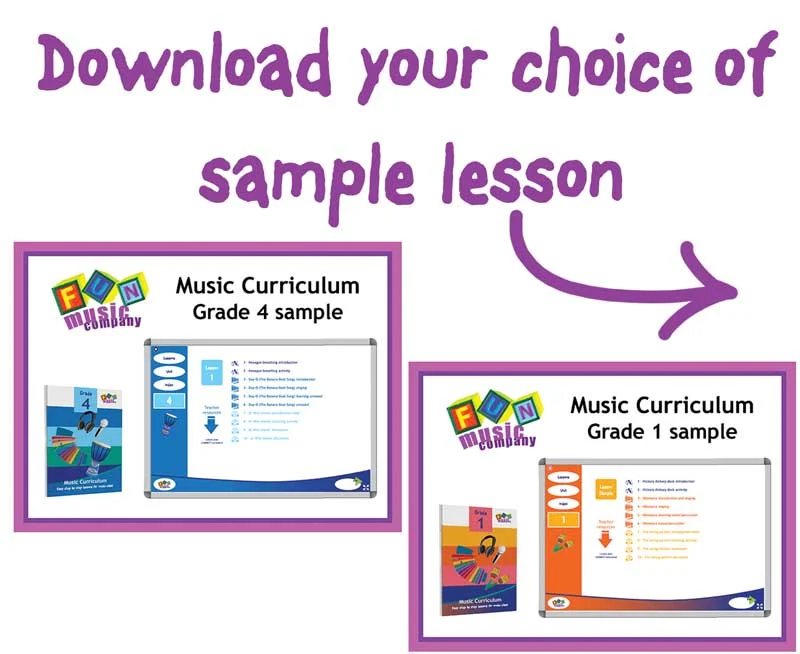
Ready to see what a week of music lessons looks like in your grade level?
Download a free sample pack below and take it for a test drive in your classroom.
 We value your privacy and would never spam you. We may email you valuable ideas for music teaching once or twice a week, however you can unsubscribe at any time. Check details of our privacy policy here.




Leave A Comment