


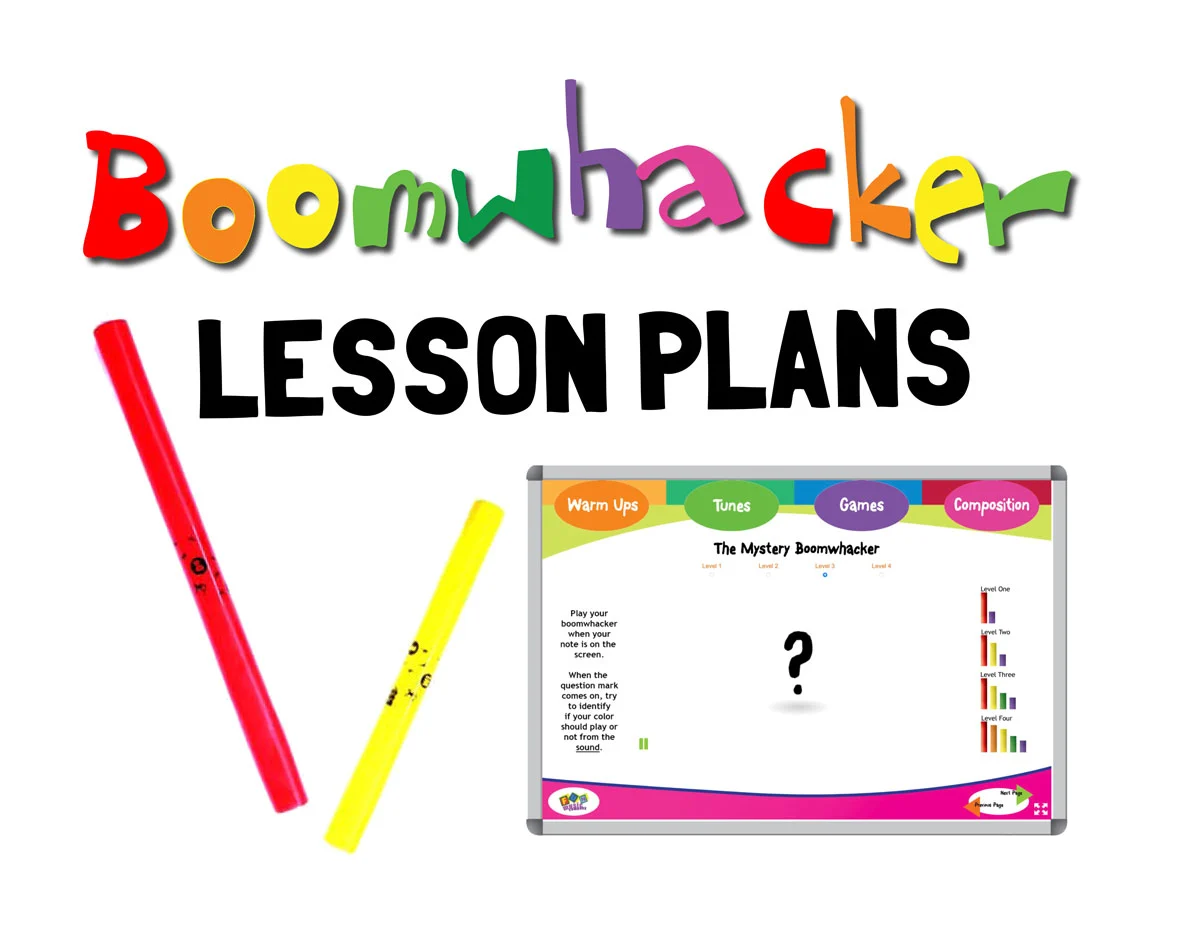
Boomwhacker Lesson Plans: Everything You Need for K–6
So you’ve got a set of boomwhackers. Your students have seen those colourful tubes in the classroom on their way in, and by the time they’re seated they are barely containing their excitement.
The colourful tubes are out, the energy is high — and then it hits you: what am I actually doing with these for the next forty minutes?
If you’ve ever searched for a boomwhacker lesson plan and found yourself wading through a mix of YouTube videos, random song sheets, and activities that don’t quite hang together — you’re not alone. The resources are out there, but building them into a lesson that actually flows? That’s a different challenge altogether.
The good news is that a great boomwhacker lesson doesn’t have to be complicated. It just needs structure. In this post, I’m walking you through exactly what a well-sequenced boomwhacker lesson looks like — from the moment students walk in to the moment they pack away — along with a ready-to-go Fun Music Company lesson you can use this week.
Let’s get into it.
What Makes a Good Boomwhacker Lesson?
Before we get into the step-by-step, it’s worth understanding why structure matters so much with boomwhackers specifically.
Boomwhackers are brilliant — but they come with a built-in challenge: the moment students pick them up, every instinct tells them to whack something. Without a clear lesson arc, that energy can easily tip from productive to chaotic. A well-structured lesson channels the excitement in a direction that’s musical, purposeful, and focused — so students are engaged rather than just loud.
A good boomwhacker lesson has five key phases:
- Introduction — context-setting, especially for classes new to boomwhackers
- Warm-up — short, focused activities that build skills and settle the group
- Song — the musical centrepiece of the lesson
- Game — an engaging activity that consolidates learning
- Pack away and review — a structured close that reinforces what was learned
How much time you spend on each phase — and whether you include the introduction at all — depends on one key question:
Have your students played boomwhackers before?
If this is their first time, the introduction is essential. If they’re already familiar with boomwhackers, you can move straight to the warm-up and use the time you save elsewhere in the lesson. We’ll cover both scenarios below.
Phase 1: Introduction to Boomwhackers (First-Time Classes Only)
If your students have played boomwhackers before, you can skip most of this section — a quick “who remembers what these are?” and a brief recap of your classroom rules is all you need. Then move straight to Warm-Up #1.
For classes picking up boomwhackers for the first time, this introduction does two things: it builds genuine curiosity about what they’re holding, and it sets clear expectations for how they’re used.
What Are Boomwhackers?
Start by holding up a couple of different boomwhackers — ideally one long and one short — and let students observe them before you explain anything.
Ask: what do you notice? Most will spot the colours and the different lengths straight away.
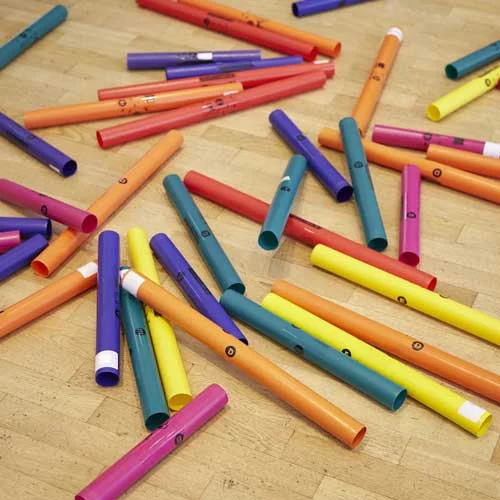
Boomwhackers are pitched percussion tubes — each one is tuned to a specific musical note. The colour tells you which note it is, and the length tells you something important about music: longer tubes make lower sounds, shorter tubes make higher sounds.
This is the element of music called pitch — and boomwhackers make it something students can literally see and feel, not just hear.
Play one long tube and one short tube and ask students to listen: which one sounds higher? Which one sounds lower? Let them hear the difference before they play themselves.
How We Play Boomwhackers
Keep this simple and demonstrate as you explain:
- Hold the boomwhacker in a relaxed grip, you don’t want to choke the sound
- Strike it gently into your other hand.
- If your other hand hurts when you hit it… don’t hit it so hard
Hitting the boomwhacker into the other hand is our first and most preferred method of playing boomwhackers. There are many ways of playing boomwhackers that work, and we’ve gone into detail on that in our comprehensive guide to getting started with Boomwhackers.
Decide on the rules for your classroom, and decide how you wish to communicate them to the students.
Most importantly:
1. Boomwhackers should never be used to hit another person.
2. Boomwhackers should never be played in a way that bends or damages them.
Phase 2: Play Along Warm-Ups
Every good boomwhacker lesson includes a warm-up phase — and ideally, more than one activity. Warm-ups do two things at once: they settle the class into focused playing mode, and they build specific musical skills before the main song begins.
The key is to choose warm-ups that are short, clear, and screen-based — so students can follow along without needing to read notation or remember complicated instructions. Each warm-up should have a single musical focus, and students should feel a sense of achievement by the end of it.
Here are two warm-ups we use in our ready-to-go boomwhacker lesson:
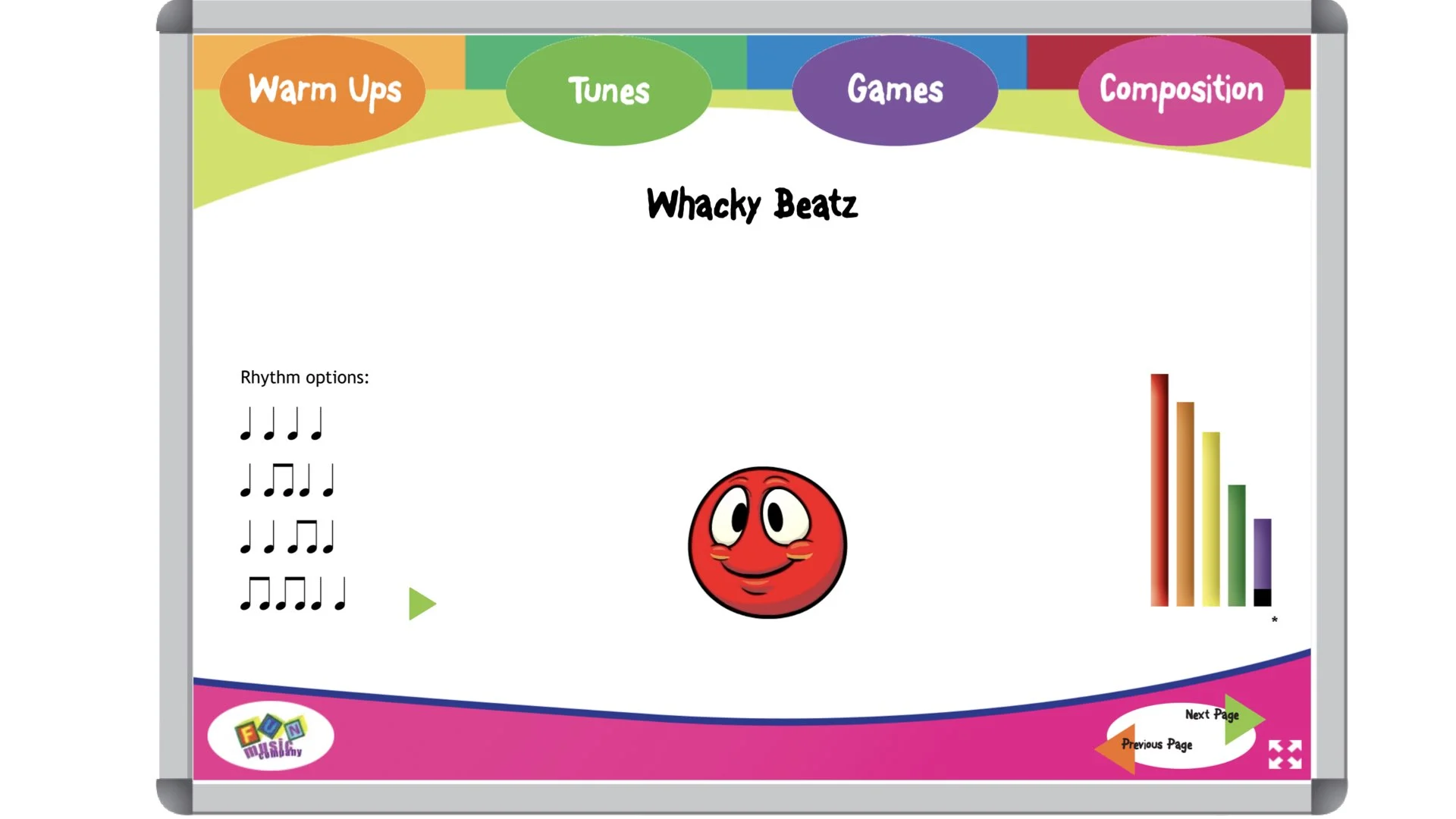
Warm-Up #1: Steady Beat (Whacky Beatz)
The first warm-up focuses on steady beat — playing at the right time, neither rushing ahead nor dragging behind. It sounds simple, but for many students this is genuinely challenging, and it’s the foundation of everything else that happens in the lesson.
Our Whacky Beatz warm-up is the opening activity from our Boomwhacker Beatz program. Students watch a colour-coded screen and play their boomwhacker only when their colour appears — building precision and ensemble awareness from the very first beat.
✨ After the warm-up: if time allows, have each group swap boomwhackers with another group and repeat. Every student gets to practise the same skill on a different pitch.
Warm-Up #2: Rests (Wait to Eat the Doughnut)
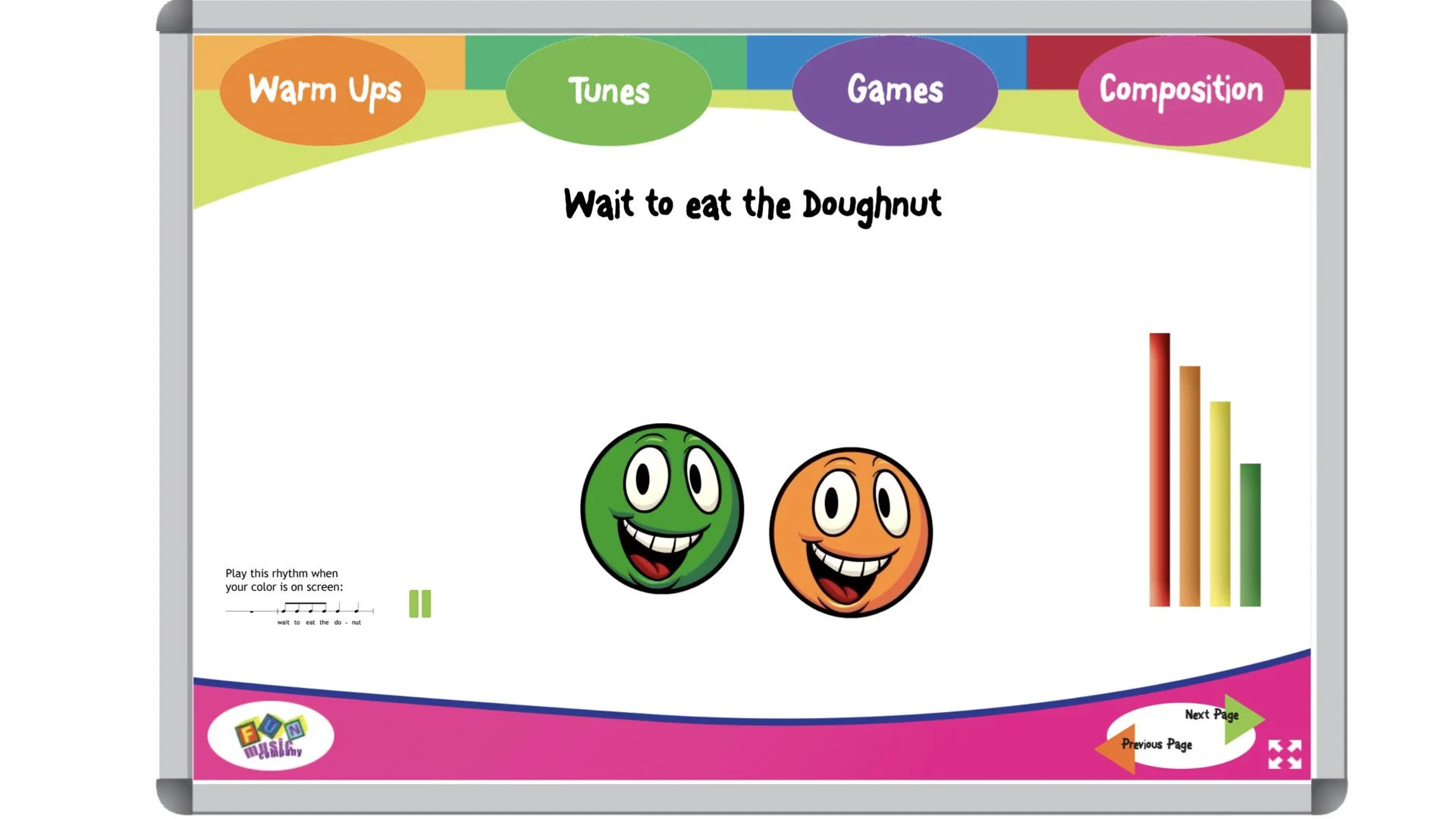
The second warm-up adds a new layer: the rest. Rather than explaining what a rest is, this warm-up makes students feel it.
Our “Wait to Eat the Doughnut” warm-up works like this: students watch for their colour to appear on screen. When it does, they play a rhythmic pattern. But the key is what happens in the bar before — they wait, they get ready, they resist the urge to play early. That waiting bar is a rest, and by the end of the activity students have experienced it dozens of times without ever being told what it’s called.
The rhythm itself — wait-to-eat-the / dough-nut — falls on four quavers followed by two crotchets, with natural pauses built in. It’s unforgettable, and it works beautifully even with the youngest classes.
✨ After the warm-up: swap groups and repeat. Students who’ve mastered the pattern on one pitch will enjoy the challenge of playing it on a different one.
Both warm-ups are included in the free Boomwhacker Activity Sample Pack, with the screen-based resources ready to run.
Phase 3: Work on a Song
This is the musical centrepiece of the lesson — the moment when everything practised in the warm-ups comes together in a full piece of music.
A good boomwhacker song for classroom use should be immediately accessible (so students can participate from the first run-through), musically interesting enough to hold attention, and structured so every group has a clear role rather than some students sitting out while others play.
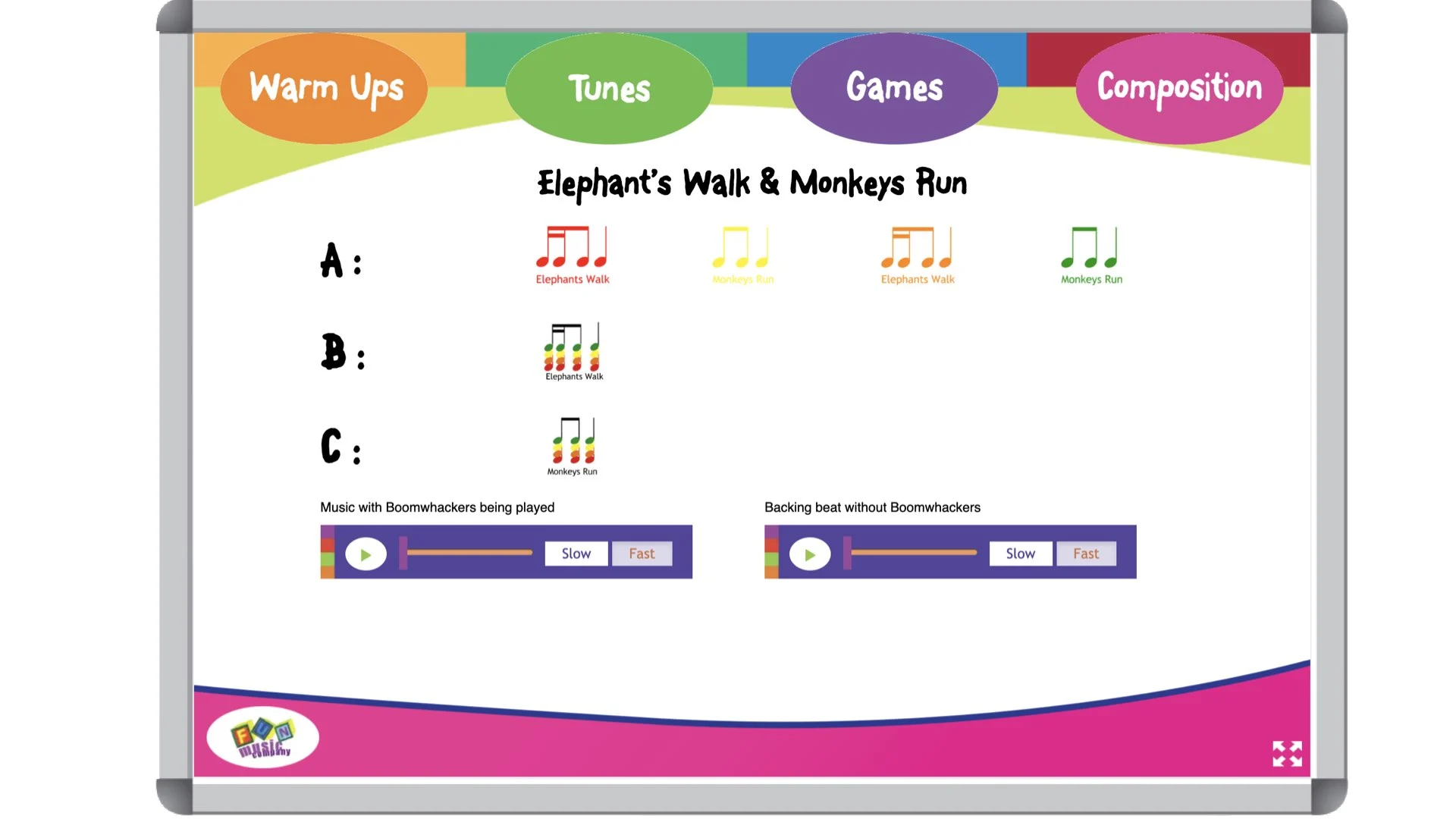
For this lesson, we use Elephants Walk, Monkeys Run — an original Fun Music Company composition designed specifically for boomwhackers. It’s one of the songs from our Boomwhacker Songs for K–6 post, where you’ll find the full arrangement and free resources.
The song uses four boomwhacker pitches and gives students colour-coded cues throughout — so even a class that’s never played together before can get through it successfully in the first lesson.
✨ After the song: swap groups and play again if time allows. Students will enjoy the challenge of playing a different boomwhacker part.
Phase 4: A Boomwhacker Game
If the song is the centrepiece of the lesson, the game is the reward — and it’s where some of the deepest musical learning quietly happens.
A good boomwhacker game channels the energy that’s been building all lesson into something focused and purposeful. It asks students to listen carefully, make decisions, and respond to what they hear — often without realising they’re doing any of those things because they’re having too much fun.
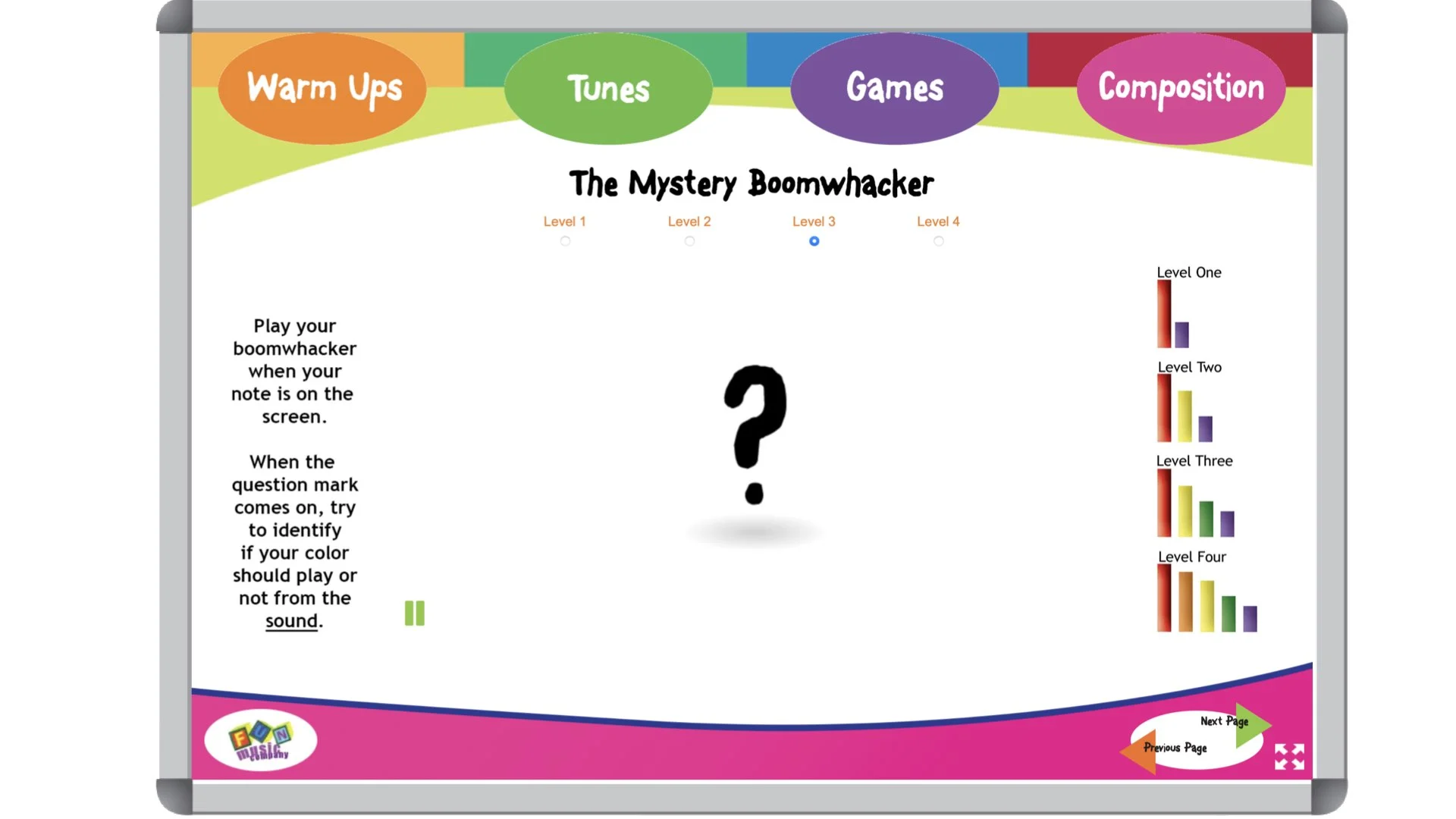
We have a full post dedicated to boomwhacker games and activities for K–6, so we won’t replicate all of that here. But for this lesson, we recommend starting with the Mystery Boomwhacker Game.
Students watch for their colour to appear and play when they see it. But at certain points, a question mark appears instead of a colour — and students have to stop relying on their eyes and use their ears. They listen carefully to the pitch being played and decide: is this my note? Should I play?
That moment of decision is where pitch recognition starts to develop in a meaningful way. The focus it generates in a classroom is something you need to see to believe.
The Mystery Boomwhacker Game is included in the free Boomwhacker Activity Sample Pack. Head to the games and activities post for the full range of options, including games that work especially well for Grades 3–6.
Phase 5: Pack Away and Review
Don’t underestimate this part of the lesson. A structured close is where the learning gets consolidated.
Pack away should be deliberate: students return their boomwhackers to the correct storage location in the order you direct. Doing this calmly after an energetic lesson is itself a valuable skill.
Once boomwhackers are away, use two or three minutes for a brief discussion:
- How did you feel about the music we played today?
- What did you notice about the sound of the boomwhackers?
- How could we make our group performance together even more effective?
- What other instruments might we pair with boomwhackers to make an even more interesting performance?
Try to use this part of the lesson for open ended questions. Allow students to give their input and feedback, and you’ll never know the insights and suggestions that they share. Because they drive the discussion and are felt heard, they will be more enthusiastic to come back to music class again and again!
Your Boomwhacker Lesson Plan at a Glance
| Lesson item | Suggested Fun Music Company content |
|---|---|
| 1 – Introduction to boomwhackers | |
| 2 – Warmups | “Whacky Beatz”, “Wait to eat the doughnut” |
| 3 – Boomwhacker Song | Elephants Walk, Monkeys Run |
| 4 – Boomwhacker Game | The Mystery Boomwhacker |
| 5 – Pack up and review |
All of the Fun Music Company resources referenced in this lesson are available as part of the free Boomwhacker Activity Sample Pack. You can have everything ready to go before your next class.
Boomwhackers Are Great. But Music Is So Much More.
If you’ve made it this far, you’re clearly serious about giving your students a genuinely good music lesson — and that matters.
Here’s something worth saying honestly: boomwhackers are a wonderful part of a music program. They’re accessible, engaging, and musically rich. But they work best as one instrument within a broader curriculum — not as the whole program, week after week.
Music education covers so much ground: rhythm, pitch, melody, dynamics, form, listening, composing, performing. Boomwhackers can touch many of those areas brilliantly — but a full music program is what makes those elements connect and build on each other over time.
The teachers who get the best results from boomwhackers are the ones using them as part of a structured K–6 curriculum — where boomwhackers show up as a tool within a lesson, not as the lesson itself.
If you’d like to see what that looks like in practice, our K–6 Music Curriculum Program is designed to give classroom teachers and music specialists everything they need to deliver a complete, sequential music education — week by week, grade by grade.

Learn more about the Fun Music Company K–6 Curriculum Program »
In the meantime, grab the free Boomwhacker Activity Sample Pack below and run this lesson with your next class. We’d love to hear how it goes!
Download the Free Boomwhacker Lesson Plan Sample Pack
We’ve put everything from this lesson into one easy download — the two warm-ups, Elephants Walk, Monkeys Run, and the Mystery Boomwhacker Game. One PDF and a set of online classroom materials, ready to go.
Enter your details here
and we will email you the activities.
and we will email you the activities.
 We value your privacy and would never spam you. By submitting this form, you are joining the Fun Music Company mailing list. We email valuable ideas for music teaching once or twice a week, however you can unsubscribe at any time. Check details of our privacy policy here.


Leave A Comment