


Boomwhacker Games and Activities for Primary or Elementary Music Classes
Have you ever handed out a set of boomwhackers and immediately thought — what have I done?
You’re not alone. The moment those colourful tubes hit students’ hands, excitement levels go through the roof. And while that energy is exactly what makes boomwhackers so magical, it can also make lessons feel like controlled chaos — especially if you’re not sure what to do next.
Here’s the thing: boomwhackers aren’t just a fun instrument. They’re one of the most powerful teaching tools you have. When you pair them with the right games and activities, suddenly your students are developing pitch recognition, reading rhythms, listening carefully, and even composing their own music — all while having the time of their lives.
In this post, I’m sharing four of my favourite boomwhacker games and activities that work right across K–6. Whether you’re a music specialist or a classroom teacher who’s never taught a music lesson before, these are designed to be simple to run and genuinely engaging for kids.
And the best part? You can grab all four of these as part of a free sample pack — more on that below.
Let’s dive in!
Why Games and Activities Make Boomwhackers So Effective
Boomwhackers are one of those rare instruments that students pick up almost instantly. There’s no complicated technique to learn, no reading music required to get started, and every child in the room can participate — regardless of their musical background or experience.
But what really unlocks their potential is the structure that games and activities provide.
When students are playing a boomwhacker game, they’re not just having fun — they’re listening carefully, waiting for their cue, making decisions, and responding to what they hear. That’s active musical learning happening in real time, often without students even realising it.

Here’s what well-designed boomwhacker activities can develop across your K–6 classes:
Pitch recognition — students learn to identify and respond to specific pitches, building aural awareness that underpins so much of their musical development.
Rhythm and beat — keeping a steady beat, reading rhythmic patterns, and responding accurately to what they hear are all skills that transfer across every area of music.
Music reading — colour-coded notation gives even your youngest students a meaningful, accessible entry point into reading music on the staff.
Composition and creativity — when students get to arrange and create their own musical ideas, they develop ownership over their learning in a way that’s hard to replicate with other activities.
Ensemble skills — waiting, listening, and playing together as a group builds the kind of musical awareness that makes every future ensemble experience richer.
The games in this post target all of these areas — and they’re designed to work whether you have a room full of music specialists-in-the-making, or kids who’ve never thought of themselves as musical at all.
Boomwhacker Game #1: The Mystery Boomwhacker Game
Skills developed: Pitch recognition, aural awareness
Works well for: Grades K–6
This is one of those games that sounds simple — and it is — but the level of focused listening it produces in a classroom is amazing!
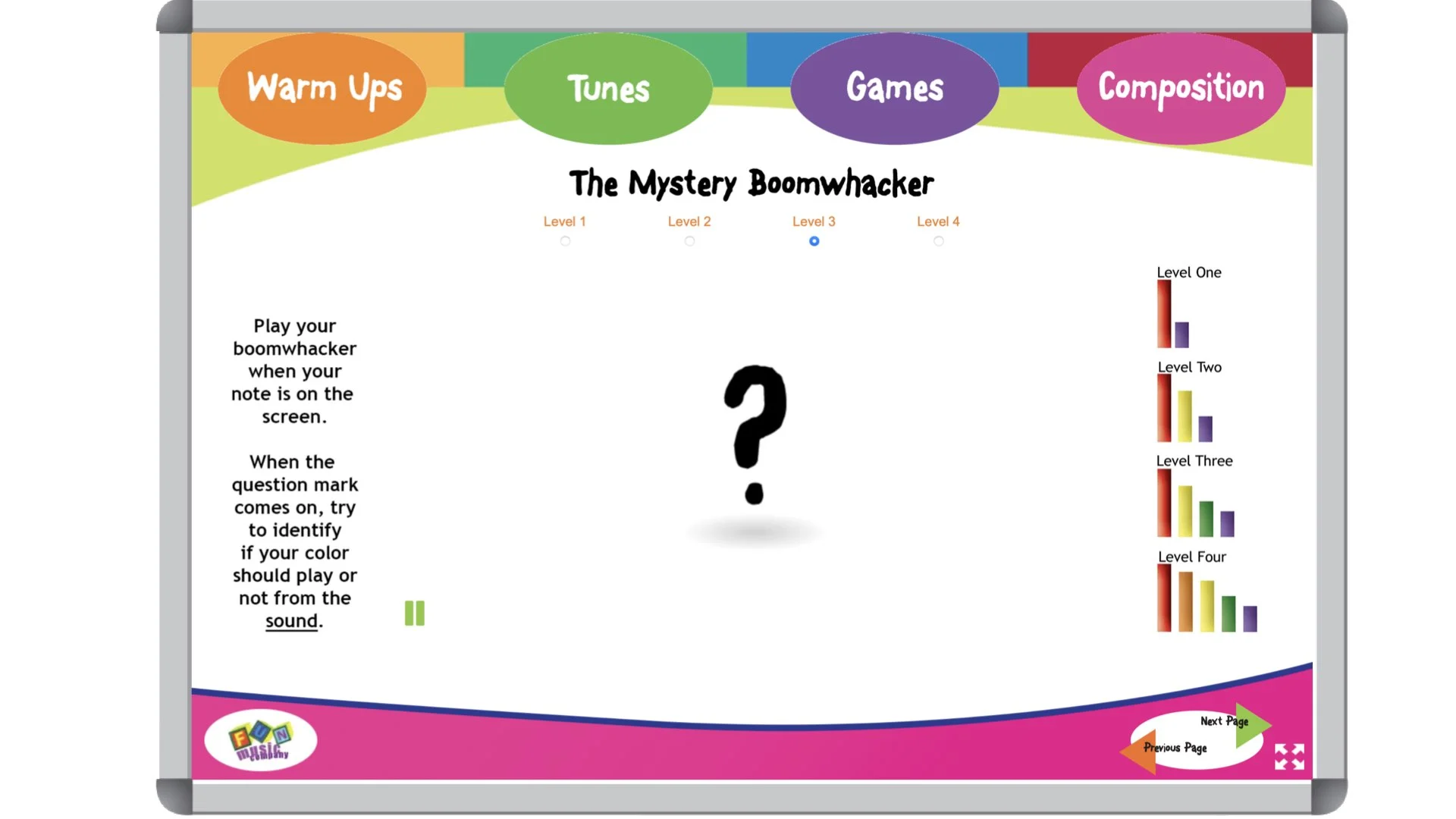
Here’s how it works. Students are divided into groups, each holding a different colour boomwhacker. As the game plays on screen, students watch for their colour to appear and play when they see it. So far, so straightforward!
But here’s the twist. At certain points in the game, a question mark appears on the screen instead of a colour. When that happens, students have to stop relying on their eyes and use their ears. They listen carefully to the pitch being played and decide — is this my note? Should I play?
That moment of decision is where the real musical learning happens. Students aren’t just responding visually anymore — they’re actively using their aural pitch recognition skills to make a musical judgement call. For many students, this is one of their first experiences of really listening to pitch in a purposeful way.
It’s also wonderfully self-regulating. Students who play when they shouldn’t quickly learn to listen more carefully next time. And students who get it right feel a genuine sense of achievement.
Boomwhacker Game Online Resource
This game is included in the free Boomwhacker Activity Sample Pack — you can grab it below and have it running in your classroom this week.
Boomwhacker Game #2: The Poison Rhythm Game
Skills developed: Rhythm recognition, active listening, self-control
Works well for: Grades 3–6
If you want a game that has your students on the absolute edge of their seats, this is it.
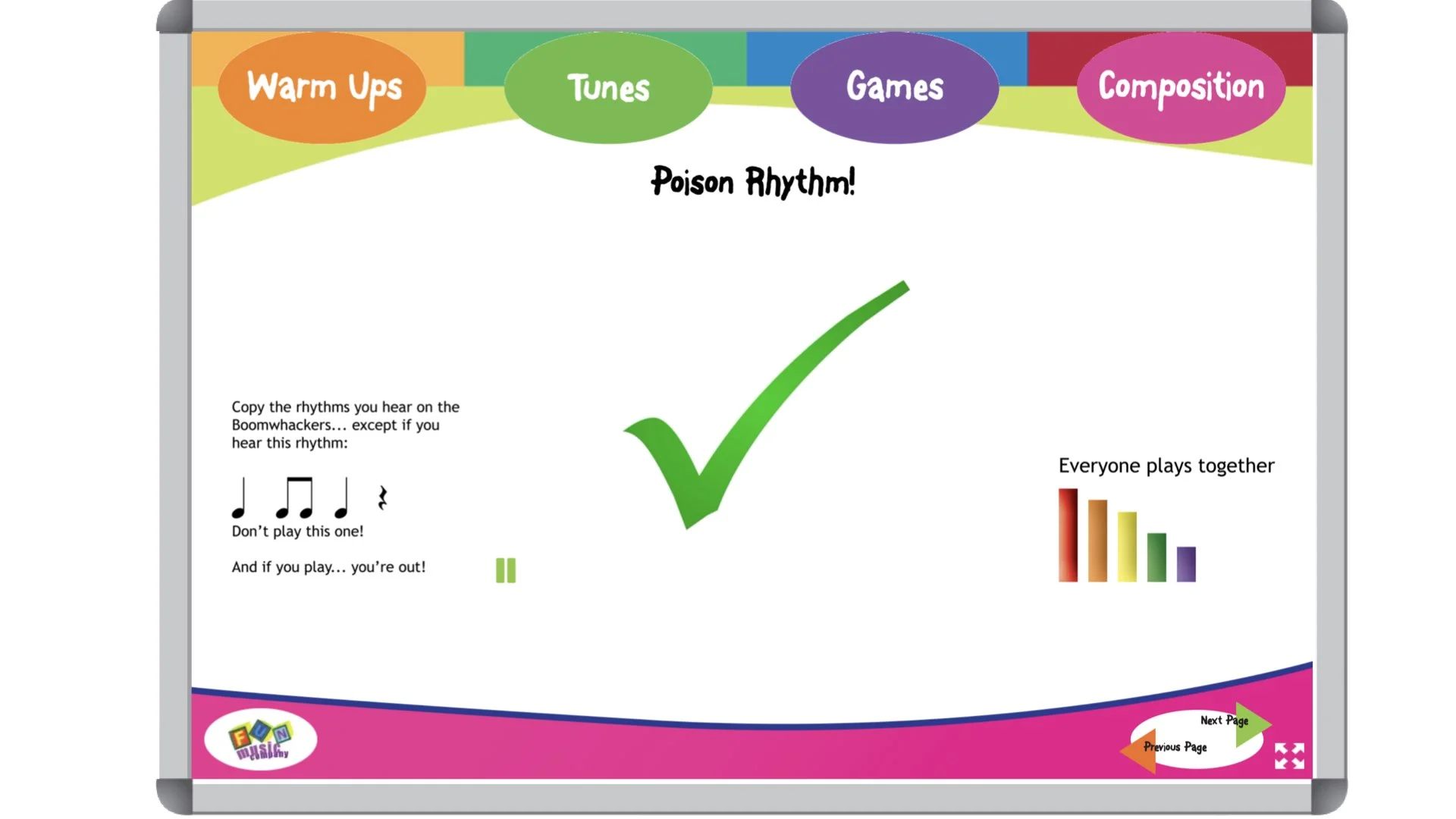
The Poison Rhythm Game is a listening game with a delicious twist. Students listen to rhythmic patterns played by the boomwhackers on the board, and their job is to play back each rhythm they hear — except for one. That one rhythm is the poison rhythm, and if they play it? They’ve been got!
Before the game begins, you introduce the poison rhythm to the class. It goes like this: “don’t play this one!” Students learn it, they know it, and then the game begins.
And then the sneaky magic happens.
Because once the game is underway, students are listening so intently to every single rhythm that comes up — ready to echo it back — that the moment the poison rhythm appears, the room erupts. Some students catch it and stay silent, bursting with pride. Others play it and immediately know they’ve been tricked. Either way, the laughter and the learning happen at exactly the same time.
What makes this game so effective from a teaching perspective is the quality of listening it demands. Students can’t zone out for a second. They have to hold the poison rhythm in their memory, compare every new rhythm they hear against it, and make a split-second decision — all while keeping up with the pace of the game. That’s a sophisticated set of musical skills wrapped up in something that feels purely like play.
It also works beautifully as a classroom management tool. When students know the poison rhythm is coming, they naturally settle and focus. You’ll notice the room get quieter the moment the game starts — and that’s a beautiful thing.
This game is included in the free Boomwhacker Activity Sample Pack along with the other activities in this post.
Boomwhacker Game #3: The Music Line Wizard Game
Skills developed: Pitch reading, music literacy, visual tracking
Works well for: Grades 2–6
If the Mystery Boomwhacker Game builds aural pitch recognition and the Poison Rhythm Game develops listening and self-control, the Music Line Wizard Game is where those skills start connecting to something even bigger — reading music.
And it does it in the most gentle, accessible way imaginable.
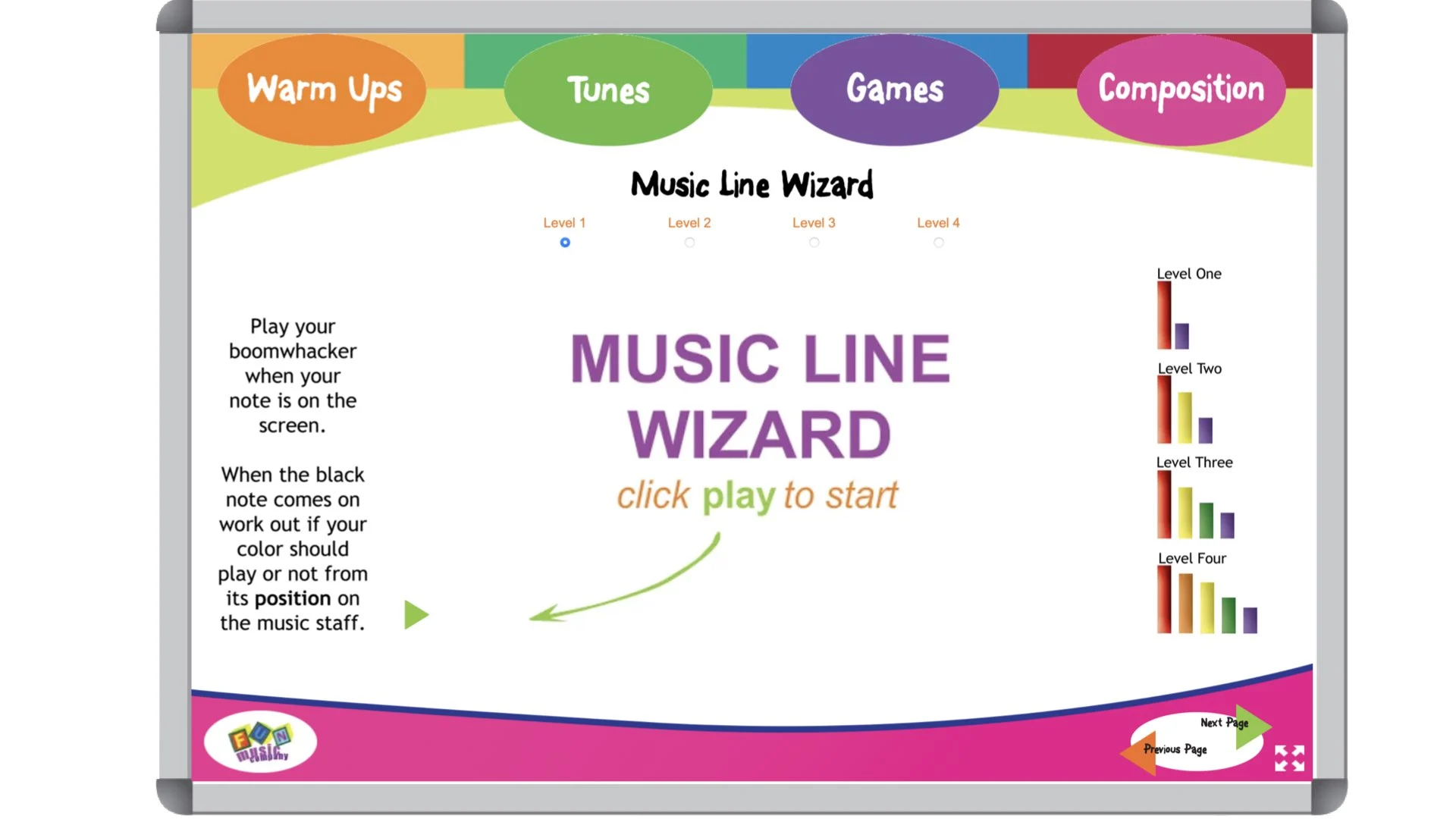
Here’s how it works. As the game plays on screen, boomwhacker beatz jump onto the musical staff. Students watch for their colour and play when they see it appear — just as they do in the other games. That familiar mechanic means even your youngest students can jump in with confidence straight away.
But then the twist arrives. Occasionally, a black music note appears on the staff. When that happens, students have to look carefully — does that note sit on the line or space that matches their boomwhacker’s pitch? If it does, they play. If it doesn’t, they stay silent.
That single decision is actually a foundational act of music reading. Students are matching a written note on a staff to a specific pitch — which is exactly what music literacy is built on. But because it’s embedded in a fast-paced, colour-coded game they’re already enjoying, it never feels like a theory lesson. It just feels like the next exciting challenge.
For generalist classroom teachers, this is particularly powerful. You don’t need to teach students what the lines and spaces of the staff mean before playing this game — the game teaches it for you, through repeated exposure and play.
For music specialists, it’s a brilliant way to reinforce notation concepts that students are learning in other parts of your program, in a context that’s genuinely motivating.
This game, like the others, is included in the free Boomwhacker Activity Sample Pack. If you haven’t grabbed it yet, now is a great time — you’ll have all three games plus the composition activity we’re about to look at, ready to go.
Boomwhacker Activity #4: Composition with Pitch Circles
Skills developed: Composition, creative thinking, musical decision-making
Works well for: Grades K–4
So far we’ve looked at games that develop listening, pitch recognition, and music reading. This activity takes things in a completely different direction — and hands the creative reins over to your students.
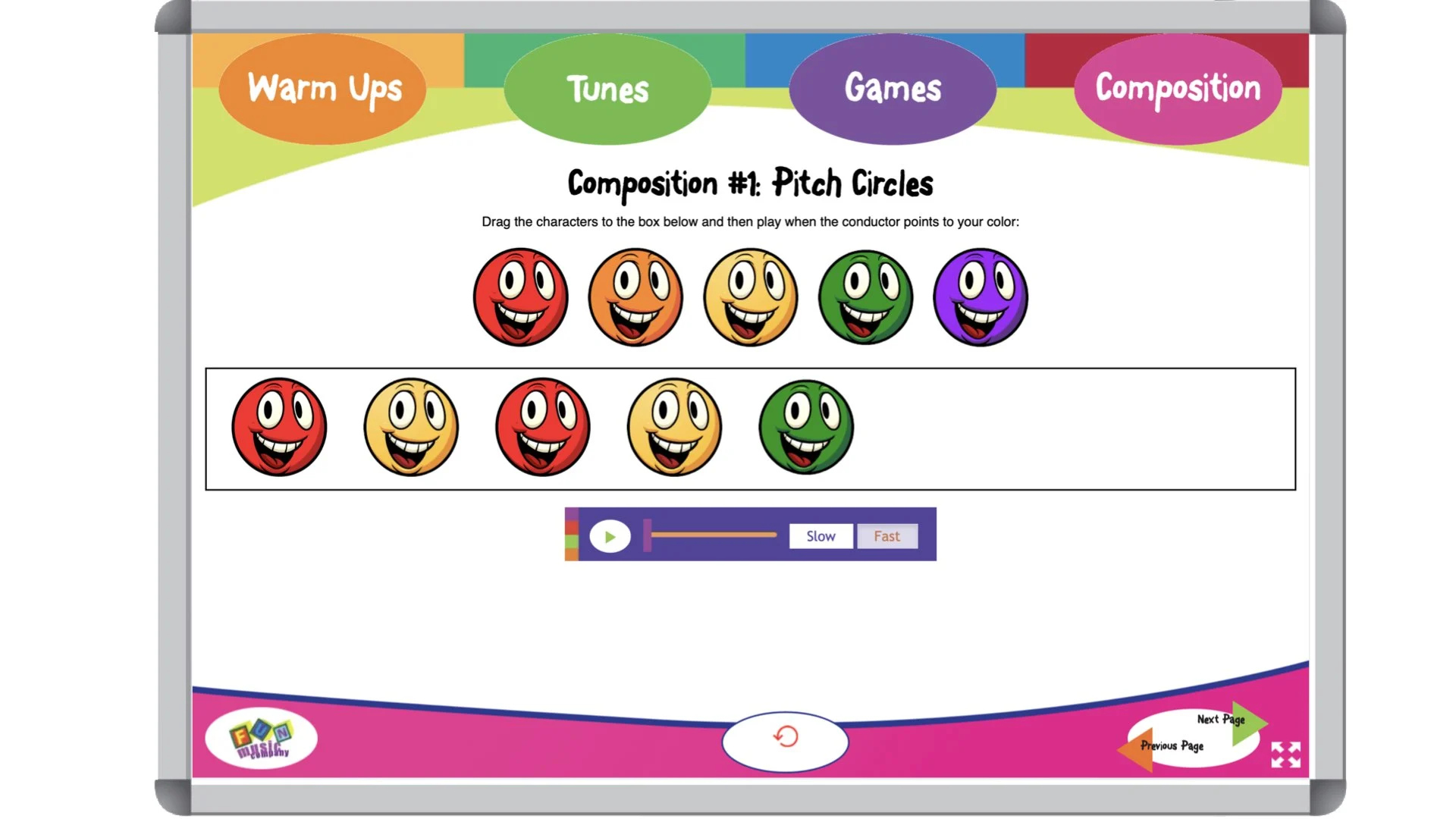
Pitch Circles is a composition activity, and it’s one of the most accessible introductions to composing that you’ll find for primary aged students. Here’s how it works.
Students take turns to come up to the board, and arrange boomwhacker colours on the board in whatever order they choose. That sequence of colours becomes the basis for their composition — a piece of music that is entirely their own.
After that, the students can decide on the rhythm that the whole group will play on each circle.
Then a student can hit play on the backing beat track on the whiteboard, and conduct the group, by pointing to the circles as they progress across the screen.
It sounds beautifully simple, and it is. But don’t let that simplicity fool you. The musical thinking happening underneath is genuinely sophisticated. Students are making decisions about pitch sequence, musical shape, and creative intention — all core elements of composition — in a way that feels completely natural and achievable, regardless of their musical experience or background.
For students who’ve never thought of themselves as composers, this activity is often a revelation. There’s no wrong answer. Every arrangement produces something musical. And the moment a student hears their own composition played back for the first time, the look on their face is something you won’t forget in a hurry.
For teachers, it’s just as rewarding. Whether you’re a music specialist looking for a structured entry point into composition, or a classroom teacher who’s never taught composing before, Pitch Circles gives you a clear, manageable framework that actually works in a real classroom.
And this is just the beginning. Pitch Circles is one of ten composition activities available in the Boomwhacker Beatz program, which is included as a bonus with the Fun Music Company K–6 Music Curriculum. If your students love this activity — and they will — there’s a whole world of composing waiting for them.
Tips for Managing Boomwhackers in the Classroom
Let’s be honest. Boomwhackers are loud, colourful, and incredibly tempting to bang on every available surface. If you’ve ever had a lesson derail the moment the tubes came out of the bag, you’ll know exactly what I mean.
The good news is that with a few simple strategies in place, boomwhacker lessons can actually be some of the most focused and engaged your students will ever be. Here’s what works.
Establish your signals before the instruments come out
Before a single boomwhacker leaves the bag, make sure your students know your start and stop signals. A raised hand, a clap pattern, a verbal cue — whatever you already use in your classroom works perfectly. The key is that students practise responding to it before the excitement of holding an instrument kicks in. Once those tubes are in their hands, you’ll be glad you did this first.
Use the “rest position” from the very first lesson
Teach students a specific rest position for holding their boomwhacker when they’re not playing — for example, resting it across their knees or holding it vertically with the tip touching the floor. This gives students something purposeful to do with the instrument when it’s not their turn, and dramatically reduces the temptation to tap, wave, or sword fight with their neighbour.
Let the game do the work
This is where the activities in this post really shine. When students are absorbed in a game — waiting for their colour, listening for the poison rhythm, tracking notes on the staff — they’re naturally focused. The game itself becomes your classroom management strategy. You’ll often find that the trickiest part of a boomwhacker lesson isn’t managing behaviour — it’s getting students to stop playing when it’s time to pack up!
Have students sit in groups, and keep colours together
Have students sit in groups, and assign one colour boomwhacker to each group. This keeps things very simple, and prevents arguments about who gets what boomwhacker. If you’re doing a game or activity with four pitches, you’d do it like this.
Step 1: With the class sitting on the carpet, divide them into four groups: far left, centre left, centre right, far right. Make sure everyone knows which group they are in, and have them shuffle apart so that there are visible gaps between groups.
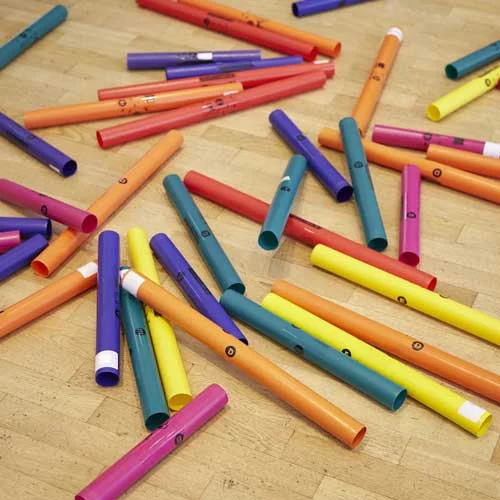
Step 2: Have four buckets with the boomwhackers organized into single pitches, and you can pass that bucket to a group, and the students will all take one. Simple, fast, effective. You could even have a competition on which group can pick out their boomwhackers from the bucket and get them into the rest position the fastest and with the least noise!

Keep it fun, short, and move onto something else!
Boomwhackers are great — they really are. However, these boomwhacker games and activities are best used as one activity within a more comprehensive lesson plan. That’s the beauty of a well-structured music curriculum: boomwhackers get to be the exciting, energetic highlight of a lesson rather than the whole lesson itself.
That’s exactly how our Fun Music Company K–6 Curriculum Program is designed. Each lesson is carefully sequenced so that boomwhacker activities sit alongside singing, rhythm work, listening, and composition — giving students a rich, balanced musical experience every single week. And because the planning is already done for you, all you have to do is show up and teach.
Ready to Try These Boomwhacker Games and Activities With Your Class?
Download Your Free Boomwhacker Activity Sample Pack
If you’ve made it this far, you’re already ahead of the game — because you know that boomwhackers work best when there’s a plan behind them.
The four activities in this post — the Mystery Boomwhacker Game, the Poison Rhythm Game, the Music Line Wizard Game, and the Pitch Circles Composition Activity — are all designed to be simple to run, genuinely engaging for students, and musically meaningful from the very first time you use them.
And the best part? You can have them in your hands today, completely free.
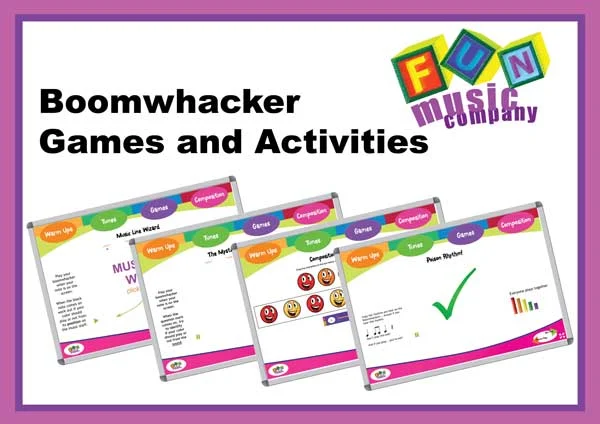
The Fun Music Company Boomwhacker Activity Sample Pack includes all four of these activities, ready to use in your classroom this week. No prep, no overwhelm — just great music teaching.
Enter your details here
and we will email you the activities.
 We value your privacy and would never spam you. By submitting this form, you are joining the Fun Music Company mailing list. We may email you valuable ideas for music teaching once or twice a week, however you can unsubscribe at any time. Check details of our privacy policy here.
Want to keep exploring boomwhackers? Here are a few more resources to help you get the most out of this brilliant instrument in your K–6 classroom:
The Complete Guide to Boomwhackers → — everything you need to know about getting started, what to buy, and how to use boomwhackers across every grade level.
Boomwhacker Songs for Your K–6 Music Classroom → — a collection of songs your students will love playing, from simple melodies for beginners right through to more complex arrangements for older students.
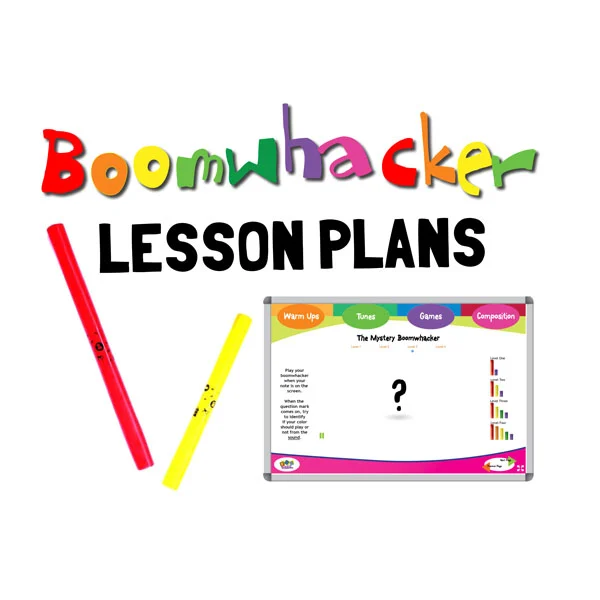
Boomwhacker Lesson Plans: A Complete Guide for K–6 → — ready to turn these games and songs into a complete, structured lesson? This guide walks you through exactly how a great boomwhacker lesson flows from warm-up to pack-away — with a ready-to-go lesson you can use this week.
Boomwhacker Beatz animations → — the original, and the best! Your students will have an amazing time playing along with these interactive animations.


Leave A Comment