


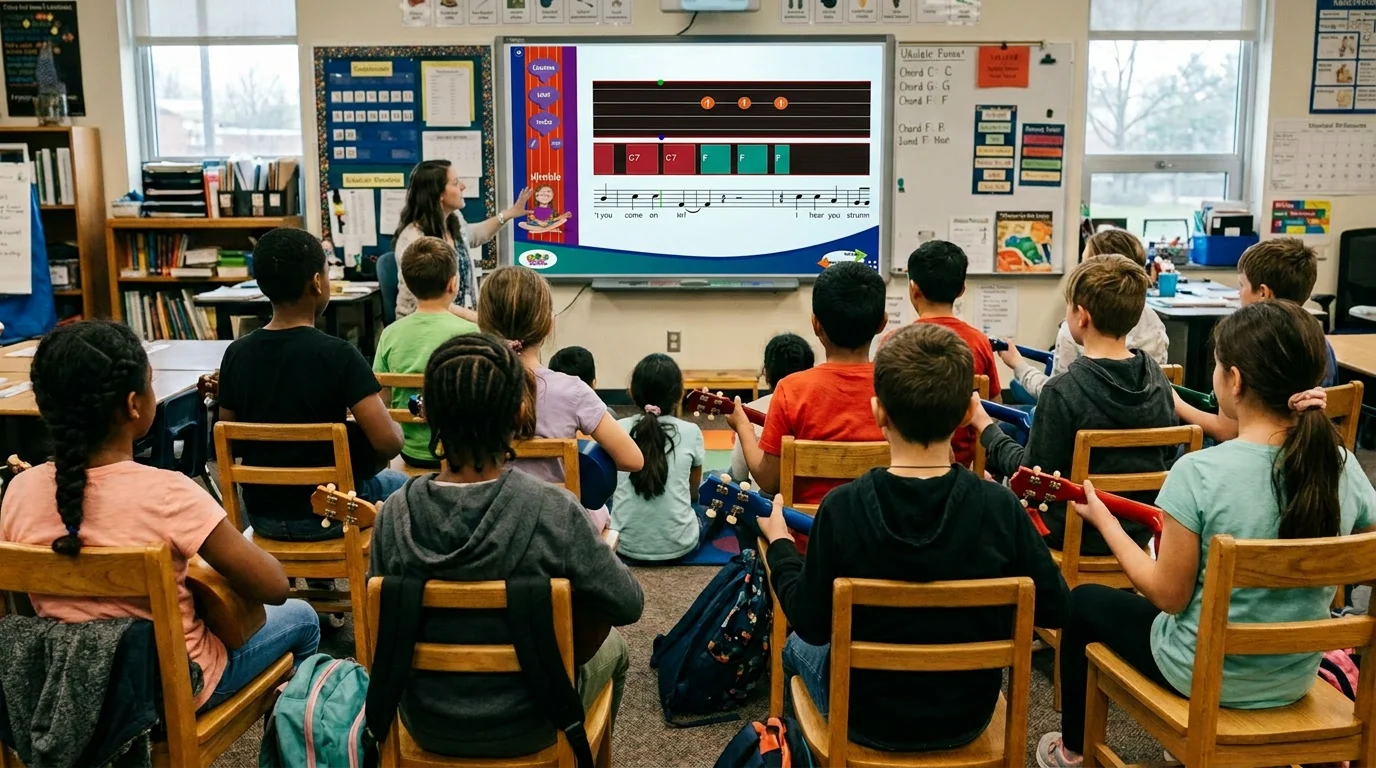
How to Start a Ukulele Program in Your Primary School: A Complete Guide
If you’re thinking about starting a ukulele program at your school, you’re not alone — and you’ve picked one of the smartest instruments a primary school could choose. But “where do I even start?” is a completely fair question, whether you’re a music coordinator building a case for the budget committee, a specialist teacher planning your first unit, or a generalist classroom teacher who’s just been asked to make this happen.
The good news is that starting a ukulele program doesn’t have to be complicated, expensive, or something only a music specialist can pull off. With the right instruments, a simple structure, and a bit of planning up front, any primary school can have a thriving ukulele program running within a term.
This guide walks you through everything you need to know — from why ukulele works so well in a classroom setting, through to instrument selection, program structure, and the practical (and sometimes overlooked) considerations like copyright. By the end, you’ll have a clear plan for getting started, whatever stage you’re at.
And once your program is up and running, our companion guide, How to Teach Ukulele in the Classroom: A Complete Guide, walks you through exactly how to teach it, lesson by lesson.”
Why Ukulele?
Not every instrument is a natural fit for a whole-class primary setting. Ukulele is — and it’s worth understanding exactly why, especially if you’re making the case to a principal or budget holder.
It’s affordable at scale.
A class set of ukuleles costs a fraction of a class set of most other instruments. For schools working with tight budgets, that matters — you can outfit an entire class without the spend that keyboards, guitars, or orchestral instruments would demand.
It’s the right size for young hands.
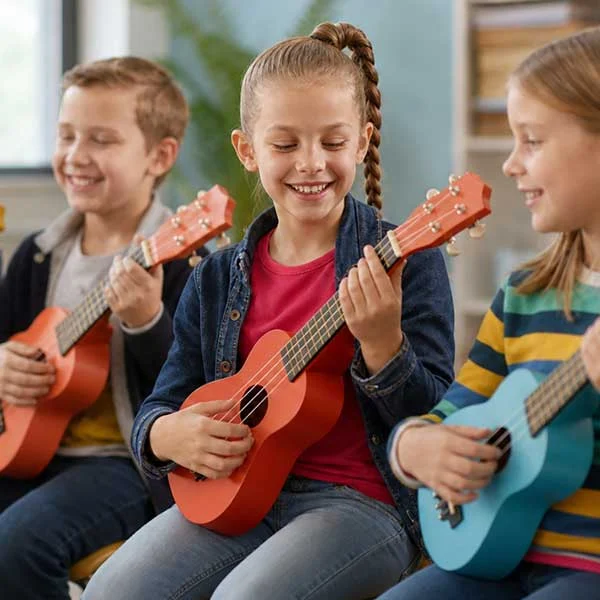
The soprano ukulele is small, light, and easy for little fingers to manage. Students can hold it comfortably, reach the frets, and produce a clean sound far sooner than they could on most other instruments — which means less frustration and more music-making, right from the first lesson.
It builds real musical skill.
Ukulele isn’t just a “fun extra” — it teaches chord shapes, strumming patterns, rhythm, and ensemble playing, all of which transfer directly to broader musical understanding. Students who learn ukulele are building genuine musicianship, not just a party trick.
It aligns naturally with the curriculum.
Ukulele lends itself well to the Australian Curriculum’s music strands — students can explore, perform, compose, and respond, all through an instrument they can actually take home and keep practising on. That’s a rare combination.
It doesn’t require a music specialist to get started.
With the right program and support, a generalist classroom teacher can deliver an effective ukulele program — you don’t need years of musical training to give your students a genuinely rich experience.
What You Need to Get Started
The good news is that a ukulele program doesn’t require a long shopping list. Here’s what you actually need before your first lesson.
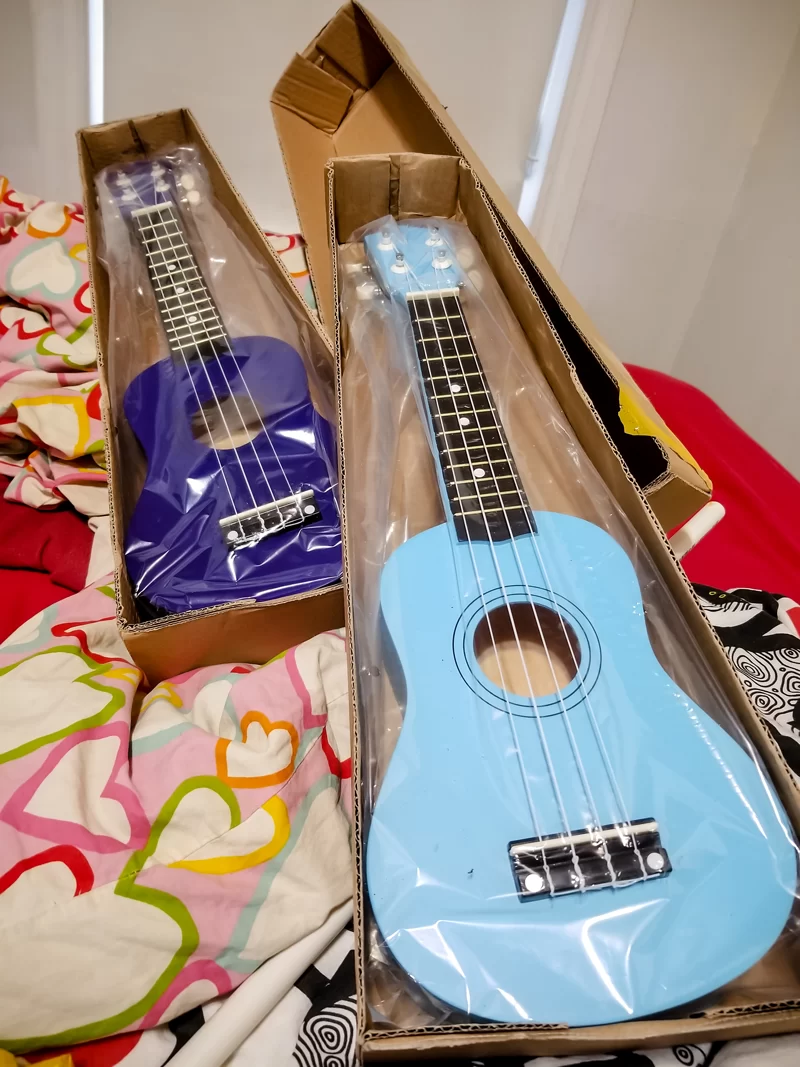
A class set of soprano ukuleles.
For a typical class of 25–30 students, you’ll want enough instruments that students aren’t waiting around to have a turn — ideally one ukulele per student, though sharing across two lessons a week can work if budget is tight. Student-grade soprano ukuleles for school use typically sit in an affordable price bracket per instrument, though it’s worth getting a current quote from a few suppliers, as pricing varies by brand, timber, and whether you’re buying direct or through an education supplier.
If you’d like specific brand recommendations or retailer suggestions for your location, the Fun Music Company helpdesk is happy to help — just get in touch.
Spare strings.
Strings break, especially in the first few months while students are learning how much pressure to use. A small stock of spares means a snapped string doesn’t take an instrument out of action for a week.
A tuner.
A simple clip-on tuner (or a tuning app) makes it realistic to get a whole class set in tune quickly, even if you’re not confident tuning by ear yourself.
A storage solution.
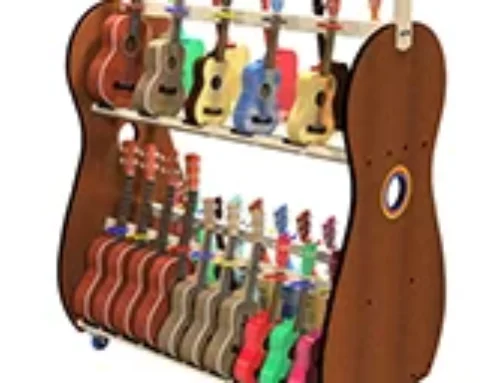
This is one area where schools sometimes overthink things before they’ve even started. You don’t need a purpose-built rack on day one — ukuleles stored upright in boxes, in a cupboard, or leaning carefully against a wall will do the job while you’re getting your program off the ground. What matters far more than the storage itself is having a clear routine: a set process for how and when students collect and return their instrument, so that care becomes part of the habit from lesson one. You can always upgrade to a proper rack once the program is established and you’ve got a sense of the numbers you’re working with long-term.
A simple instrument-assignment system.
More on this in the next section, but it’s worth knowing upfront: giving each ukulele a number and assigning it to a specific student (rather than “grab whichever one”) heads off a surprising number of classroom management headaches before they start.
Choosing the Right Ukuleles for a Class Set
Not all ukuleles are created equal — and for a classroom setting, the right choice isn’t necessarily the same instrument you’d recommend to an adult learner buying their first ukulele.
Soprano vs concert.
Soprano ukuleles are the standard choice for primary classrooms, and for good reason: they’re the smallest and lightest size, which makes them manageable for young students, particularly in the early years.
Concert ukuleles are slightly larger with a fuller sound and a bit more room between the frets, which some upper primary students find easier to play accurately — but they come at a higher cost and aren’t as forgiving for the smallest hands in the room.
For most whole-school programs a soprano class set is the more practical and cost-effective choice, with concert ukuleles occasionally considered as an upgrade option for senior students who’ve outgrown the soprano.
Geared tuners vs friction pegs.
This is one of the most important — and most overlooked — decisions for a school setting. Friction pegs (the traditional wooden peg style) are usually cheaper, but far more prone to slipping out of tune, which becomes a real problem when you’re trying to keep an entire class set in tune across a busy teaching day.
Geared tuners (mechanical, similar to a guitar’s) hold their tuning far more reliably and are much easier for students and teachers to adjust accurately. For a school set that needs to survive constant handling by 25-plus students a week, geared tuners are worth the small additional cost.
Durability considerations.
School instruments take a different kind of punishment than a ukulele kept at home — they’re picked up, put down, dropped, and handled by dozens of different students every week. Laminate wood construction (rather than solid wood) is generally the better choice for school sets: it’s more resistant to changes in temperature and humidity, and more forgiving of the occasional knock, without the risk of cracking that solid wood instruments carry. It won’t have quite the same tonal richness as a solid wood instrument, but for a classroom set, durability should take priority over tone quality.
As mentioned above, if you’d like specific brand or retailer recommendations suited to your budget and location, the Fun Music Company helpdesk is there to help.
Structuring Your Program
Once you’ve got your instruments sorted, the next question is how the program actually runs week to week. Here’s what to think through.
Year levels.
Ukulele works well as a program from Year 3 onwards, once students have the hand size and fine motor coordination to manage chord shapes comfortably.
That said, there’s no single “correct” starting point — some schools introduce it earlier with simplified one-finger chords, others hold off until Year 5 to align it more closely with a broader instrumental program.
The right entry point depends on your students and your existing music curriculum, not a fixed rule.
Lesson frequency.
A once-a-week lesson is the most common structure and works well for building steady progress without overwhelming a crowded timetable. Some schools run a short daily practice block in addition to the main lesson during the early weeks, which can help students build finger strength and muscle memory faster — but it’s entirely optional, not a requirement for a program to succeed.
Integrating with your broader music curriculum.
Ukulele doesn’t need to sit apart from the rest of your music program — it can be a vehicle for teaching the same skills and concepts you’re already covering elsewhere: rhythm, pitch, ensemble playing, and composition. Framing it as part of the whole curriculum, rather than a stand-alone ‘extra,’ helps it feel cohesive rather than like one more thing competing for time.
For a closer look at what that actually looks like week to week, see our guide to Ukulele Lesson Plans for Primary School Teachers.
Classroom management: the two things that matter most.
The single biggest cause of a school ukulele set slipping out of tune isn’t the weather or the strings — it’s students who haven’t yet been taught what the tuning pegs do. A simple first-day rule solves most of this before it starts: no one touches the tuning pegs until they’ve been shown how. Make tuning something you or a trained student “tuning monitor” does, at least in the early weeks, and you’ll save yourself a lot of retuning time later on.
The second is instrument ownership. With a class set — especially one built up over time from different brands or colours — “I want the red one” disputes are a genuine first-day risk if you don’t plan for it.
The fix is simple: number each ukulele, assign one to each student (however you’d like to allocate them), and keep a register per class so every student always knows which instrument is theirs. It also means that if an instrument develops a fault, you know exactly which one it is and who’s been playing it — which makes maintenance far easier to track.
Copyright Considerations for Your School Ukulele Program
This is a section that often gets overlooked when schools are setting up a new program — but it’s worth understanding from the start, because it protects both you and your school.
Why it matters. It’s natural to want your students playing songs they already know and love. But most popular songs are protected by copyright, and using them in a school context — printing chord sheets, distributing lyrics, performing at assemblies or concerts — can require licensing that many schools aren’t aware they need. This isn’t about being overly cautious for the sake of it; it’s simply good professional practice, the same as you’d apply to photocopying a textbook or screening a film.
What you can use freely. Traditional and folk songs that have passed into the public domain are completely free to teach, print, and perform without any licensing concerns. There’s a wealth of genuinely good material in this category — songs that have stood the test of time precisely because they work so well for group singing and simple accompaniment, which makes them ideal for a beginner ukulele program.
Originally composed material is another safe and often overlooked option. Music written specifically for educational use — where the composer has designed it for classroom teaching and cleared it for that purpose — sidesteps the copyright question entirely while still giving students engaging, age-appropriate repertoire to build their skills on.
What about popular songs? If your school does want to use current or well-known songs — for a class activity, a concert, or just because students are excited about them — the responsible approach is to check whether your school already holds a relevant music licence and to understand what that licence does and doesn’t cover. This is a genuinely nuanced area, particularly once resources move online, so if you’d like the full picture — including why YouTube play-alongs are riskier than they look — we’ve written a detailed guide: Play-Alongs, Pop Songs and Copyright: What Every Music Teacher Should Understand.
The takeaway for your program.
You don’t need to avoid music your students love — but building your core program around public domain and purpose-written material means you can teach, print, and perform with complete confidence, without needing to navigate a licensing question every time you plan a lesson.
Frequently Asked Questions
There’s no single readiness test — it comes down to hand size, fine motor development, and your existing music program. Most schools find success starting anywhere from Year 3 onwards, with many choosing to introduce it in Years 5–6 specifically. If you’re unsure what’s right for your context, the Fun Music Company helpdesk is happy to talk it through.
That’s completely workable. Many schools begin with a smaller set and rotate pairs or small groups through activities, or build up to a full class set over a year or two as budget allows. Starting smaller and expanding later is a perfectly reasonable way to introduce the program.
Ukulele is a relatively quiet, gentle-sounding instrument compared to options like boomwhackers or percussion, which makes it a comfortable fit even in schools with classrooms close together. As with any instrument program, a bit of noise management routine (like agreed “quiet hands” signals) helps keep things focused and on task.
Ukulele offers a few advantages over some traditional classroom instruments: it’s genuinely engaging for students, builds chord and rhythm skills that transfer to broader musicianship, and — unlike recorder — carries less of an “everyone finds this a bit painful to listen to” reputation in a shared learning space. That said, many schools run both as part of a broader instrumental program; it doesn’t need to be one or the other.
A once-a-week lesson is the standard structure, and with a ready-made curriculum, planning time is minimal — teachers are following a structured program rather than building lessons from scratch. This is one of the areas where a good curriculum resource makes the biggest difference to teacher workload.
Costs vary depending on brand, quality, and supplier, but ukulele remains one of the most affordable whole-class instrument options available. Beyond the initial instrument purchase, ongoing costs are minimal — mainly the occasional replacement string. If you’d like a clearer picture for your school’s budgeting, the Fun Music Company helpdesk can help you get a current quote.
No — with the right program and support materials, a generalist classroom teacher can deliver an effective ukulele program. You don’t need a music degree or years of playing experience to get real results with your students; you just need a clear, well-structured curriculum to follow.
Want a Ukulele Program That’s Ready to Teach, Lesson by Lesson?
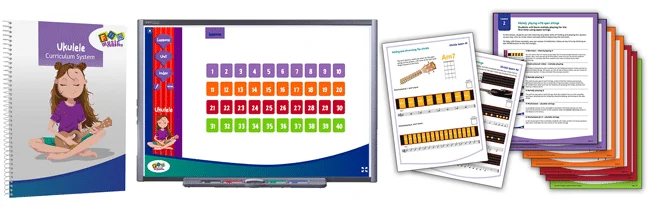
Everything covered in this guide — instrument selection, program structure, classroom management, copyright-safe repertoire — comes together in a complete, ready-to-teach solution with The Fun Music Company Ukulele Curriculum.
Instead of piecing together your own program from scratch, you get a structured, sequential curriculum designed specifically for primary school classrooms — built by a team with 30+ years of experience taking music programs into schools just like yours. Whether you’re a specialist teacher or a generalist stepping in to lead this for the first time, the curriculum guides you lesson by lesson, so you’re never left wondering what comes next.
Starting from the very first lessons, students learn to play chords and melodies, tune their own instrument, and play in time with their classmates — progressing at a genuinely achievable pace, with every lesson mapped to the Australian Curriculum.
If your school is thinking beyond ukulele alone, it’s worth knowing that ukulele is just one part of a much bigger picture. The Fun Music Company’s full K–6 Music Curriculum includes the complete ukulele program as part of the membership — alongside bucket drumming, boomwhackers, and 200+ lessons covering every area of the primary music curriculum. For schools wanting a genuinely whole-school solution rather than a single-instrument program, this is the option that covers everything, with ukulele already built in.



Leave A Comment