


Boomwhacker Songs for Your K–6 Music Classroom
Looking for boomwhacker songs?
Have you ever pulled out a set of boomwhacker pitched percussion tubes and watched your students’ faces absolutely light up — only to find yourself wondering, “Now what do I actually do with these?”
You’re not alone. Boomwhackers are one of the most exciting pitched percussion instruments you can bring into a primary music classroom. They’re colourful, they’re affordable, and students love them. But finding the right boomwhacker songs to play — songs that are genuinely classroom-ready, sequenced by difficulty, and designed for groups of real kids — is harder than it should be.
That’s exactly why we’ve put together this collection of original boomwhacker songs for you. Whether you’re looking for easy boomwhacker songs for your very first lesson or something a little more adventurous for an experienced class, there’s something here for everyone.
A Quick Note on Why These Songs Are Originals
You might be wondering why we’re not sharing arrangements of well-known pop songs or chart hits. The short answer: copyright. We’ve written a full article explaining our thinking on this — Play-Alongs, Pop Songs, and Copyright: Why We Do Things Differently — but the heart of it is this: using copyrighted songs in a classroom play-along isn’t actually covered by the licenses many teachers assume protect them. Rather than put you or your school in a difficult position, we create and use our own original compositions and traditional folk songs. That way, you can teach with complete confidence.
Everything you’ll find in this post is an original Fun Music Company piece — written specifically for the classroom, and yours to use freely with your students.
Which Boomwhackers Do You Need?
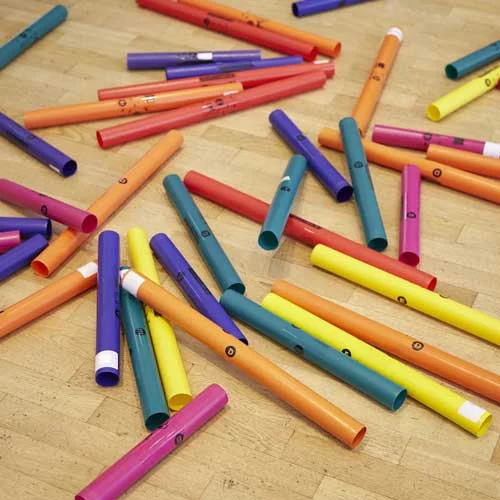
Boomwhackers come in sets of different notes, and a full chromatic set can feel overwhelming at first. The good news is that you don’t need them all to get started with songs for boomwhackers.
The songs in this post use just four boomwhackers each — all drawn from the most common notes in a standard diatonic C major set. Between the three songs, the notes used are:
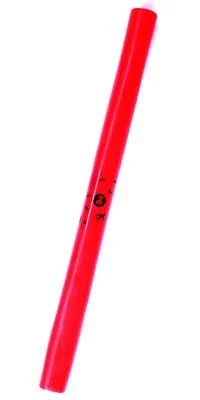
Red – C
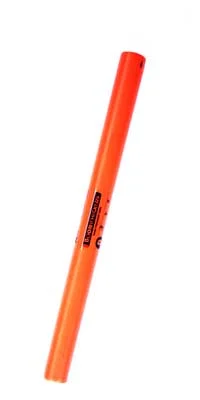
Orange – D
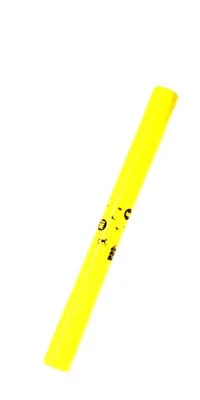
Yellow – E

Green – G

Purple – A
If you already have a basic boomwhacker set, you almost certainly have everything you need.
The songs in this post use just four boomwhackers each — and they’re drawn from the most common notes you’ll find in a standard diatonic C major set:
Which set should I buy?
We recommend the standard diatonic set as the best starting point for classroom use. It covers the eight notes of the C major scale — C, D, E, F, G, A, B, and high C — which is more than enough to get started with a huge range of boomwhacker songs and activities. You can find more detail on the full range of sets in our Boomwhackers: A Complete Guide for Music Teachers guide.
One thing we’d suggest leaving out, at least to begin with, is the double-length bass tubes. While they look impressive, they’re more fragile than the standard tubes and have a tendency to bend with regular classroom use. There’s also a practical classroom management consideration: the bass tubes are visually distinctive, and students will compete to be the one who gets to play them. Keeping things equal with the standard set means you can focus on the music rather than managing who gets to play which tube.
How to store your boomwhackers
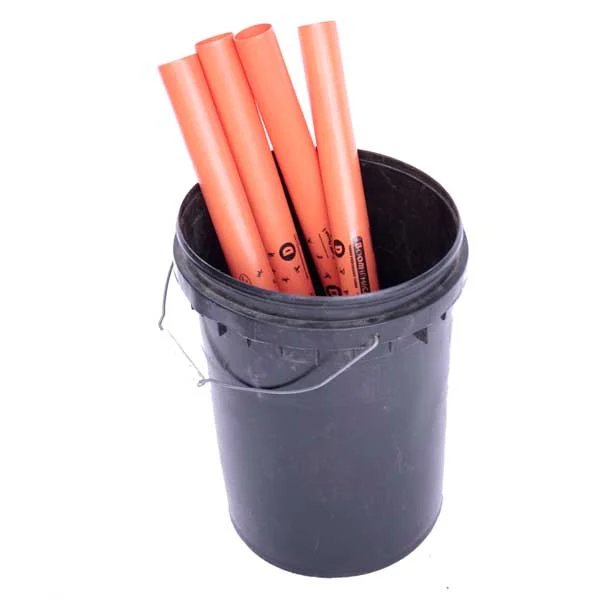
A little organisation goes a long way with boomwhackers. Our favourite system is simple: one bucket per colour. Label each bucket with its colour and note name, and students can sort, collect, and pack away the tubes themselves — which is a genuinely useful five-minute activity in its own right. It also means distribution at the start of a lesson takes seconds rather than the kind of chaotic scramble that eats into your teaching time.
How to Organise Your Students into Groups
One of the things that makes boomwhacker songs so effective in the classroom is that they’re naturally collaborative. Each student — or small group of students — is responsible for one colour, and the music only works when everyone plays together.
Here’s a simple approach that works well across K–6:
1. Assign one colour per group. With four boomwhackers per song, split your class into four groups. In a class of twenty-four, that’s six students per group — plenty of room to share tubes, take turns, or have students without a boomwhacker keep the beat by clapping.
2. Keep the colour groups together. Each song uses coloured sheet music to match the tubes. Students don’t need to read music — they just watch for their colour and play when it appears. This makes boomwhacker songs accessible to absolute beginners and non-music-specialist teachers alike.
3. Practise each part separately first. Before bringing the whole class together, let each group practise their rhythm in isolation. Even thirty seconds of individual group practice makes the combined performance dramatically more successful.
4. Bring it all together. Once each group is confident with their part, count everyone in and enjoy the moment. There’s nothing quite like a class full of boomwhackers playing in time together for the first time!
Ready to dive in? Here are three original boomwhacker songs, arranged from simplest to most advanced — so you can start wherever feels right for your class.
1. Boom Boom Beat
✅ Free resource — no membership required
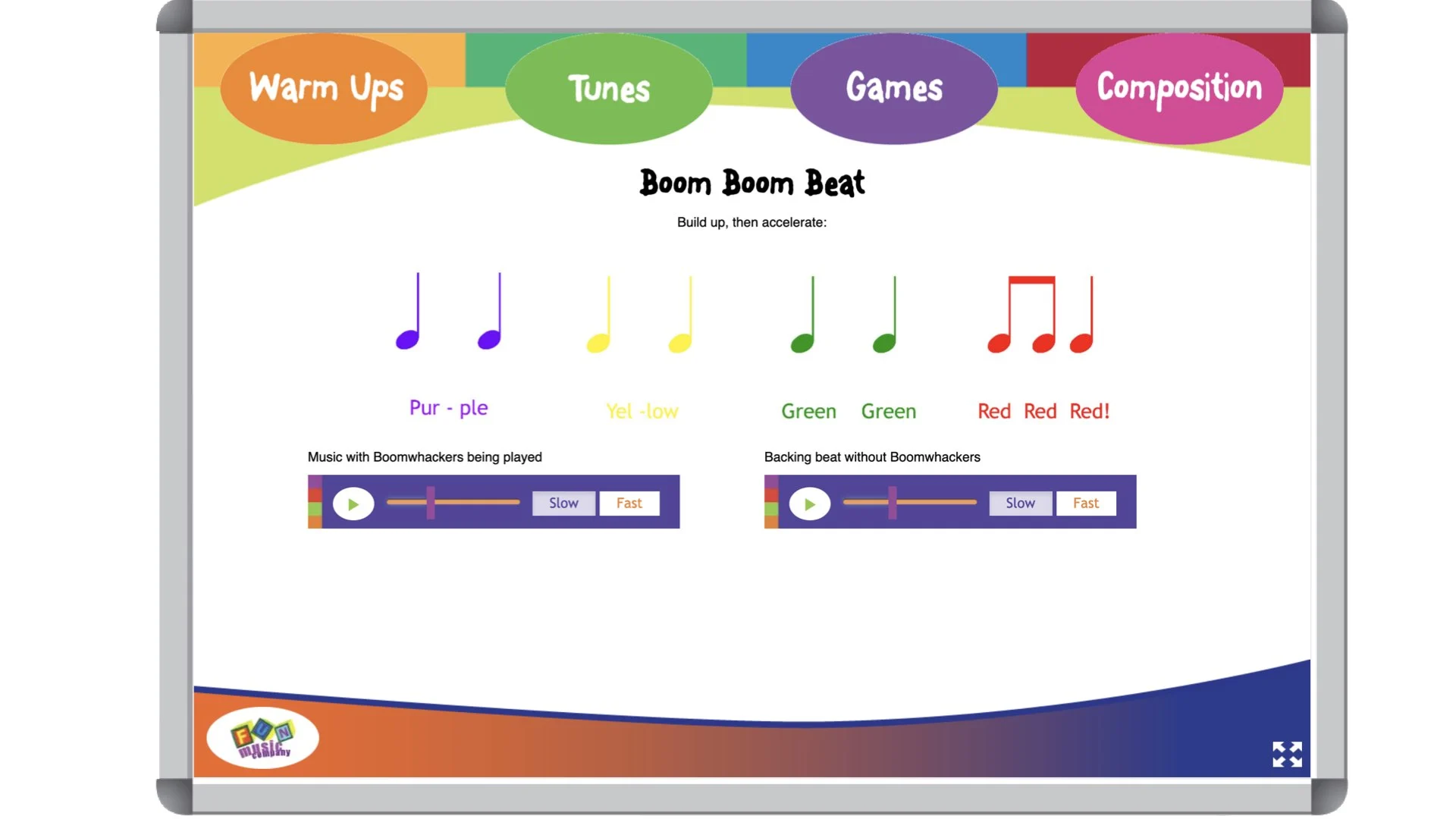
If you’re introducing boomwhackers for the very first time, this is where to start. Boom Boom Beat is built on a simple four-note repeated pattern — short enough for students to learn in minutes, satisfying enough that they’ll want to play it again and again.
The rhythm is steady and predictable, which means even the youngest students in your class can find success quickly. That early win matters. When a student hears the music come together because of their contribution, something clicks — and that’s the moment a love of music begins.
How It Works
Boom Boom Beat uses a repeated rhythmic pattern — Starting with just two notes, and going around the group. Start with just the purple group (A) playing their two notes, and then add the second two yellow notes (E), then add the G, and finally the Red Cs. Then there is an accelerando, building up to a big ending.
This makes it ideal for younger students (Grades K–2) or any class that’s new to boomwhackers, but the satisfying groove and tempo change means older students will enjoy it just as much.
Teaching Tips
- Start with just one group at a time. Start with the purple group, have them play their two notes, and the whole class can hear and feel the beat. Then add in the yellow group, making sure that everyone is still hearing the beat.
- Use body percussion first — have the whole class clap the pattern before picking up the tubes.
- Once the entire pattern is playing, you’ll hear the backing beat speed up. This is a gradual accelerando – a musical technique of speeding up throughout a song.
- The accelerando gives a wonderful opportunity for a discussion of the musical element of Tempo. Exploration of the elements of music is a core part of most music curricula around the world.
- This piece can also be used without the backing beat. Experiment with choosing a student to be the conductor, bringing in each of the groups, and then controlling the accelerando until it gets really fast. It’s lots of fun!
Classroom Resource
Please find the resources required for this Boomwhacker song below.
This song is able to be done with most classes from early primary or elementary through to older classes.
Bookmark the link below for use in your classroom.
Members can click the buttons at the top of the screen to access other parts of the Boomwhacker Beatz program included in our complete music curriculum.

2. Elephants Walk, Monkeys Run
✅ Free resource — no membership required
This one is a step up in difficulty — plus a step up in fun!
Elephants Walk, Monkeys Run introduces students to two contrasting rhythms by tying them directly to the natural rhythm of language. The words “elephants walk” create a slow, heavy pattern; “monkeys run” creates something faster and lighter.
Students don’t need to understand formal rhythm notation to feel the difference. They just say the words, feel the rhythm in their bodies, and then transfer it to the boomwhackers. It’s one of the most natural and effective ways to teach rhythm in a primary classroom.
How It Works
There are three sections: A, B, and C.
In the A section, the four groups play either the ‘elephants walk’ or the ‘monkeys run’ rhythm. First, the red Cs play ‘elephants walk’ then the yellow E’s answer with ‘monkeys run’. Then the orange and green groups do the same thing.
This makes an easy to remember, fun groove that the class enjoy playing all together. They can hear each other’s parts and stay in rhythm.
After they have played that a few times, you will hear the backing music transition to the B section.
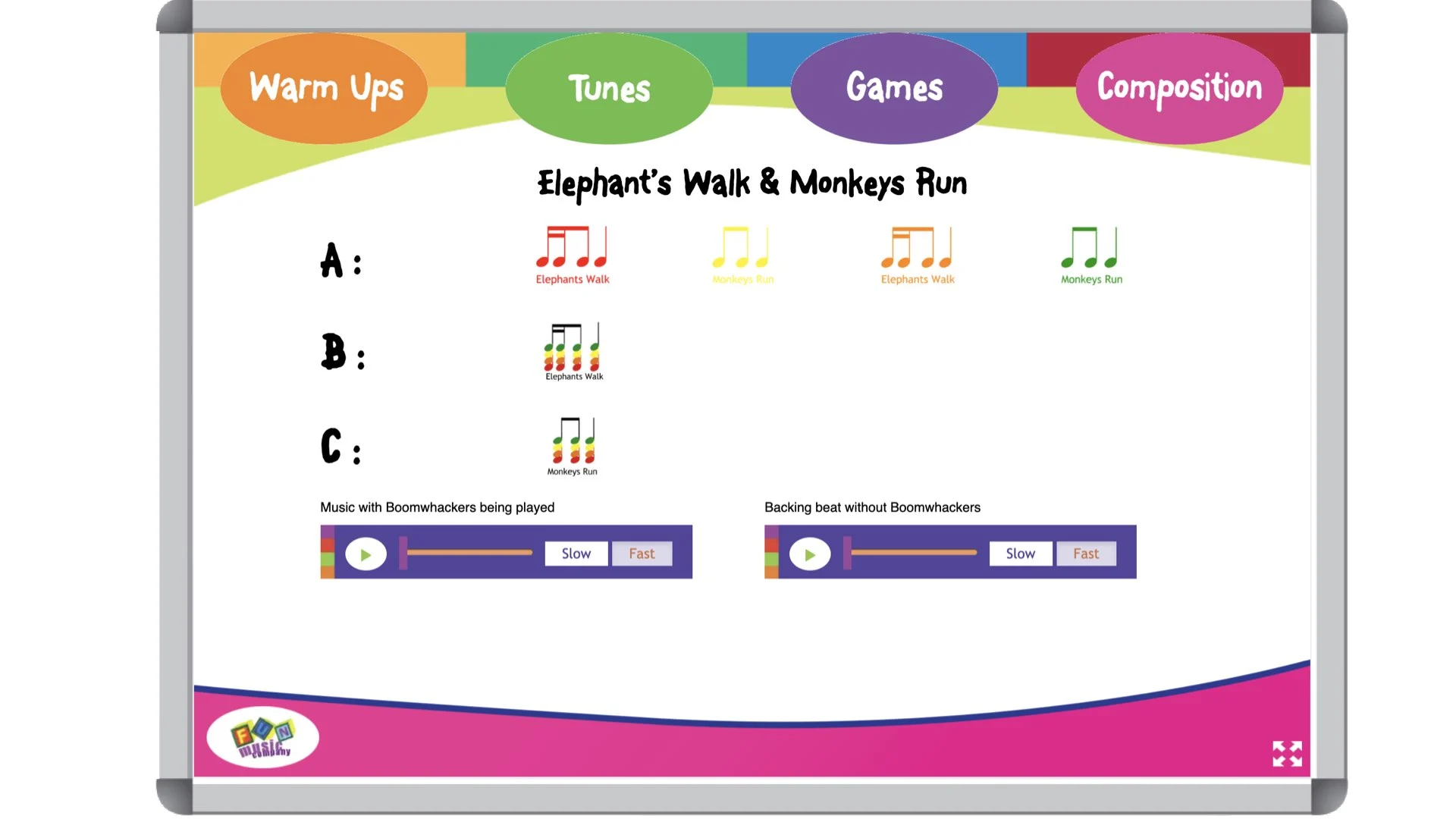
In the B section EVERYONE plays the ‘elephants walk’ rhythm together, in slow and deliberate style.
Then it returns to the A section again, and everyone plays the part they first learned.
Then the music announces something different, and we move into the C section.
Here, everyone will play the ‘monkeys run’ rhythm all together, and there is an accelerando, before returning to the A section.
Teaching Tips
- Before handing out boomwhackers, always practice the rhythms first with body percussion. Clap and say ‘elephants walk’ several times in rhythm, and have them echo you in rhythm. Then, have them practise ‘monkeys run’ in the same way.
- Have students explore and discuss the notation on the screen. Ask, what do you notice about this rhythm? They may notice that red and orange are going to play ‘elephants walk’ and yellow and green are going to play ‘monkeys run’.
- Get into groups, and then practice again with body percussion, without handing out boomwhackers. This is one of the keys to success here. Get your groups organized and have the students know which group they will be in, before you even think about handing out boomwhackers.
- If you were doing this with older classes, you can have students discuss the form of the song. (This song is a rondo, by the way). Form is something covered in detail in the SKILLS element in Grades 5 and Grade 6 of the Fun Music Company curriculum.
Expansion Idea
Here at the Fun Music Company, we encourage teachers and students to use these ideas as a start to create their own music. This is what the COMPOSE section of our music curriculum is all about!
With this boomwhacker song, you can take the same idea, and apply it to different word phrases. You can try one or two of the ones below, but even better is to have students create their own ideas, and make this song your own!
Alternative word phrases:
- Penguins waddle, cheetahs sprint
- Popcorn pops, jelly wobbles
- Spaghetti slides, pizza flops
Classroom Resource
Please access the resources required for this Boomwhacker song below.
Bookmark the link below for use in your classroom.
Fun Music Company Curriculum members can click the buttons at the top of the screen to access other parts of the Boomwhacker Beatz program, which is included in our complete curriculum program.
3. Percussion is Cool!
✅ Free resource — no membership required
Percussion is Cool is the most advanced piece in this collection — and also the most exciting. The rhythm is more syncopated and complex than the first two songs, giving students a real challenge. But here’s what makes this one special: it also has a full bucket drumming arrangement.
How It Works
This piece is similar to elephants walk, monkeys run in that again it uses word association to teach the rhythms.
This is a common thing we do throughout the Fun Music Company curriculum program, as we help students go from never having played a note of music, to understanding what they are seeing when they encounter music notation.
This time, all four groups play the same rhythm in the A section: ‘percussion is cool’
Then, in the B section all groups play in unison.
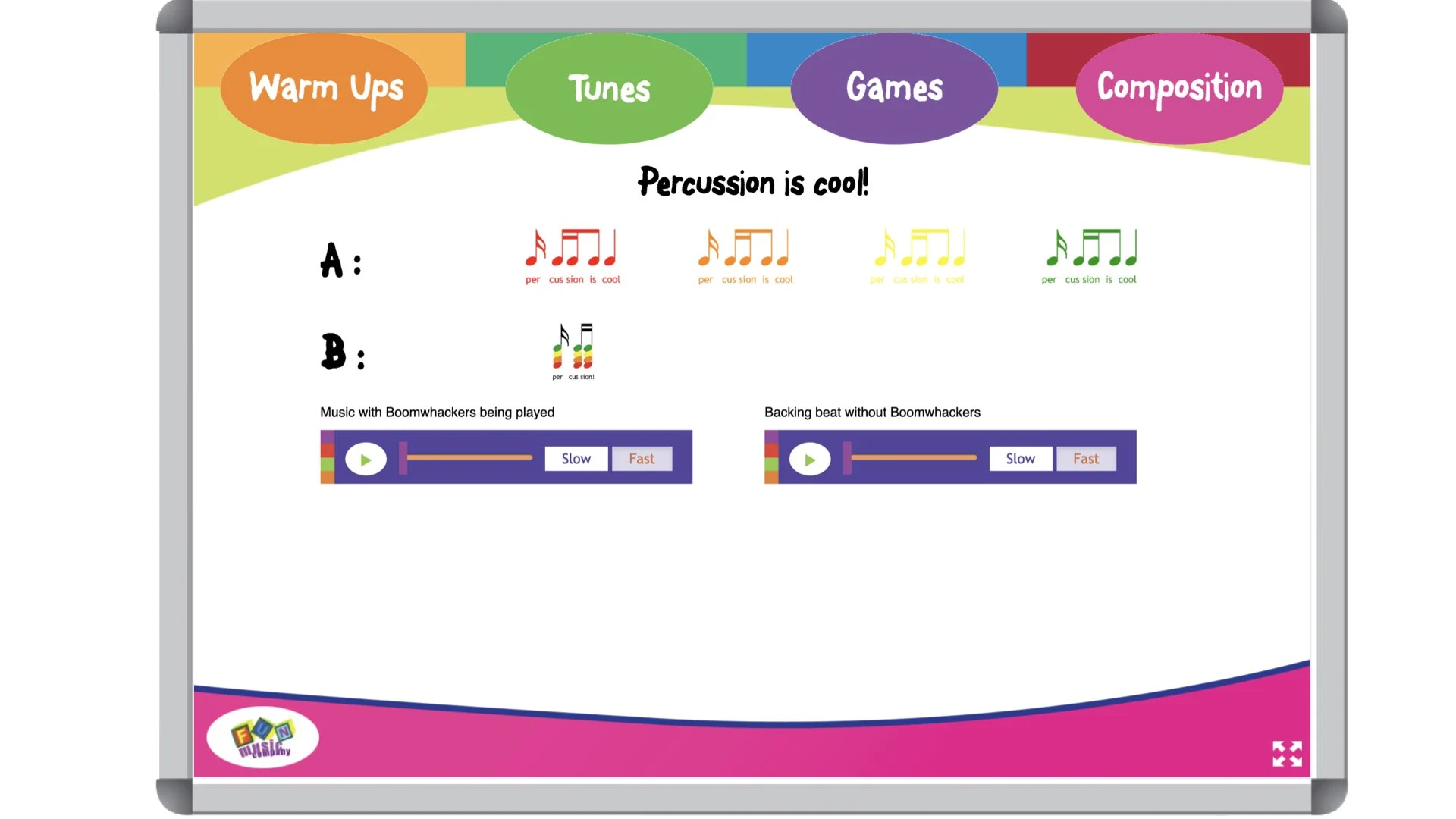
A note on the notation of this boomwhacker song.
Music theory purists will probably look at the notation on the screen and say: “This is wrong! The notes in each group should be beamed together.” And do you know what? They are 100% correct.
However, for the purposes of this activity, we want students to get to playing as quickly as possible. We want them to be exposed to the notation without being confused by the music theory — and that’s why we’ve notated it the way we have.
Later, when we combine this piece with other instruments with our complete bucket drumming arrangement we will notate it beamed together correctly, and that is easy to do. We have tested this display many ways, and this is the way students understand it quickly, even from the very first lesson.
Teaching Tips
- As always, begin with learning the rhythms with body percussion first. This is a key strategy we suggest throughout our curriculum program. Students cannot learn something effectively when they have an instrument in their hands. They must learn it first, THEN transition to the instrument.
- Discuss the concept of emphasis of words, and how it relates to beat. The rhythm ‘percussion is cool’ has the downbeat, the emphasis on ‘cuss’, so speak and clap it ‘perCUSSion is cool‘. Have the students feel this in their bodies/
- Separate into groups, and make sure they can pass the rhythm between the groups with body percussion, before handing out the boomwhackers.
- When you’ve learned this version, try our bucket drumming version of this piece, and then you can even put them together! You can even make a performance piece out of this for your school concert!
Classroom Resource
Please click below to load the classroom screen resource for this boomwhacker song.
Bookmark the link below for use in your classroom.
Fun Music Company Curriculum members can click the buttons at the top of the screen to access other parts of the Boomwhacker Beatz program, which is included in our complete curriculum program.
More Boomwhacker Resources
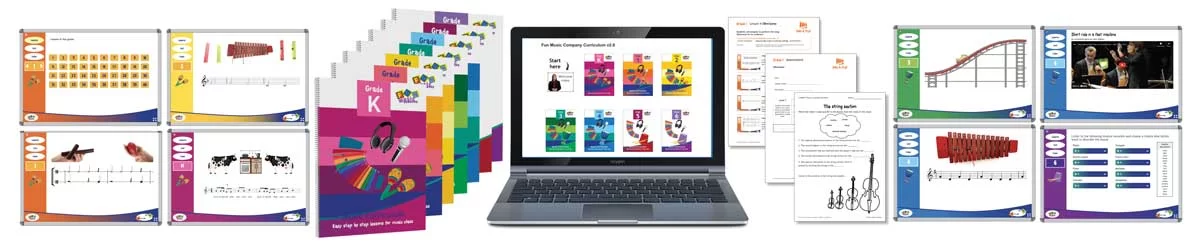
These three boomwhacker songs are a great place to start — but they’re just the beginning. Our K–6 Music Curriculum Program includes a full sequence of pitched percussion activities with Boomwhacker colour-coded parts built in for grades K-2, so your students can build skills year on year.
As students get past grade 3, they can move onto more complex instruments such as xylophones, marimbas and ukulele. However, boomwhackers still appear from time to time and are used to their fullest throughout the full program.
Songs are just one part of what boomwhackers can do in your classroom. Head over to our Boomwhacker Games and Activities for K–6 Music Classes to see how the same instrument can build pitch recognition, rhythm skills, and even student composition — all through games your class will actually want to play.
Want to see how these songs fit into a complete lesson? Our boomwhacker lesson plan guide walks you through a full structured lesson — warm-ups, song, game, and review — so you can go from these resources to a complete lesson in one step.”
And if you’re working on bucket drumming as well as boomwhackers, head over to our complete guide to getting starting with bucket drumming to find beats, backing tracks, and everything you need to build a full classroom percussion program.


Leave A Comment