


How do you create effective, easy to use primary and elementary music lesson plans?
What are the essential steps to creating elementary and primary music lesson plans?
What curriculum, learning outcomes, and assessments should be in elementary and primary music lesson plans?
How can you create all the elementary and primary music lesson plans you need, and still have time to breathe?
How do busy teachers create elementary and primary music lesson plans without spending countless hours after school? That’s the question I’ve been answering for music educators across Australia, the USA, UK, and Canada for over two decades.
I’m Janice Tuck, creative director here at The Fun Music Company. Whether you’re searching for primary school music lesson plans (the term used in Australia and the UK) or elementary music lesson plans (common in the USA and Canada), you’re in the right place. This guide will show you how to create effective, curriculum-aligned music lesson plans for elementary and primary students—and still have time to breathe. I’ll break down the essential steps, reveal what actually needs to be in your lesson plans, and show you how to teach engaging music lessons starting tomorrow.
Author:
Janice Tuck
Music teacher and creative director
of the Fun Music Company.
What is in a music lesson plan?
A music lesson plan for primary or elementary students is a document that outlines what is going to happen in a lesson.
In its traditional form, it would include:
- A statement of the learning outcome for the lesson.
- Lists of the resources and supplies needed for the lesson.
- A list of activities that the students will complete.
- Guidelines for the amount of time required for each activity in the lesson plan
- A guide for assessing the students learning and seeing how they meet the learning outcome.
- Statements showing how the lesson supports the needs of state and/or national curriculum requirements.
- A space for evaluation and reflection of the lesson and planning. This, should in theory, make for a more successful lesson from this topic in the future.
Now my question to anyone is:
How many teachers actually have time to create such a document for every single lesson they teach?
Not many, that is for sure!
When surveyed, 92%* of Australian teachers stated they didn’t have time to prepare adequately for their lessons.
Also … 86% of teachers reported they didn’t have time to create a lesson planning document for every lesson.
Does this lesson planning process cause stress?
Most teachers are typically required to teach throughout most of the day. However, if they’re fortunate, they may get one or two non-contact hours each week. During these limited hours, they must fit in all their marking, planning, assessments, phone calls, and correspondence. Alternatively, they might take their planning home, leading to long hours spent in the evening and on weekends. Consequently, they end up feeling tired and burned out.
In light of this, it is no surprise that a recent survey* of over 3,000 teachers revealed that 78% are experiencing stress. Moreover, 36% report that they are suffering from burnout.
So… in short: the chance of teachers making a comprehensive primary or elementary music lesson plan (like the one above) for every single lesson they teach is very unlikely!
We believe that this lesson type of planning process is unnecessary. Plus we believe it is actually CAUSING the stress that finds teachers leaving the profession!
It’s a myth that any music teacher should be preparing each lesson to this degree. Instead what music teachers need is a simple lesson planning system. A system which saves time on preparation and does not create more work and stress!
What is the #1 piece of advice regarding primary and elementary music lesson plans?
We have spent the past two decades of talking and learning from the best music educators in the world.
What is the #1 piece of advice we’ve learned?
CONNECTION and RAPPORT with students is the most important skill that any music teacher can possess.
We believe all music teachers should have time in each lesson to think about their students and what their needs are.
Our wish is that any teacher should be able to show up and teach. They should have a step-by-step consistent program with the activities set. Then the planning is easily handled! It shouldn’t matter how much experience they have.
That’s exactly why we make our primary music lesson plans simple and easy to use. They require little if any preparation time from the teacher.
What SHOULD be in your primary and elementary music lesson plans?
What are the critical parts of a music lesson plan?
1 – A statement of the learning outcome for the lesson.
2 – The lesson activities
That is it. The rest of it should be handled by the overall program of lessons, not on an individual lesson basis.
Links to curriculum? That needs to be handled by the structure of the overall program that is put in place. A balance of activities linked to all the curriculum outcomes achieves this.
What about assessments? These can and should be handled by the framework of the overall program. Students in primary/elementary music should be assessed once or twice per school term. These assessments should be done in the easiest possible manner. To do more than that takes away time from valuable learning opportunities and FUN in every class.
The rest of it is either unnecessary, or can be handled by consistent repetition.
For example, creating a list of supplies for the grade level is often redundant. The instruments and resources we need for a grade are often the same for each lesson. Instead, organise the teaching space so that all instruments and resources are available when you need them.
Critical piece #1
Statement of the learning outcome for the music lesson plan
This is a critical piece of the puzzle. In doing anything from making dinner to running for a leadership position, the first step is always to set an outcome.
A learning outcome is just an intention. However, if a teacher is doing this themselves they have to think “ok … where do I start with creating a learning outcome?”
So they may start by looking at a curriculum document such as the Australian curriculum. Here they will find a content statement such as this:
“Manipulate elements of music to communicate ideas, perspectives and/or meaning when composing and practising for performance”
(from Australian curriculum v9, Music, Years 3 and 4)
However, this can leave any person feeling confused and vague about what to actually do!
A curriculum content statement is not a lesson outcome!
The content statement above is not intended to be an outcome for ONE lesson. Instead, it’s intended to be a part of an overall structure of the curriculum.
For this reason The Fun Music Company spend many hours thinking about these content statements. We spend hours and hours thinking up ideas that focus on sections of the content statements. Then, we create a music lesson plan around it.
We then look at the entire program of lessons and work out whether we have covered the content statement appropriately.
For example in the COMPOSE section of Grade 3 we have a lesson for this curriculum statement were the learning outcome is:
“Students will work together in small groups to create an untuned percussion piece which tells a story using dynamics.”
So our curriculum statement requires that students manipulate an element of music, and they are doing this in this lesson by using dynamics.
They are also communicating perspectives and/or meanings through the means of telling a story.
There are similar lessons through our program for each of the elements of music: pitch, melody, rhythm etc.
Teachers should not have to think up lesson outcomes!
It is our firm belief that teachers shouldn’t have to come up with their own lesson outcomes. Instead, they should be able to choose from a range of them, and go and teach the lesson! Total lesson preparation time: 5 minutes.
If a teacher has to come up with an idea for a lesson based on the curriculum outcome it will take anywhere from 3 to 4 HOURS to come up with a lesson idea and write the lesson plan.
And what teacher has time for an extra 3-4 hours of out-of-school preparation every night after the school bell rings?
Critical piece #2:
The lesson activities of the music lesson plan
(Stepping AWAY from the curriculum to the common sense corner for a moment)
Before I get into the lesson activities and how they are structured … I just want to take a moment to step AWAY from the curriculum, and think about what we are doing and why.
Music. That is the subject we are involved in.
As the great, late Richard Gill has said… “Music is important, and music is good.”
If you have not seen it, take a moment to watch Richard’s famous Ted-x talk from 2011:
Richard Gill was one of my mentors, a wonderful man and advocate for music education.
Richard passionately believed that children should be involved in SINGING and PLAYING music.
In this speech above, and in many of his speeches he said:
“Music is the RIGHT of every child, no matter where, and what the circumstance.”
Children have to be engaged in music, and this requires focus.
Therefore, what we believe here at the Fun Music Company is that all music lessons should include singing and playing music actively.
So while the curriculum is very important, the means by which they need to access the curriculum must always include singing and playing, and children actively involved in music making.
Richard also says in his famous speech above:
“Through singing, is how we engage every child”
“Singing is how we teach children to be literate, to read and write”
“Through singing, is how we teach children to analyse.”
So while the curriculum is important, we have to make sure that we involve the singing and playing of music every single lesson. Also singing and playing is in the curriculum anyway, so its not like we’re doing anything different or contrary to the curriculum.
That is why in our Fun Music Company curriculum program we involve the singing and playing at every level, in every lesson.
How we create elementary and primary music lesson plans at the Fun Music Company
So to plan our lessons, this is the basic structure that we work on when we create music lesson plans for the Fun Music Company curriculum.
1. A SKILLS warmup. (aligned to the curriculum.)
2. Singing and playing music (aligned to the curriculum.)
3. COMPOSE or CONNECT activities (aligned to the curriculum.)
At times, the COMPOSE or CONNECT activity can more than cover the entire lesson time, however there is still singing and playing instruments at the heart of what we do.
At times, the singing and playing music could take more of the lesson if needed – however the COMPOSE or CONNECT activity is always there.
This is a screenshot of an outline from our NEW Fun Music Company curriculum V2.0, from Grade 2:
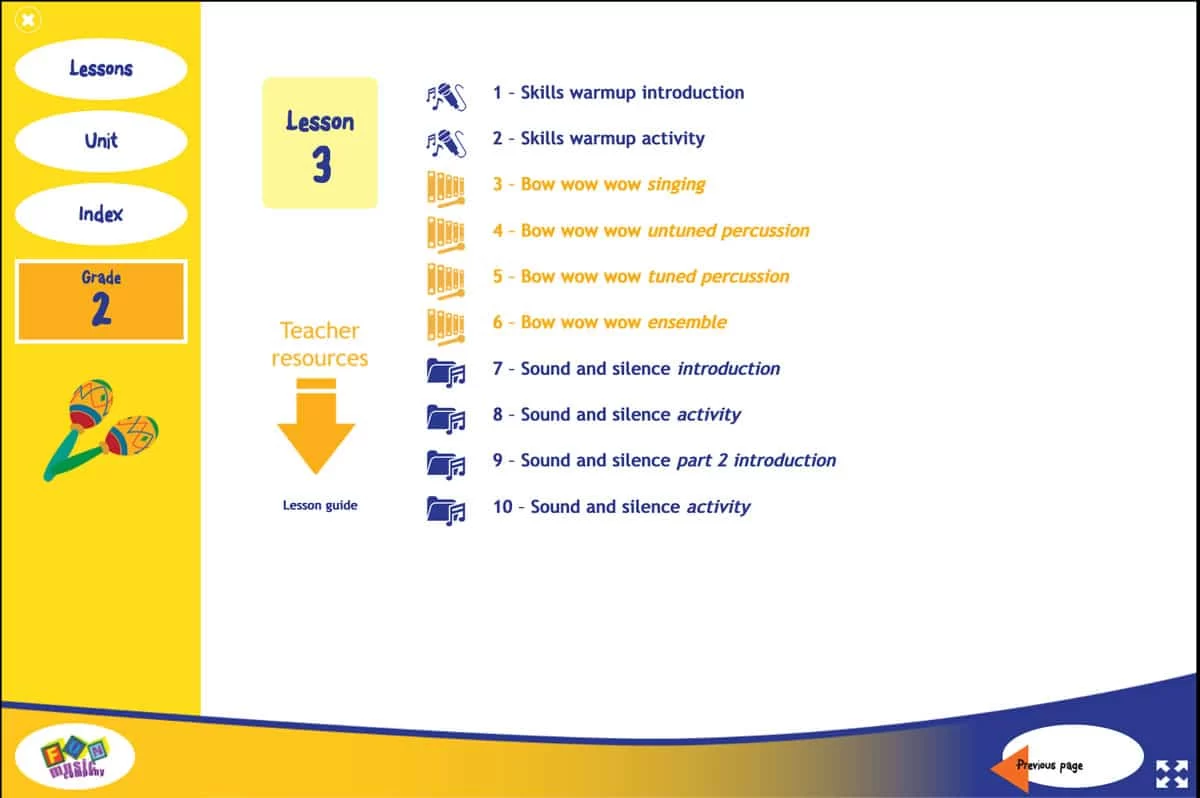
In this lesson the students do a quick SKILLS warmup. They then get into singing and playing with a great song called Bow Wow Wow. Finally they do a COMPOSE activity developing sound and silence.
Here is a PDF of the lesson plan for the COMPOSE lesson guide for grade 2, so you can see how the sequence of lessons links to the curriculum.

Frequently asked questions about primary or elementary music lesson plans
The fastest approach is using a prepared curriculum program rather than creating lessons from scratch. With ready-made lesson plans that include learning outcomes, activities, and curriculum alignment, teachers can prepare a full lesson in under 5 minutes instead of 3-4 hours.
Yes! Effective music education can happen with minimal resources. Many activities use body percussion, voice, and everyday classroom items. The Fun Music Company designs lessons that work regardless of available instruments, making music education accessible for all schools.
Music lesson plans should align with your state or national curriculum standards (such as Australian Curriculum v9, NSW Creative Arts Syllabus, or US state standards). Rather than linking each individual lesson to curriculum, effective programs balance activities across all curriculum outcomes throughout the year.
Most primary and elementary schools schedule music lessons once per week. The Fun Music Company curriculum is designed around this weekly structure, with each lesson building on previous concepts while remaining engaging and manageable for busy teachers. Schools can and do choose different structures, and that is ok – teachers can still work with programs like the Fun Music Company curriculum with more or less than one lesson per week.
No! Both specialist music teachers and generalist classroom teachers can successfully teach music with the right resources. The key is having ready-to-use, curriculum-aligned lesson plans that require minimal musical background and preparation time.
An effective music lesson plan needs just two critical components: (1) A clear statement of the learning outcome, and (2) The lesson activities. Everything else—curriculum links, assessments, and resource lists—should be handled by your overall program structure, not on an individual lesson basis.
Creating comprehensive lesson plans from scratch can take 3-4 hours per lesson. However, with a structured curriculum program like The Fun Music Company’s approach, lesson preparation time drops to just 5 minutes. The key is having pre-planned learning outcomes and activities that align with curriculum requirements.
Yes! Primary music lesson plans and elementary music lesson plans refer to the same thing—just with different regional terminology. “Primary” is used in Australia, the UK, and New Zealand, while “elementary” is common in the USA and Canada. Both cover music education for students aged approximately 5-11 years (Kindergarten through Grade 6).
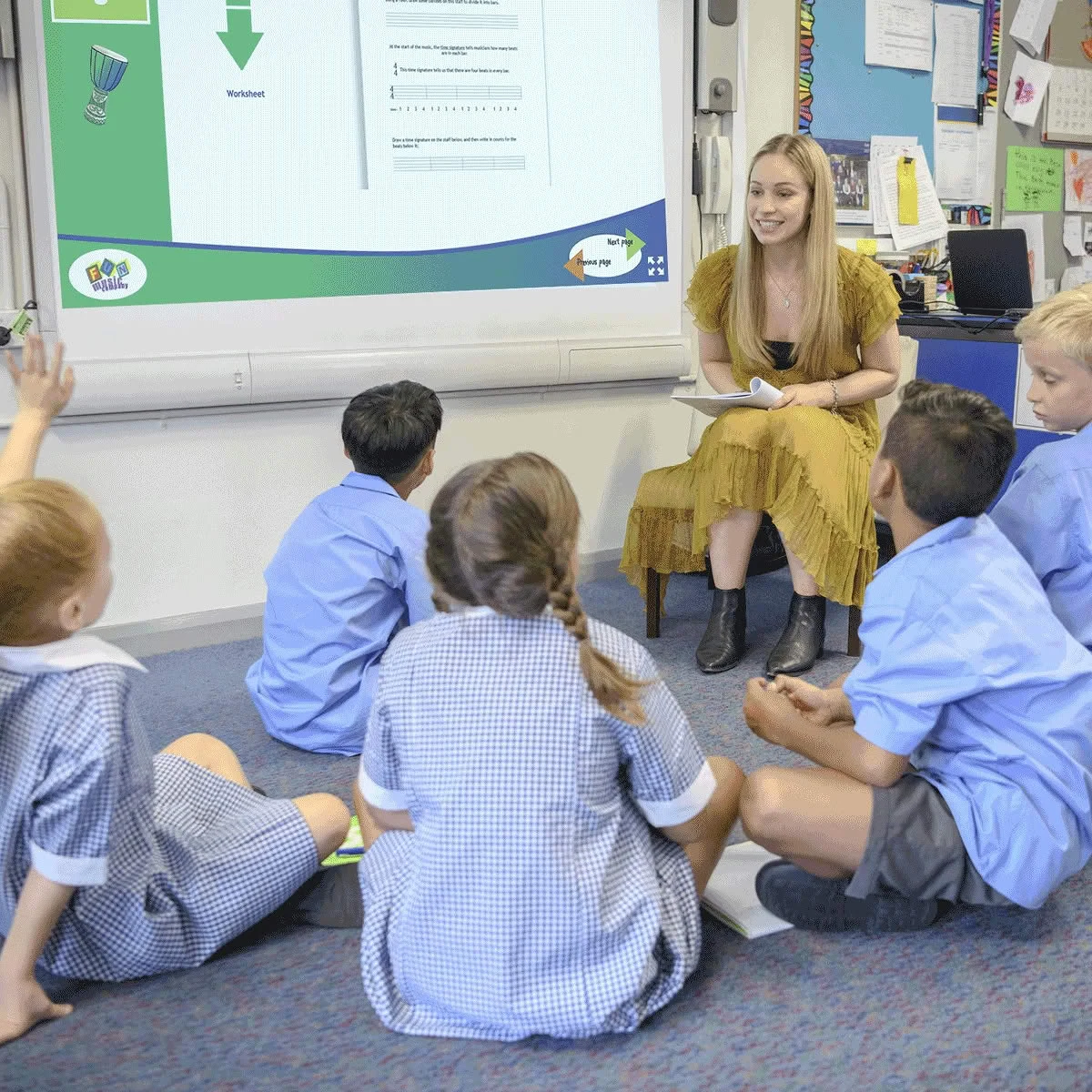
We always get questions like: I don’t have an interactive whiteboard – can I still use this? and Can I use my iPad?.. and all those sort of technology-related questions.
Well … for this one … we are pleased to announce that the answer is yes!
Yes, you can use it, no matter what technology you happen to have in your classroom.
We’ve set this up as an online system. It is set up as a type of webpage that you access in the classroom. Its fully setup online, so there is nothing to download or install or anything for these programs, you simply login to our new members area, choose the module you want and away you go.
Its setup to work on any device, and yes, even iPads!
For this program, all you need is a screen, and some sort of device that can access the internet attached to it. A computer with any internet browser will do it or any sort of iPad or tablet device.
How to teach a usable primary or elementary music lesson right now
As we’ve described in this article, the two single most important factors in creating any primary music lesson plan are:
1. having an outcome in mind
and
2. having a set of fun planned activities that help you progress towards your specific class’s curriculum and learning needs.
Becoming an impactful music teacher is not about being the most skilled musician or singer or having all the answers upfront. It’s about having a systematized approach, being prepared to try new ideas and putting the needs of your students first.
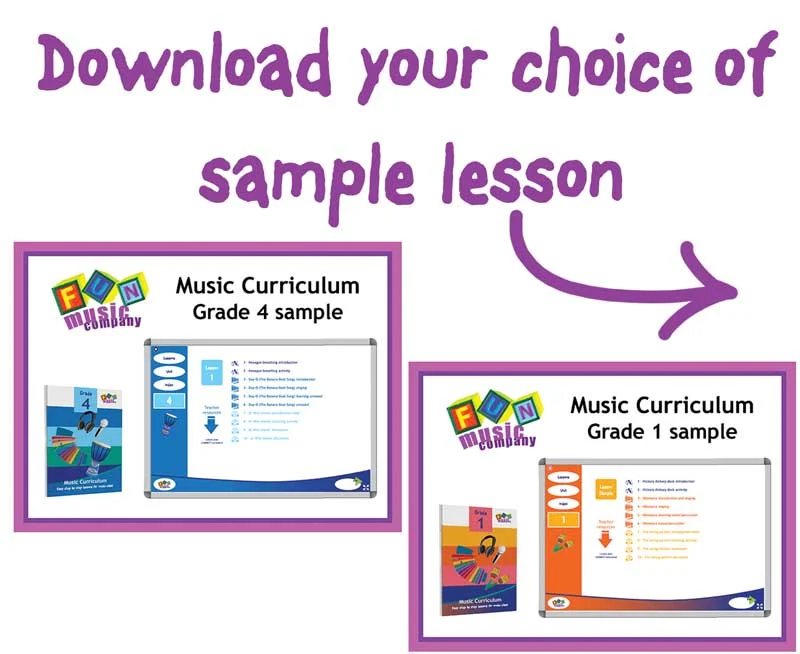
So start by downloading our free music curriculum sample pack by entering your details below.
If you’re looking to add an instrument program to your lesson planning, teaching ukulele is one of the best options for primary and elementary classrooms. Also if you have access to Boomwhacker pitched percussion tubes, we have lots of ideas for boomwhackers in the classroom at the Fun Music Company.
Also, if buckets and drumsticks are more accessible for your school, our bucket drumming lesson plan is a fantastic, low-cost way to get an entire class playing together.
“Having access to your music program has made the teaching and planning of my music classes SO much easier!”
This was what Liz, a music teacher from a small Catholic school in Sydney wrote to us in an email recently. This is typical of the hundreds of responses we get every week from teachers across Australia using the Fun Music Company Curriculum Program.
Imagine having an entire year of music lessons already planned, prepared, and ready to teach — no more Sunday night scrambles or piecing together resources from different places. That’s exactly what teachers at over 350 schools across Australia are experiencing right now.
Our curriculum program gives you complete, sequential lesson plans for every week of the school year, with videos, worksheets, interactive resources, and everything you need to walk confidently into your music room — whether you’re a specialist or a classroom teacher who’s been asked to teach music.
Ready to see what a week of music lessons looks like in your grade level?
Download a free sample pack below and take it for a test drive in your classroom.
 We value your privacy and would never spam you. We may email you valuable ideas for music teaching once or twice a week, however you can unsubscribe at any time. Check details of our privacy policy here.
“Janice … you look tired. Are you okay?” It was those words that caused me to re-think my approach to teaching and start creating prepared music programs that wouldn’t require hours and hours of preparation. That is why I’ve been working hard for more than 18 years to create one of Australia’s most popular music curriculum programs.
It doesn’t matter if you’re a music specialist, like Andrea, who said “I have been teaching music for 35 years and this is a dream come true” or someone like Jodie, who said she “finds it really great, because she has no musical background”. This program can help you!
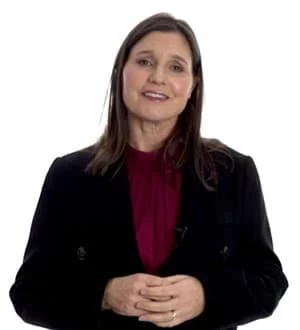
Janice Tuck
Music Teacher and Creative Director of the Fun Music Company.
* Teacher well-being survey by Education support UK. https://www.educationsupport.org.uk/resources/for-organisations/research/teacher-wellbeing-index/




Janice, this blog post is incredibly insightful and a fantastic resource for music educators! The breakdown of essential elements for primary music lesson plans is both practical and encouraging, especially for teachers who often feel overwhelmed by the demands of comprehensive lesson planning. I appreciate how you emphasize the importance of connection and rapport with students as a crucial skill for music teachers, which often gets overlooked in favor of strict curriculum adherence. Your approach to simplifying the planning process by focusing on clear outcomes and engaging activities is a breath of fresh air. It’s also wonderful to see your commitment to making music education accessible and enjoyable for both teachers and students. Thank you for sharing your expertise and making such a positive impact on music education!
Marko
CKORD
———
Hi Thanks for this information. I teach Year 1 to 6 at a primary school in Western Australia. I’ve found that I need to divide your lessons into 3, sing and play, composition and then connection always incorporporating a little review from the previous week as well as a little theory game. At the beginning of the year I always plan to do way too much to get covered… I forget the chn need to remember the routines, etc. but we always have fun.
I love the way your programs offer sing and play, compose and connection sections. This year we are also learning ukulele using your program, chn love it.
There are a few suggestions I would like to offer. The songs in different languages are great for a change, but can we have more in English especially for the younger children. Also is there any plans to offer alternative songs for each year…. I’m a bit bored teaching the same ones each year, yes I do add my own choices but they don’t have the great online lessons attached. Maybe, a book 1 and book 1b choice? Then I could alternate. Also I teach splits 3/4 4/5 so I need to choose a book, but if I had a book B I could alternate my teaching so the chn don’t get the same lessons twice.
Also, this is really pedantic sorry! Your volume at the beginning of each section is much louder than when Janice speaks… just something to think about . We turn off the sound now until we see Janice!
Really enjoying using the curriculum. Thanks heaps
Hi Andrea – great to hear from you and thankyou for your kind comments! I’ve got great news for you, because we’ve been thinking the same thing about the number of songs in the program. Our curriculum version 2.0 is on the verge of being released in the next few months, and it has DOUBLE the amount of “Sing and play” songs – we are going to 8 per grade. Because you’re an existing member, you’ll be getting this upgrade for free. :) I’m so glad you’re enjoying the program, and thanks so much for your detailed feedback, its much appreciated.
I agree with Andrea, just to add some more ‘weight’ to her comment…
The opening can give the children a fright if I’m not careful
Thank you for your efforts.
Thanks so much Alison for letting us know – we are looking at ways of correcting this for you.