


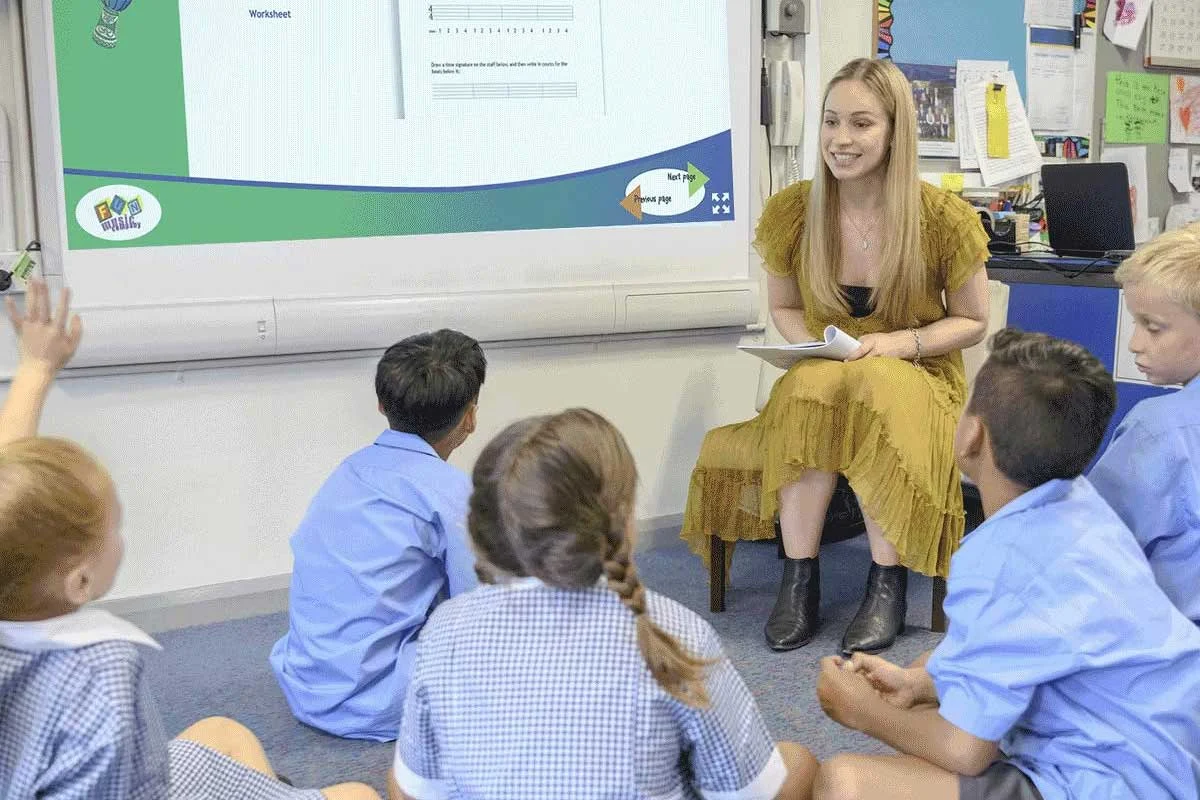
How to Teach Music in Primary School
(When You’re Not a Music Teacher)
The short answer:
Teaching music in primary school without a music background is entirely achievable — and the key is structure, not musical skill. If you’ve just been handed the music timetable and aren’t sure where to start, you’re in the right place. Generalist classroom teachers deliver excellent music lessons every day, all over the world — not because they’re trained musicians, but because they have a clear framework, the right activities, and content that’s been designed with them in mind. This guide walks you through exactly that: what to teach, how to structure your lessons, and where to find resources that do the heavy lifting for you.
You’ve been handed music on the timetable. Maybe it came with a box of instruments you’re not sure how to use, or maybe it came with nothing at all — just an expectation that you’ll figure it out. Sound familiar?
If you’re a generalist classroom teacher who has been asked to deliver music lessons, you’re not alone. It happens in schools all over the world. And the good news? You don’t need a music degree to do this well.
The secret — and it really is this simple — is that great music lessons are built on structure, not skill. When you have a clear framework, the right starting-point activities, and content that’s been designed with teachers like you in mind, you can walk into a music lesson with confidence.
Here’s exactly how to get started.
Why Structure Matters More Than Musical Ability
Think about a lesson you teach brilliantly — whether that’s mathematics, reading, or science. What makes it work? Most likely it’s a clear sequence: an engaging opener, a focused teaching point, some guided practice, and a wrap-up. Music lessons work exactly the same way.
What trips up non-music teachers isn’t a lack of talent — it’s a lack of sequence. When you’re unsure what comes next, the lesson loses momentum and students pick up on that quickly. But give yourself a repeatable structure and a set of go-to activities, and suddenly music becomes one of the most rewarding sessions of the week.
A reliable lesson framework looks like this:
- Warm-up (3–5 mins): A movement activity or simple rhythm game to focus attention and signal that music time has begun.
- Main activity (15–20 mins): Your core musical experience — singing, playing instruments, or listening with purpose.
- Secondary activity (5–10 mins): A quieter listening activity or similar activity held in reserve. If the main activity is going well and students are fully engaged, skip it or save it for next week. If things aren’t clicking — and every teacher knows that feeling — bring this forward, extend it, and use it to regain momentum.
- Reflection (3–5 mins): A brief check-in: What did we learn? What did we notice? This is where musical vocabulary starts to stick.
That’s it. Once you internalise that rhythm, teaching music becomes much more achievable.
Activities That Work Without a Musical Background
The activities below have all been used successfully by classroom teachers with no formal music training. They’re organised by year level — though you’ll know your students best, so use your judgement on what fits where.
Singing and Movement
Best for Kindergarten and Early Years
Young children are natural movers, and that’s your greatest asset in the early years classroom. At this age, music and movement are almost inseparable — children absorb rhythm, pitch, and musical patterns through their bodies long before they can articulate what they’re hearing.
Singing doesn’t require a perfect voice — it requires enthusiasm and consistency. Start with songs that have predictable patterns and actions so students can join in quickly without needing to read music or understand theory. Call-and-response activities work beautifully here: you clap a pattern, students clap it back. Simple, effective, and endlessly repeatable.

The main challenge with early years is keeping transitions smooth and maintaining pace. Have your next activity ready before you need it, and keep instructions short. If a song is working, it’s absolutely fine to do it again — repetition at this age is learning, not laziness.
Tip: build a small repertoire of 4–5 songs the class knows well. That sense of shared musical memory is genuinely powerful, and gives you a reliable anchor at the start or end of any lesson.
Boomwhackers
Best for Grades 1–4
By Grades 1–4, students are ready to start making deliberate musical choices — and Boomwhackers are the perfect vehicle for that. These colour-coded pitched tubes let students play melodies and harmonies without reading a single note of music, which makes them ideal for non-specialist teachers and students alike.
Display colour-coded notation on a screen, point to the colours in sequence, and students play the melody. It genuinely works from the very first lesson. As students progress through Grades 1–4, you can introduce more complex patterns, part work, and ensemble pieces that require real listening and coordination.
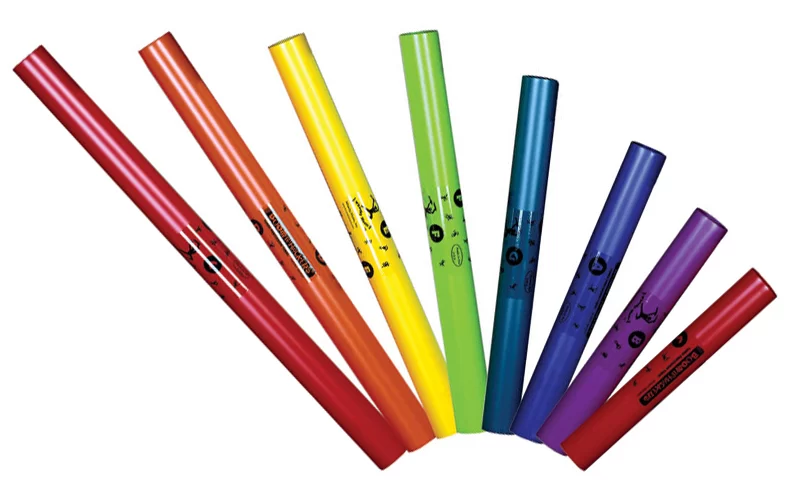
The challenge at this level is managing the enthusiasm — Boomwhackers are exciting, and students will want to play constantly. Clear signals for “play” and “rest” are essential. Establish those in the first lesson and reinforce them every time.
They’re also brilliant for ensemble work: different students hold different tubes and play their note when it appears. Instant orchestra, minimal preparation.
Bucket Drumming
Best for Grades 5–6
Older students bring a different energy to music — they want to feel capable, and they respond strongly to activities that feel genuinely impressive. Bucket drumming delivers exactly that. All you need are upturned buckets and drumsticks. No tuning, no sheet music, no theory prerequisites.
At Grades 5–6, students can handle greater rhythmic complexity and longer sequences, and they relish the challenge of layering parts and playing in a tight ensemble. The physicality of drumming also suits this age group well — it’s active, loud (in a controlled way), and deeply satisfying when a piece comes together.
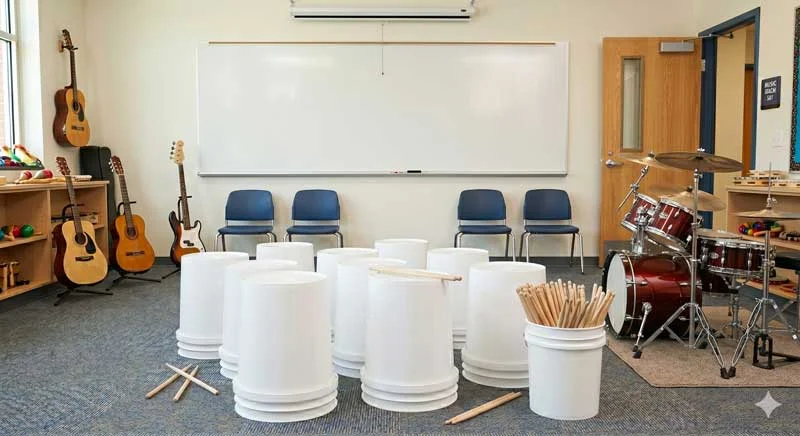
The key is teaching patterns in small, manageable chunks. Introduce one bar at a time. Layer parts gradually. The challenge at this level is less about engagement — bucket drumming tends to take care of that — and more about channelling energy productively. Clear expectations around when to play and when to stop are essential, and worth spending time on in the first lesson.
Guided Listening
Suitable for All Year Levels
Guided listening works across every year level, but what it looks like shifts significantly as students get older. The activity stays the same; the questions and vocabulary you use grow with them.
In the early years, keep it sensory and physical: Can you tap the beat? Does the music make you want to move fast or slow? Is it happy or sad?
In Grades 1–4, start introducing simple musical language: loud and soft, fast and slow, verse and chorus.
By Grades 5–6, students can begin to discuss structure, instrumentation, and how the music makes them feel and why — conversations that develop genuine critical thinking alongside musical understanding.
The common thread at every level is purposeful focus. Give students one specific thing to listen for before the music starts. That single instruction transforms passive hearing into active listening — a skill that carries well beyond the music classroom.
Keep a short playlist of contrasting pieces — something fast and rhythmic, something slow and lyrical, something from a different cultural tradition. Even five minutes of purposeful listening once a week builds musical understanding significantly across a school year.
What to Do When You Feel Out of Your Depth
Every teacher — music specialist or not — has moments of doubt in front of a class. Here are a few reframes that help:
You don’t need to know the answer — you need to model curiosity.
“I wonder what that instrument is called? Let’s find out together.” Students respond beautifully to a teacher who’s learning alongside them.
Simple done consistently beats complex done occasionally.
A five-minute rhythm routine at the start of every lesson is worth more than an elaborate one-off activity.
Use a structured program.
The biggest thing that separates confident non-specialist music teachers from anxious ones isn’t experience — it’s having a resource that tells them exactly what to do next.
How to Set Up a Consistent Weekly Music Session
If you’re teaching music once a week, consistency is your best friend. Students benefit enormously from predictable routines, and you’ll spend far less mental energy on preparation when the structure is already in place.
A reliable weekly session might look like this:
- A familiar warm-up song or rhythm activity (the same one for several weeks)
- One core activity: drumming, Boomwhackers, singing, or listening
- A secondary activity held in reserve in case you need it
- A brief cool-down: a reflection question, or a quiet listening moment
Once students know the routine, transitions become smoother, engagement deepens, and you’ll find yourself actually enjoying music time rather than dreading it.
For a comprehensive guide to planning your music sessions from scratch, the Elementary & Primary Music Lesson Plans guide covers everything you need — including what to include in your lesson plans, how to structure a term of music, and how to align lessons with curriculum outcomes.
Getting the Right Support in Place
One of the most common things we hear from classroom teachers who’ve been handed the music program is: “I wish I’d had this sooner.”
The Fun Music Company’s K–6 Music Curriculum was built specifically for this situation. It’s used by thousands of teachers worldwide — many of them generalists with no formal music background — who wanted to deliver genuinely excellent music lessons without spending their evenings planning them.
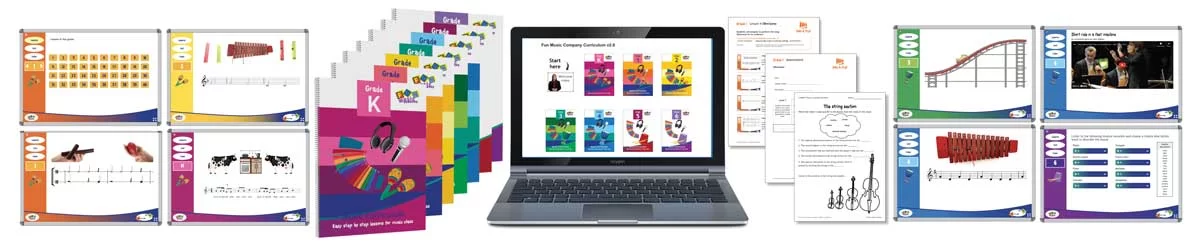
Every lesson is planned. Every activity is explained step by step. The program covers singing, playing, listening, and composing — all four areas of music education — across every year level from Kindergarten to Year 6.
Frequently Asked Questions
Engagement in music comes from active participation. The moment students switch from watching to doing, attention sharpens considerably. Keep activities short and varied, introduce new challenges in small steps, and build in moments where students can hear the result of their collective effort — a full piece played together, a rhythm passed around the circle. That sense of group achievement is a powerful motivator.
You don’t necessarily need traditional instruments at all. Body percussion and bucket drumming require nothing more than bodies and upturned buckets. Boomwhackers are an affordable and highly effective option for pitched activities. If your school has any instruments already — even a basic class set of rhythm sticks or shakers — you can start there and build gradually.
With the right resources, preparation time can be as little as 10–15 minutes per lesson. The key is having a program that tells you exactly what to teach, in what order, with all the materials included. Teachers who struggle with preparation are usually trying to design lessons from scratch — and that’s a problem of resourcing, not ability.
Pitch-perfect singing is not a requirement for teaching music effectively. What matters is your willingness to participate. Students take their cue from their teacher’s attitude, not their vocal range. If you sing enthusiastically and without apology, your class will follow. You can also use recordings to model singing and focus your role on facilitating rather than performing.
No. Most of the activities that work best in primary school music — body percussion, bucket drumming, Boomwhackers, singing, and guided listening — don’t require the teacher to read music notation at all. A structured program that sequences activities clearly is far more valuable than a music qualification.






Leave A Comment