


Australian Curriculum Music v9: Foundation Year Explained for Primary Teachers
The Australian Curriculum v9 for Music at Foundation Year requires students to begin exploring music through play, imagination and creative expression. It covers four interrelated strands: developing practices and skills, presenting and performing, creating and making, and exploring and responding. The curriculum at this level is deliberately broad — the same content statements apply across all five Arts subjects in Foundation Year — which means music at this level is about awakening curiosity, developing aural awareness, and building early musicianship through exploration rather than formal instruction.
A Note on Year Level Names
Foundation Year is the first year of primary school in Australia — but what it’s called depends on which state you’re in. It’s known as Kindergarten (or K) in New South Wales and the Australian Capital Territory, Prep in Queensland, Victoria and Tasmania, Reception in South Australia, Pre-primary in Western Australia, and Transition in the Northern Territory. Regardless of what your school calls it, the Australian Curriculum v9 requirements are the same, and this article addresses them all.
What Students Should Be Able to Do by the End of Foundation Year
The Australian Curriculum v9 achievement standard describes what students are expected to know and be able to demonstrate by the end of Foundation Year. For Music, it reads:
By the end of the Foundation year, students describe experiences, observations, ideas and/or feelings about arts works they encounter at school, home and/or in the community.
Students use play, imagination, arts knowledge, processes and/or skills to create and share arts works in different forms.
Source: Australian Curriculum, Assessment and Reporting Authority (ACARA), Australian Curriculum v9.0 Music. Licensed under CC BY 4.0.
In plain language, this means that by the end of their first year of school, students should be able to make music in response to ideas and experiences, and share that music with others in some form — even if that’s as simple as clapping a rhythm for the class or singing a song they’ve learned.
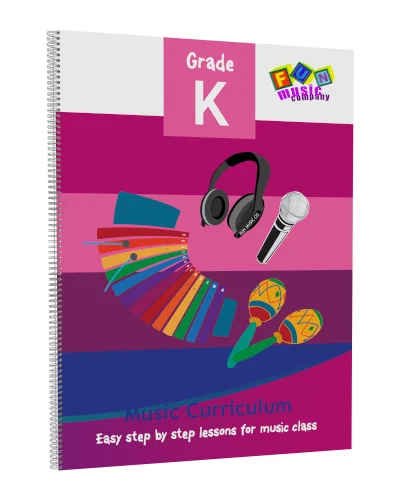
This is the benchmark the Fun Music Company Curriculum is built around. Every lesson at Foundation level has been designed with this standard in mind, ensuring that students arrive at the end of the year having genuinely experienced all four strands — not just the ones that are easiest to cover.
Why Music at Foundation Year Looks Different from Other Year Levels
If you look at the curriculum documents for Years 1 through 6, you’ll notice that the content statements become increasingly music-specific as students progress. At Foundation Year, that’s not the case. The content statements are written for the Arts broadly, not for Music specifically — the same statements govern what students should experience in Dance, Drama, Media Arts, Visual Arts, and Music.
This reflects something important about how young children learn: in the Foundation Year, the boundaries between arts subjects are naturally blurry. A child responding to music through movement is doing music and dance simultaneously. A child creating sounds to tell a story is working in music and drama at once. The curriculum acknowledges this and doesn’t try to force artificial separation.
For classroom teachers — particularly generalist teachers covering music for the first time — this is actually good news. It means Foundation music doesn’t require specialist knowledge of music theory or notation. What it requires is an understanding of how to guide children to explore sound, respond to music, create simple musical ideas, and share them. That’s entirely achievable with the right structured program.
The Four Strands of the Australian Curriculum v9 at Foundation Year
The Australian Curriculum v9 for Music is structured around four interrelated strands. Here’s what each strand requires at Foundation Year and how the Fun Music Company program addresses it.
Strand 1: Developing Practices and Skills (SKILLS)
Content statement:
Students learn to use play, imagination, arts knowledge, processes and/or skills to discover possibilities and develop ideas. (AC9AMUFD01)
Source: Australian Curriculum, Assessment and Reporting Authority (ACARA), Australian Curriculum v9.0 Music. Licensed under CC BY 4.0.
In music at Foundation Year, developing practices and skills is all about the ears and the voice. Before children can read music, perform in an ensemble, or compose a piece, they need to develop their fundamental musical capacities: listening carefully, responding to what they hear, feeling the beat in their bodies, and discovering what their voices can do.
The Fun Music Company SKILLS unit at Foundation Year builds these capacities through two core activities that run throughout the year: Listening Games and Echo Singing and Rhythm activities.
In Listening Games, students hear specially composed pieces of music and respond through movement, discussion, and imagination — learning to identify instruments, describe characters, and make meaning from what they hear.
Echo Singing and Echo Rhythm activities develop the voice and the sense of beat through call-and-response patterns, building pitch awareness and rhythmic skills in a way that feels like play rather than formal instruction.
By the end of the year, students have encountered a wide variety of musical sounds and developed the foundational listening and vocal skills that underpin everything that follows in Years 1 through 6.
Strand 2: Presenting and Performing (SING & PLAY)
Content statements:
Students learn to use play, imagination, arts knowledge, processes and/or skills to discover possibilities and develop ideas. (AC9AMUFD01)
Students learn to create artworks that communicate ideas. (AC9AMUFC01)
Students learn to share their artworks with audiences. (AC9AMUFP01)Source: Australian Curriculum, Assessment and Reporting Authority (ACARA), Australian Curriculum v9.0 Music. Licensed under CC BY 4.0.
In the Foundation Year, the presenting and performing strand is not about formal concerts or polished recitals — it’s about students learning songs, building ensemble skills with percussion, and sharing what they’ve prepared with an audience of classmates or family. The experience of preparing something and presenting it is itself the learning.
The Fun Music Company SING & PLAY unit at Foundation Year follows a structured five-lesson cycle that is repeated across a carefully chosen repertoire of songs throughout the year. For each song, students move through the same sequence: learning to sing, adding untuned percussion parts, adding tuned percussion parts, preparing a performance, and sharing it with an audience.
This cycle is deliberately repeated so that the process of preparing and presenting music becomes familiar and confidence-building rather than stressful. The repertoire draws on folk songs and traditional songs from a range of cultural backgrounds, chosen for their musical accessibility and their potential for layered ensemble arrangements.
Tuned percussion at Foundation Year is colour-coded throughout — including Boomwhackers, which are ideal at this level because their colour system allows students to play ensemble parts from the very first lesson, before they can read music notation.
By the end of the year, students have experienced the full arc of music-making — learning, rehearsing, performing and reflecting — multiple times, and that accumulated experience shapes their relationship with music for years to come.
Strand 3: Creating and Making (COMPOSE)
Content statement:
Students learn to create artworks that communicate ideas. (AC9AMUFC01)
Source: Australian Curriculum, Assessment and Reporting Authority (ACARA), Australian Curriculum v9.0 Music. Licensed under CC BY 4.0.
Composition at Foundation Year doesn’t look like sitting at a piano and writing a melody. It looks like a child choosing how loud or soft to make a clapping pattern, inventing a chant about their pet, or deciding which animal sound to represent with which instrument. These are genuine acts of musical creation — they just use the materials and thinking capacities that five-year-olds actually have.
The Fun Music Company COMPOSE unit at Foundation Year takes students through twenty structured activities that progressively develop their ability to make and organise musical ideas. They begin by creating simple chants with their name and favourite food, explore the contrast of sound and silence, experiment with loud and soft, and gradually work toward more complex compositional tasks — including creating soundscapes, setting stories to music, and ultimately producing a group musical story based on the tale of Peter Rabbit.
Throughout all of these activities, the emphasis is on musical decision-making: students are constantly being asked to make choices about how their music sounds and why. This is composition in the truest sense, and it builds creative confidence that carries through the entire curriculum.
Strand 4: Exploring and Responding (CONNECT)
Content statement:
Students explore how and why the arts are important for people and communities. (AC9AMUFE01)
Source: Australian Curriculum, Assessment and Reporting Authority (ACARA), Australian Curriculum v9.0 Music. Licensed under CC BY 4.0.
The exploring and responding strand is where students begin to understand music as something that exists in the world beyond their classroom — something that people across history and cultures have created, valued, and used to communicate meaning. At Foundation Year, this is approached through guided listening to a wide range of musical examples, with students responding through movement, discussion, and reflection.
The Fun Music Company CONNECT unit at Foundation Year takes students on a guided listening journey through a wide range of music spanning classical orchestral works, First Nations Australian music, world music traditions, jazz, and other familiar Western styles.
For each piece, the focus is on exploration and response — students are guided to notice how the music makes them feel, what it might be communicating, and why it might be important to the people who created it. First Nations Australian music is included from the very first lessons of the year, reflecting the curriculum’s explicit requirement that students begin exploring how music is important for people and communities.
This breadth of listening experience at Foundation Year is not incidental: it directly builds the cultural understanding and musical reference that the curriculum requires students to develop throughout their primary schooling.
What a Well-Structured Foundation Year Music Program Looks Like
The Australian Curriculum v9 gives schools and teachers significant flexibility in how they implement music at Foundation Year. But flexibility without structure can leave gaps — and in the Foundation Year, gaps in musical experience have consequences that compound over the years that follow.
A well-structured Foundation Year music program covers all four strands with genuine depth, not just a token activity in each. It develops listening skills and vocal skills progressively across the year, not just in the weeks leading up to an assembly. It gives students repeated experience of the full performance cycle — learning, preparing, and sharing — so that performing feels familiar rather than frightening. And it introduces students to music from diverse cultures and traditions, building the broad musical awareness the curriculum explicitly requires.
The Fun Music Company Foundation Year program was first developed in 2017 to align with the first version of the Australian Curriculum for Arts:Music and revised in 2024 to align with v9. It provides 38 weeks of fully planned, ready-to-teach lessons across all four strands, designed to be delivered by generalist classroom teachers with no specialist music background. Every lesson maps directly to the relevant content statements, so teachers can be confident they’re meeting the curriculum requirements without spending hours researching what those requirements actually mean.
Frequently Asked Questions
The Fun Music Company program is designed as a coherent K–6 sequence, meaning the Foundation Year program deliberately builds the skills and experiences that Years 1 and 2 will build upon. The listening skills developed in Foundation SKILLS directly support the more advanced aural work of the Year 1–2 SKILLS unit. The songs and ensemble experience in Foundation SING & PLAY prepare students for the more structured performance work of Year 1–2. And the creative confidence built in Foundation COMPOSE underpins the more detailed composition projects that begin in Year 1. Nothing in the Foundation program is standalone — it’s the foundation (in every sense) of everything that follows. If you’d like a complete overview of how the curriculum progresses across all primary years, see our Australian Curriculum Music v9: Complete Guide for Primary Teachers.
Yes. The Australian Curriculum v9 explicitly requires students to explore how and why the arts are important for people and communities, and this includes First Nations Australian perspectives. The Fun Music Company Foundation Year CONNECT unit includes First Nations Australian music from the very beginning of the year, introducing students to the importance of music for First Nations culture and community as part of their earliest musical experiences at school.
The Australian Curriculum does not specify a set number of hours for music at Foundation Year. Here at the Fun Music Company, our recommendation is that schools aim for one dedicated music lesson per week of approximately 30–45 minutes, though the curriculum is flexible enough to allow for music to be integrated into other learning areas. Consistent, regular music time is more valuable than occasional longer sessions — especially at Foundation Year, where repetition and familiarity are central to how young children develop musical skills.
Yes — and Foundation Year is actually one of the most accessible year levels to teach music without a specialist background. The curriculum at this level doesn’t require knowledge of theory, notation, or formal musicianship. What it requires is the ability to guide exploration, facilitate listening and responding, and lead simple songs and activities. A structured, ready-to-teach program removes the planning burden entirely and gives you exactly what to do in each lesson.
No. The Australian Curriculum v9 does not require music notation at Foundation Year. The focus is entirely on aural and kinaesthetic experience — listening, singing, moving, creating and responding. Notation becomes progressively relevant from around Year 3 onwards. At Foundation Year, the priority is developing the ear and the voice, not reading symbols on a page.
Ready to Teach Foundation Year Music with Confidence?
The Fun Music Company K–6 Curriculum Program includes full Foundation Year lesson plans across all four strands, aligned to the Australian Curriculum v9, and designed to be delivered by any classroom teacher regardless of musical background. Every lesson is planned, resourced, and ready to use.
Click here to learn more about the Fun Music Company Curriculum Program for the Foundation Year »


Leave A Comment