

Australian Curriculum Music v9:
A Complete Guide for Primary Teachers
The Australian Curriculum v9 for Music is the national framework that defines what music education should look like in primary schools from Foundation Year through to Year 6. For classroom teachers — whether you’re a specialist music educator or a generalist primary teacher who also teaches music — understanding what the curriculum actually requires is the foundation of effective music teaching. This guide explains the Australian Curriculum v9 for Music in plain language: what it contains, how it is structured, how it progresses across the primary years, and how a well-planned program can meet its requirements in any classroom.
The Australian Curriculum is the federal curriculum framework used as the basis for music education across Australia. Individual states and territories implement it through their own local frameworks — more on that below — but the content statements, achievement standards and strand structure described in this guide apply nationally.
A Brief History of the Australian Curriculum for Music
The first national Australian Curriculum for the Arts, including Music, was released in 2014. It represented a landmark moment for music education in Australia — for the first time, there was a shared national framework describing what music education should look like from Foundation to Year 10, regardless of which state or territory a student lived in.
In 2020–21, the Australian Curriculum, Assessment and Reporting Authority (ACARA) undertook a comprehensive review of the curriculum across all learning areas. The review process was extensive, drawing on research, consultation with educators, and analysis of curriculum frameworks from around the world. Version 9.0 of the Australian Curriculum was released in April 2022, with the Music learning area updated to reflect current understandings of music education, cultural inclusion, and the role of First Nations Australian music in the curriculum.
Schools and systems were supported to transition to v9.0 from 2023, with full implementation expected across most jurisdictions by 2025. The Fun Music Company curriculum program was revised and updated to align with v9.0 in 2024, ensuring that every lesson maps directly to the current content statements and achievement standards.
How the Australian Curriculum v9 for Music Is Structured
The Australian Curriculum v9 for Music is built around two key organising elements: four interrelated strands that define the types of musical activity students engage in, and five year-level bands that define how expectations progress from Foundation Year through to Year 10. In primary school, the relevant bands are Foundation, Years 1–2, Years 3–4, and Years 5–6.
The Four Strands
Every piece of musical activity in the Australian Curriculum v9 sits within one of four strands. These strands are interrelated — they inform and support each other — but each has its own content statements and its own distinct focus.
Developing practices and skills is the strand concerned with the technical and aural foundations of music-making. It covers listening skills, aural awareness, singing technique, instrumental skills, music notation literacy, and the ability to manipulate the elements of music with increasing control and intentionality. This strand underpins everything else: students need well-developed musical skills and ears to perform, compose and engage with music meaningfully.
Presenting and performing is the strand concerned with students sharing music with others. It covers learning and rehearsing pieces, developing ensemble skills, reading from notation, and presenting performances in settings that range from informal classroom sharing to formal concert performance. Across the primary years, the expectations around performance grow from simple informal sharing in the early years to multi-part ensemble performance for real audiences by Years 5 and 6.
Creating and making is the strand concerned with composition and musical creativity. It covers improvisation, composition using elements of music, the use of compositional devices, and the documentation and recording of musical works. This strand begins with simple sound exploration in Foundation Year and develops into sophisticated project-based composition work involving digital tools, notation, and deliberate artistic intention by Years 5 and 6.
Exploring and responding is the strand concerned with students’ engagement with music as listeners, critics and cultural participants. It covers listening to and analysing music from a wide range of cultural, historical and social contexts, with a specific and important focus on First Nations Australian music throughout the primary years. This strand builds students’ musical reference library and their capacity to engage with music thoughtfully and articulately.
The Fun Music Company’s Four Units
The Fun Music Company curriculum program maps directly onto these four strands through four named units that run across every grade level. SKILLS addresses the developing practices and skills strand. SING & PLAY addresses the presenting and performing strand. COMPOSE addresses the creating and making strand. CONNECT addresses the exploring and responding strand. This mapping is explicit and complete — every lesson in the program links to a specific content statement in the relevant strand.
The Elements of Music
Running through all four strands are the elements of music — the building blocks that students learn to identify, describe, manipulate and combine across the primary years. These include dynamics (the variation in volume from soft to loud), tempo (the speed of the music), pitch (the highness or lowness of notes), rhythm (the pattern of long and short sounds), timbre (the distinctive quality of different instruments and voices), texture (the layers and density of musical sound), and form (the structure and organisation of a musical work). Students encounter these elements from Foundation Year and develop an increasingly sophisticated understanding of how they work and how they can be used expressively as they move through the primary years.
How the Australian Curriculum v9 Progresses Through the Primary Years
One of the most important things to understand about the Australian Curriculum v9 for Music is that it is genuinely progressive. The content statements are not repeated across year bands — they build deliberately, with each band introducing new expectations that extend and deepen what came before. Understanding this progression is essential for planning a coherent music program across the primary years.
Foundation Year
The Foundation Year curriculum introduces students to music through play, imagination and exploration. The key word across all four strands at this level is explore — students are discovering what music is, what it can do, and how they can participate in it. In the developing practices and skills strand, students use play, imagination, arts knowledge and skills to discover possibilities and develop ideas. In the presenting and performing strand, students share their musical works with audiences in informal settings. In the creating and making strand, students create artworks that communicate ideas. In the exploring and responding strand, students explore how and why the arts are important for people and communities. These are deliberately open, inviting content statements that set music up as something joyful, accessible and worth engaging with.
The Fun Music Company Foundation Year program meets these requirements across 40 weeks of SKILLS lessons built around listening games and echo activities, a full SING & PLAY unit introducing ensemble singing and percussion, a COMPOSE unit developing students’ capacity to create and communicate musical ideas, and a CONNECT unit of 20 guided listening activities spanning world music traditions. Read the full Foundation Year curriculum breakdown here.
Years 1 and 2
The Years 1–2 curriculum introduces the first music-specific content statements in the sequence. Students move from broad exploration to more focused musical activity: developing listening skills and skills for singing and playing instruments (developing practices and skills), singing and playing music in informal settings (presenting and performing), selecting and combining elements of music when composing (creating and making), and exploring where, why and how people across cultures and communities experience music, including examples of music composed and performed by First Nations Australians (exploring and responding). This is the year band where the First Nations Australian music requirement first appears explicitly, and where students begin to encounter the elements of music as named, describable features of the music they hear and make.
The Fun Music Company Years 1 and 2 programs provide 40 weeks of lessons across all four units, with SING & PLAY built around an international repertoire of folk and traditional songs with tuned and untuned percussion accompaniment, COMPOSE developing students’ ability to select and combine elements of music in their own works, and CONNECT introducing students to music from a genuinely wide range of cultural contexts. Read the full Years 1–2 curriculum breakdown here.
Years 3 and 4
The Years 3–4 curriculum introduces the most significant progression in the primary sequence: the shift from selecting and combining elements of music to actively manipulating them. Across all four strands, students are now expected to do more with music — not just explore or respond, but make deliberate choices that achieve specific effects. The developing practices and skills strand introduces music notation for the first time, adding rhythm notation, the music staff, clefs, note values, rests and dynamic markings to students’ musical toolkit. The creating and making strand asks students to manipulate elements of music to communicate ideas, perspectives and meaning. The exploring and responding strand adds a historical dimension and introduces the specific requirement to explore how First Nations Australians use music to communicate their connection to and responsibility for Country/Place.
The Fun Music Company Years 3 and 4 programs meet these requirements with a systematic notation curriculum woven through the SKILLS unit, a SING & PLAY unit where students begin reading from notation to learn their instrumental parts, a COMPOSE unit that develops compositional intention through element-by-element exploration and musical dominoes projects, and a CONNECT unit that opens each year with First Nations Australian music. Read the full Years 3–4 curriculum breakdown here.
Years 5 and 6
The Years 5–6 curriculum is the most demanding band of the primary sequence and represents the payoff of everything that has been built since Foundation Year. Four significant shifts mark this band. In the performing strand, students now perform in formal as well as informal settings — real audience performance is an explicit requirement. In the composition strand, students must use compositional devices (not just elements of music) and must notate, document and record their work. In the skills strand, students develop aural skills and skills for manipulating elements of music to achieve expressive effects — the purposeful, artistic dimension is now front and centre. And in the exploring and responding strand, the First Nations Australian music requirement shifts from Country/Place to how music is used to continue and revitalise culture — a forward-looking, living-culture lens.
The Fun Music Company Years 5 and 6 programs meet these requirements with a structural shift in the SING & PLAY unit to Marimba Band and Bucket Drumming ensemble formats (designed for formal performance), four project-based COMPOSE units per year incorporating both technology and non-technology options, extended notation and aural skills development in the SKILLS unit, and a CONNECT unit built around analytical listening across a wide range of musical traditions. Read the full Years 5–6 curriculum breakdown here.
Achievement Standards Across the Primary Years
Each year-level band in the Australian Curriculum v9 for Music includes an achievement standard — a description of what students are expected to know and be able to do by the end of that band. These standards are the benchmark against which student learning is assessed, and they reflect the progressive demands of the curriculum across the primary years.
By the end of Foundation Year, students explore and respond to music, sharing their musical ideas with others. By the end of Year 2, students identify and describe the use of elements of music, and sing and play music in informal settings. By the end of Year 4, students describe the use of elements of music and how they communicate ideas, demonstrate listening skills in their performing and composing, and combine elements of music in their own compositions. By the end of Year 6, students explain — not just describe — how elements of music are combined and how compositional devices are used, perform music in a range of forms in formal and informal settings, and manipulate elements and devices to compose music that communicates meaning.
The shift in language across the bands — from explore to identify and describe to manipulate and combine to explain and evaluate — is the curriculum’s clearest signal of the depth of musical understanding it expects students to develop across the primary years. A well-planned, well-resourced program can genuinely get students there.
First Nations Australian Music in the Australian Curriculum v9
One of the most important features of the Australian Curriculum v9 for Music is its specific, sustained focus on First Nations Australian music. This is not a tokenistic requirement — it is woven through every year band of the primary curriculum, with content statements that become progressively more specific and more demanding as students move through the primary years.
In Foundation Year, students explore how and why the arts are important for people and communities — a broad statement that includes First Nations Australian music within a global frame. In Years 1 and 2, a dedicated content statement requires students to explore examples of music composed and performed by First Nations Australians. In Years 3 and 4, the requirement deepens: students explore how First Nations Australians use music to communicate their connection to and responsibility for Country/Place. In Years 5 and 6, the focus shifts forward: students explore how First Nations Australians use music to continue and revitalise culture.
This progression — from general awareness to specific cultural practice to living cultural revitalisation — reflects the curriculum’s intention that students leave primary school with a genuine, respectful and informed understanding of First Nations Australian music as a living tradition, not a historical artefact.
The Fun Music Company CONNECT unit places First Nations Australian music at the opening of each year’s listening sequence, establishing from the first lesson that this is a central part of music education, not an addition to it.
State and Territory Curriculum Frameworks
The Australian Curriculum v9 for Music is the national framework, but individual states and territories implement music education through their own local curriculum frameworks. In most cases, these frameworks are closely aligned with or directly based on the Australian Curriculum, but there are differences in structure, terminology and implementation timelines that are worth understanding.
In Victoria, music education is governed by the Victorian Curriculum F–10. The Fun Music Company has developed scope and sequence documentation mapped to the Victorian framework. For more detail, see our Victorian curriculum overview and Victorian Curriculum Music Scope and Sequence.
In New South Wales, music education is governed by the NSW Syllabus for the Australian Curriculum. For more detail, see our NSW curriculum overview and NSW Curriculum Music Scope and Sequence.
In Western Australia, music education is governed by the Western Australian Curriculum. WA has recently released a new edition of their curriculum framework — updated resources and mapping for WA schools are in development. In the meantime, see our WA curriculum overview and WA Curriculum Music Scope and Sequence.
Teachers in other states and territories — Queensland, South Australia, Tasmania, the ACT and the Northern Territory — generally implement the Australian Curriculum directly, and the content in this guide applies to your context without significant modification.
The Fun Music Company K–6 Curriculum Program
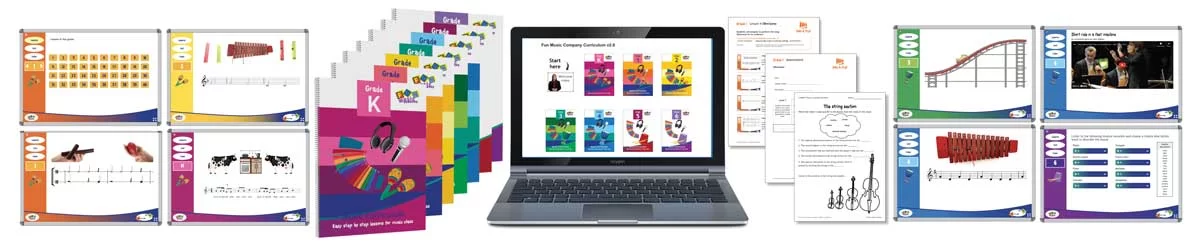
The Fun Music Company K–6 Curriculum Program is a fully planned, ready-to-teach music curriculum for primary schools, aligned to the Australian Curriculum v9. The program covers Foundation Year through Grade 6, with a complete program for each grade level across all four strands — SKILLS, SING & PLAY, COMPOSE and CONNECT.
Every lesson in the program is designed to be delivered by any classroom teacher, regardless of musical background or experience. Step-by-step lesson plans, video support, student worksheets, assessment tools, and full scope and sequence documentation mean that teachers who have never taught music before can deliver a complete, curriculum-aligned music program with confidence.
The program has been refined through years of real classroom use across a wide range of school contexts — from well-resourced specialist music programs to generalist classrooms with limited instruments and no music background. It meets students where they are at every grade level and builds their musical skills, knowledge and enthusiasm progressively across the primary years.
Explore the complete Fun Music Company K–6 Curriculum Program »
Frequently Asked Questions
This guide focuses on the primary years (Foundation to Year 6), but it’s worth noting that the Australian Curriculum v9 for Music continues through Years 7–10 with content statements that build directly on the primary foundations. In secondary school, students are expected to work with greater independence, sophistication and artistic intention across all four strands — performing in formal settings, composing extended works, engaging critically with music from a wide range of contexts, and developing their own musical voice. Students who arrive at secondary school with a strong primary music education are significantly better prepared for this work.
The Australian Curriculum v9 for Music identifies the following elements of music as the building blocks that students develop understanding of across the primary years: dynamics (volume variation), tempo (speed), pitch (highness and lowness of notes), rhythm (patterns of long and short sounds), timbre (the distinctive quality of different sounds), texture (the layers and density of musical sound), and form (the structure and organisation of a musical work). Students encounter these elements from Foundation Year and develop an increasingly sophisticated capacity to identify, describe, manipulate and combine them as they progress through the primary curriculum.
First Nations Australian music has a dedicated content statement in every year band of the primary curriculum, from Years 1–2 through to Years 5–6. The focus of this requirement becomes progressively more specific as students move through the primary years: from exploring examples of First Nations Australian music in Years 1–2, to understanding how music communicates connection to Country/Place in Years 3–4, to understanding how music continues and revitalises culture in Years 5–6. It is one of the curriculum’s strongest commitments and one that deserves genuine, sustained attention.
No — and this is one of the things the Fun Music Company curriculum program is specifically designed to address. The Australian Curriculum for Music applies to all primary teachers, including generalist classroom teachers with little or no musical background. A well-designed curriculum program provides everything a generalist teacher needs to deliver quality music education: clear lesson plans, step-by-step instructions, video support, student resources and assessment tools. The curriculum’s own content statements are achievable in any classroom — they don’t require specialist instruments, a dedicated music room, or a music degree to deliver.
The Australian Curriculum provides the national framework, but education is a state and territory responsibility in Australia, which means each jurisdiction implements it through its own local framework. Most states and territories have adopted the Australian Curriculum as the basis for their local frameworks, either directly or with local modifications. In practice, the content statements and achievement standards described in this guide reflect what is expected in primary school music education across most of Australia, though the specific terminology and implementation details may vary by state.
The Australian Curriculum v9 for Music is the national framework that describes what music education should look like in Australian schools from Foundation Year through to Year 10. It was released by ACARA in April 2022 as part of a comprehensive review of the Australian Curriculum across all learning areas. The curriculum is structured around four strands — developing practices and skills, presenting and performing, creating and making, and exploring and responding — with content statements and achievement standards for each year-level band.
Start Teaching the Australian Curriculum v9 with Confidence
Whether you’re a specialist music teacher planning a whole-school program or a generalist classroom teacher looking for a curriculum-aligned resource you can actually use, the Fun Music Company K–6 Curriculum Program is designed for you. Fully planned, ready to teach, and mapped to every content statement in the Australian Curriculum v9 for Music.





Leave A Comment