


Australian Curriculum Music v9:
Years 1–2 Explained for Primary Teachers
The Australian Curriculum v9 for Music groups Years 1 and 2 together as a single band, with shared achievement standards and content statements that apply across both year levels. At this stage, music becomes noticeably more music-specific than at Foundation Year — students move from broad arts exploration into named musical concepts like tempo, dynamics, pitch and timbre, and begin developing skills that are distinctly musical: listening with intention, singing with awareness of pitch, and performing in ensemble settings. For classroom teachers, Years 1 and 2 represent the point where a structured, sequential music program really starts to pay dividends. The habits and confidence built in Foundation Year begin to consolidate into genuine musical skills.
How Years 1–2 Builds on Foundation Year
If Foundation Year is about awakening curiosity and exploring what music is, Years 1 and 2 are about beginning to understand how it works. Students move from responding to music instinctively to describing what they hear using musical language. They move from exploring their voices freely to developing specific singing skills. They move from simple percussion accompaniment to learning tuned and untuned parts that work together in an ensemble.
Across the two-year band, there is a deliberate progression. Year 1 introduces concepts and builds foundational skills; Year 2 extends and deepens those same skills, adding complexity in both the performing and composing strands. A student who arrives at Year 3 having had a well-structured Years 1–2 music program is in a fundamentally different position from one who hasn’t — and that difference compounds significantly through the upper primary years.
For a full overview of how the curriculum progresses from Foundation through to Year 6, see our Australian Curriculum Music v9: Complete Guide for Primary Teachers.
What Students Should Be Able to Do by the End of Year 2
The Australian Curriculum v9 achievement standard for the Years 1–2 band describes what students are expected to know and demonstrate by the end of Year 2:
By the end of Year 2, students identify where they experience music. They describe where, why and/or how people across cultures, communities and/or other contexts experience music.
Students demonstrate listening skills. They use the elements of music to improvise and/or compose music. They sing and play music in informal settings.Source: Australian Curriculum, Assessment and Reporting Authority (ACARA), Australian Curriculum v9.0 Music. Licensed under CC BY 4.0.
In plain language, this means that by the end of Year 2, students should be able to talk about where and why people make music in the world around them, demonstrate that they can listen actively and purposefully, use elements of music like rhythm and pitch to make and organise their own musical ideas, and perform songs and pieces they have learned or composed in informal settings.
Notice that the standard doesn’t say students need to read notation, perform in formal concerts, or demonstrate technical mastery. The bar at Years 1–2 is appropriately set around musical thinking, listening, and participation — which means any classroom teacher with a well-designed program can get their students there.
The Four Strands of the Australian Curriculum v9 in Years 1 and 2
The same four interrelated strands that structure the Foundation Year curriculum continue through Years 1 and 2, but the content statements become more specific and more distinctly musical. Here is what each strand requires and how the Fun Music Company program addresses it across the two-year band.
Strand 1: Developing Practices and Skills (SKILLS)
Content statement:
Develop listening skills and skills for singing and playing instruments. (AC9AMU2D01)
Source: Australian Curriculum, Assessment and Reporting Authority (ACARA), Australian Curriculum v9.0 Music. Licensed under CC BY 4.0.
This content statement marks one of the most significant shifts from Foundation Year. Where the Foundation statement was broad and arts-wide, this one is clearly music-specific: students are developing listening skills and skills for singing and playing instruments. The musical elements — tempo, dynamics, pitch, timbre, rhythm — now become named objects of study that students learn to identify, describe and manipulate.
The Fun Music Company SKILLS unit builds these capacities progressively across Years 1 and 2. In Year 1, students develop their awareness of individual musical elements through guided listening activities, echo singing exercises that build pitch awareness, and echo rhythm games that develop their sense of beat and rhythm. By Year 2, the same activity types become more sophisticated: students encounter compound time rhythms, practise solfège-based pitch matching, and develop the ability to distinguish between musical elements that are increasingly similar — for example, distinguishing between simple and compound rhythm patterns, or identifying a specific instrument within a fuller musical texture.
Throughout both years, the SKILLS unit runs parallel to the other three units rather than being taught in isolation. Students are developing listening skills while they are also performing in SING & PLAY and composing in COMPOSE — which is exactly how musical skills develop in practice.
Strand 2: Presenting and Performing (SING & PLAY)
Content statement:
Sing and play music they have learnt and/or composed in informal settings. (AC9AMU4P01)
Source: Australian Curriculum, Assessment and Reporting Authority (ACARA), Australian Curriculum v9.0 Music. Licensed under CC BY 4.0.
The presenting and performing strand in Years 1 and 2 builds directly on the performance cycle established in Foundation Year — but the repertoire becomes more musically varied and the ensemble arrangements more layered. Students continue working through a structured sequence for each song: learning, adding tuned and untuned percussion parts, rehearsing, and performing for an audience. The addition of tuned percussion parts is a meaningful step forward from Foundation Year, introducing students to the concept of melody and harmonic accompaniment in a hands-on way.
Boomwhackers are the primary tuned percussion instrument across Years 1 and 2 — their colour-coded pitch system bridges the gap between playing by ear and reading colour-coded notation on the staff, building the music literacy foundations that the curriculum requires by the end of Year 2.
Across the two-year band, the Fun Music Company SING & PLAY unit draws on a genuinely international repertoire, including songs from African, Japanese, French, American, Australian and other traditions. This is not incidental — it directly supports the CONNECT strand’s requirement that students explore music across cultures and communities, creating a natural link between performing and understanding.
Students are not just singing songs; they are also learning that music exists in many forms and contexts around the world. By the end of Year 2, students have experienced multiple complete performance cycles across a varied repertoire, and the experience of preparing and sharing music with an audience has become a familiar and positive part of their musical life rather than something novel or anxiety-inducing.
Strand 3: Creating and Making (COMPOSE)
Content statement:
Select and combine elements of music when composing and practising music for performance. (AC9AMU2C01)
Source: Australian Curriculum, Assessment and Reporting Authority (ACARA), Australian Curriculum v9.0 Music. Licensed under CC BY 4.0.
The composition content statement for Years 1 and 2 introduces an important new concept: selecting and combining elements of music. This goes beyond the Foundation Year’s broad ‘creating artworks that communicate ideas’ and asks students to make deliberate, informed musical choices — choosing how to use dynamics, tempo, pitch and rhythm to achieve a specific expressive effect.
In Year 1, the Fun Music Company COMPOSE unit builds on the creative confidence developed in Foundation Year. Students explore how individual musical elements create expressive effects through structured activities — experimenting with tempo, dynamics, articulation and pitch as tools for communicating ideas and stories.
They begin to combine these elements into short compositions and learn to record their musical ideas in simple ways. By Year 2, the composition projects become more sustained and more intentional: students work toward a completed composition using the pentatonic scale, combine and develop musical ideas with a partner, use technology to sequence and layer sounds, and present finished work to the class with a description of their expressive intent.
This progression across the two years is carefully designed. Students who reach Year 3 having worked through this sequence understand composition not as something that happens by accident, but as a process of making deliberate choices — which is exactly the foundation the upper primary COMPOSE units are built on.
Strand 4: Exploring and Responding (CONNECT)
Content statements:
Explore where, why and how people across cultures, communities and/or other contexts experience music. (AC9AMU4E01)
Explore examples of music composed and/or performed by First Nations Australians. (AC9AMU2E02)
Source: Australian Curriculum, Assessment and Reporting Authority (ACARA), Australian Curriculum v9.0 Music. Licensed under CC BY 4.0.
The exploring and responding strand in Years 1 and 2 introduces something new that didn’t exist as a distinct requirement at Foundation Year: a specific, named content statement requiring students to explore examples of music composed and/or performed by First Nations Australians. This is not a suggestion or an elaboration — it is a content statement, meaning it is a curriculum requirement at this year level.
For many generalist classroom teachers, this is one of the most daunting aspects of teaching music in Years 1 and 2. Understanding how to approach First Nations music respectfully, meaningfully, and in a way that genuinely serves the curriculum requirement — rather than tokenistically ticking a box — requires guidance and well-chosen resources.
The Fun Music Company CONNECT unit in Years 1 and 2 addresses both content statements across a sequence of twenty guided listening activities per year. In Year 1, students explore a wide range of music from different cultures and communities, including examples of First Nations Australian music, and develop the language to describe where, why and how music is experienced in different contexts. Year 2 deepens this work with a similar breadth of listening, introducing students to a wider range of musical traditions and styles while continuing to develop their ability to describe and respond to music meaningfully.
The orchestral repertoire in the CONNECT unit also introduces students to the instruments of the orchestra in Year 1, building the listening vocabulary they will draw on throughout their primary schooling and beyond.
What a Well-Structured Years 1–2 Music Program Looks Like
Years 1 and 2 represent the critical window where students either begin to see themselves as musical — capable of singing, listening, creating and performing — or they don’t. A program that covers the curriculum requirements on paper but doesn’t give students genuine, repeated experiences of music-making across all four strands will leave gaps that become increasingly difficult to address in the upper primary years.
A well-structured Years 1–2 program develops specific musical skills progressively across the two years rather than repeating the same content. It introduces the musical elements by name and gives students regular practice in identifying and manipulating them. It provides ensemble performance experience with genuine repertoire, and it approaches First Nations Australian music with depth and respect rather than a single token lesson. And it builds creative confidence through composition projects that ask students to make real musical decisions, not just fill in worksheets.
The Fun Music Company Years 1 and 2 curriculum program provides fully planned, ready-to-teach lessons across all four strands for both year levels, designed to be delivered by generalist classroom teachers with no specialist music background. Every lesson maps directly to the relevant content statements, and the two-year progression is carefully structured so that each year genuinely builds on what came before.
Frequently Asked Questions
The Years 1–2 program is the direct foundation for the significantly more sophisticated content of Years 3 and 4. Students who arrive at Year 3 with well-developed listening skills, performance experience, compositional confidence, and a broad frame of reference for music across cultures are ready for the deeper engagement the Years 3–4 curriculum requires. Students who arrive without those foundations will struggle with the jump in expectations — particularly in the SKILLS strand, which introduces music notation in Year 3, and the COMPOSE strand, which asks students to manipulate elements of music with artistic intention.
No. The Australian Curriculum v9 does not require music notation reading at Years 1 and 2. Students may be introduced to simple rhythm notation or graphic scores as a tool for recording their own musical ideas in the COMPOSE strand, but formal staff notation is not a curriculum requirement until the upper primary years. The emphasis at this level is firmly on aural and kinaesthetic learning — developing the ear, the voice, and the body’s sense of rhythm before adding the abstract layer of notation.
The key is to approach First Nations Australian music as music that is important for people and communities — just as you would approach music from any other culture in the CONNECT strand. The curriculum asks students to explore examples of music composed and/or performed by First Nations Australians, which means listening to genuine music, learning something about its context and significance, and responding to it thoughtfully. Avoid treating it as a box to tick or confining it to a single lesson. A program that weaves First Nations perspectives through the year, rather than isolating them, is more authentic and more likely to build genuine understanding.
By the end of Year 2, students should be able to identify and describe the basic elements of music — including tempo (fast and slow), dynamics (loud and soft), pitch (high and low), rhythm (patterns of long and short sounds), and timbre (the distinctive sound quality of different instruments). They don’t need to use formal notation to demonstrate this understanding — they can describe, respond to, and manipulate these elements through singing, playing, listening and composing activities.
The Australian Curriculum v9 groups Years 1 and 2 as a band because students at this age develop at different rates, and the curriculum is designed to give teachers flexibility to respond to where their class actually is rather than where the calendar says they should be. The content statements and achievement standard describe what students should reach by the end of Year 2, allowing Year 1 to be used for building the foundations and Year 2 for extending and deepening. In practice, a well-structured program makes the two-year progression explicit, so teachers know what’s expected at each point in the band.
Ready to Teach Years 1 and 2 Music with Confidence?
The Fun Music Company Grade 1 and Grade 2 curriculum programs are fully planned, ready-to-teach, and aligned to the Australian Curriculum v9. Each grade is available individually so you can start exactly where your students are.
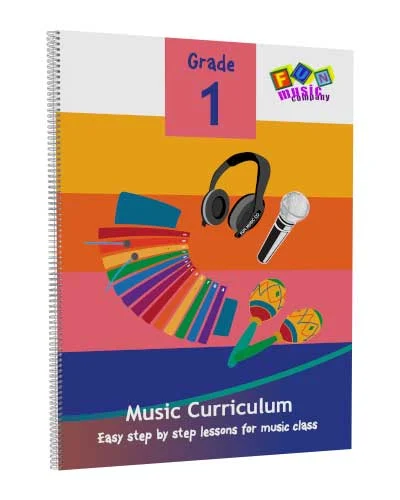
The Grade 1 Music Curriculum
The Grade 1 program builds directly on Foundation Year with 40 weeks of fully planned lessons across all four strands — SKILLS, SING & PLAY, COMPOSE and CONNECT. Every lesson introduces new musical concepts progressively, develops ensemble performance skills, and is designed to be taught by any classroom teacher regardless of music background.
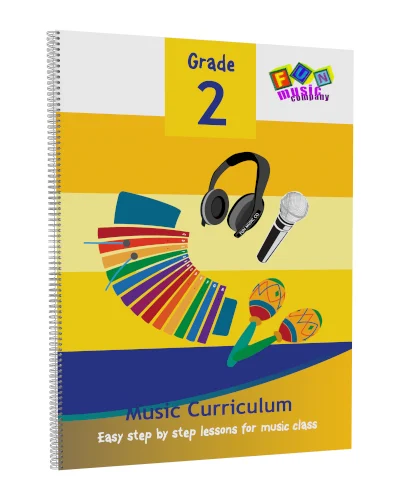
The Grade 2 Music Curriculum
The Grade 2 program deepens and extends everything established in Grade 1. Students take on more complex composition projects, more sophisticated ensemble arrangements, and a broader range of musical listening experiences. The same four-strand structure ensures full curriculum alignment, and every lesson is clear, step-by-step, and ready to use from the moment you open it.


Leave A Comment