


Australian Curriculum Music v9:
Years 3–4 Explained for Primary Teachers
The Australian Curriculum v9 for Music groups Years 3 and 4 together as a single band, with shared content statements and achievement standards that apply across both year levels. By this stage, the curriculum has become distinctly more demanding than anything students have encountered in the lower primary years.
The four strands—developing practices and skills, presenting and performing, creating and making, and exploring and responding—are now populated with content statements that expect students to actively manipulate the elements of music, not just explore or respond to them.
For teachers, Years 3 and 4 represent the point in a student’s musical education where the foundation either holds or begins to crack—and what happens in these two years has a direct bearing on how confidently students engage with music in Years 5 and 6.
How Years 3–4 Builds on Years 1 and 2
If Years 1 and 2 are about developing musical vocabulary and experiencing music across all four strands, Years 3 and 4 are about putting that vocabulary to deliberate use. Students who arrive at Year 3 with well-developed listening skills, solid ensemble experience, and growing compositional confidence are ready for the significant step up the curriculum requires. Students who haven’t had those experiences will find the jump challenging—particularly in the skills strand, where music notation is introduced for the first time, and in the composition strand, where students are now expected to manipulate elements of music with artistic intention rather than simply experimenting with them.
The two-year band structure gives schools flexibility to respond to where their students actually are rather than where the calendar says they should be. But that flexibility only works if the content statements are genuinely addressed across the band, not just touched on and moved past.
For a full overview of how the curriculum progresses from Foundation through to Year 6, see our Australian Curriculum Music v9: Complete Guide for Primary Teachers.
What Students Should Be Able to Do by the End of Year 4
The Australian Curriculum v9 achievement standard describes what students are expected to know and demonstrate by the end of Year 4:
By the end of Year 4, students describe the use of elements of music in music they compose, perform and/or experience. They describe where, why and/or how music is composed and/or performed across cultures, times, places and/or other contexts.
Students demonstrate listening skills when performing and composing. They combine the elements of music to compose music that communicates ideas. They sing and play music they have learnt and/or composed in informal settings.Source: Australian Curriculum, Assessment and Reporting Authority (ACARA), Australian Curriculum v9.0 Music. Licensed under CC BY 4.0.
In plain language, by the end of Year 4 students should be able to describe how elements of music—such as dynamics, rhythm, pitch and tempo—are being used in music they hear, perform or compose. They should be able to explain something about where and why music exists in different cultural contexts. They should demonstrate active listening through their performing and composing choices. And they should be creating their own music that combines elements deliberately to communicate an idea, and performing pieces they have learned or composed in front of an audience.
This achievement standard represents a meaningful step up from Years 1 and 2. The verb has shifted from ‘identify and describe’ toward ‘demonstrate and combine’—and that shift has real implications for what classroom music needs to look like in Years 3 and 4.
The Four Strands of the Australian Curriculum v9 in Years 3 and 4
The same four interrelated strands that have structured the curriculum from Foundation Year continue through Years 3 and 4, but the content statements are now music-specific, technically demanding, and explicitly linked to the elements of music as tools for communication. Here is what each strand requires and how the Fun Music Company program addresses it across the two-year band.
Strand 1: Developing Practices and Skills (SKILLS)
Content statement:
Develop listening skills and skills for manipulating elements of music when singing and playing instruments. (AC9AMU4D01)
Source: Australian Curriculum, Assessment and Reporting Authority (ACARA), Australian Curriculum v9.0 Music. Licensed under CC BY 4.0.
This content statement introduces two important new ideas that weren’t present in the Years 1–2 version. First, the word ‘manipulating’ replaces the earlier ‘for singing and playing instruments’—students are now expected not just to develop skills for using music but to develop skills for actively changing and controlling it. Second, the listening skills requirement is now explicitly linked to performance and composition, rather than being a separate strand of activity. Students are expected to use their listening to make better musical decisions.
The second major development in Years 3 and 4 that directly serves this content statement is the introduction of music notation. For the first time in the curriculum sequence, students begin learning to read and write conventional music notation—rhythm notation, the music staff, clefs, note values, rests, dynamic markings, and time signatures. This isn’t incidental: the curriculum’s expectation that students can manipulate elements of music deliberately requires them to have a shared language for describing, recording and communicating those manipulations.
The Fun Music Company SKILLS unit in Year 3 introduces this notation systematically through a sequence of eight dedicated notation worksheets woven throughout the year, alongside continued development of echo rhythm and echo singing skills. Students learn bars, barlines and time signatures; the music staff and clefs; pitch notation; note and rest duration; dynamics markings; and rests—each introduced progressively alongside the practical skill work that gives the notation meaning. Assessment activities at regular intervals allow teachers to track where individual students are in their development.
Year 4 builds directly on this foundation. The notation sequence continues with additional worksheets on pitch notation, note and rest duration, dynamic markings, form, eighth and sixteenth notes, and timbre. Directed listening activities in Year 4 ask students to identify specific elements—rhythm patterns, dynamics, timbre—within pieces of music and describe how they are being used, linking their aural skills directly to the manipulative work the content statement requires.
By the end of Year 4, students who have worked through this sequence can read basic rhythm notation, understand the staff, identify notes in the treble clef, and use correct symbols for dynamics and articulation. More importantly, they can apply these understandings while singing and playing—which is exactly what the curriculum demands.
Strand 2: Presenting and Performing (SING & PLAY)
Content statement:
Sing and play music they have learnt and/or composed in informal settings. (AC9AMU4P01)
Source: Australian Curriculum, Assessment and Reporting Authority (ACARA), Australian Curriculum v9.0 Music. Licensed under CC BY 4.0.
The presenting and performing content statement for Years 3 and 4 is identical in wording to the Years 1–2 statement, but the curriculum expectations around it have grown considerably. The achievement standard now asks students to ‘sing and play music they have learnt and/or composed’ in informal settings—with the added dimension that this performance experience now connects directly to notation literacy and ensemble skills that are substantially more developed than anything seen in the lower primary years.
In the Fun Music Company SING & PLAY unit, Year 3 and Year 4 each provide eight songs across 40 lessons, with each song worked through a structured sequence: learning the song and its background, adding untuned percussion accompaniment, adding tuned percussion parts using notation, putting the ensemble together, preparing for performance, and performing for assessment. The shift from the lower primary years is significant: by Year 3, students are reading from music notation to learn their instrumental parts, not simply copying by ear.
The Year 3 repertoire draws on a genuinely international range of folk songs and traditional songs, spanning cultures from North Africa — including the Moroccan folk song A Ram Sam Sam , the Americas, the Middle East, Eastern Europe, and the Torres Strait Islands. Each song is not simply a performance vehicle: its cultural background is explored as part of the learning, connecting the SING & PLAY unit directly to the CONNECT strand’s requirements around cultural exploration.
Year 4 continues this pattern with its own rich and varied repertoire, drawing on traditions from the Caribbean, the Middle East, Australia, and the Torres Strait Islands. As in Year 3, notation reading becomes progressively more central to how students learn their instrumental parts, and each performance cycle builds the ensemble skills and musical confidence the curriculum requires.
By the end of Year 4, students have experienced multiple complete performance cycles across a wide range of musical traditions, building the ensemble skills, notation literacy and performance confidence the curriculum requires.
Strand 3: Creating and Making (COMPOSE)
Content statement:
Manipulate elements of music to communicate ideas, perspectives and/or meaning when composing and practising for performance. (AC9AMU4C01)
Source: Australian Curriculum, Assessment and Reporting Authority (ACARA), Australian Curriculum v9.0 Music. Licensed under CC BY 4.0.
This is arguably the most significant content statement upgrade across the entire K–6 sequence. Where the Years 1–2 statement asked students to ‘select and combine’ elements of music, the Years 3–4 statement asks students to ‘manipulate’ them—and to do so in order to ‘communicate ideas, perspectives and/or meaning.’ The shift from combining to manipulating is deliberate: it expects students to make active, intentional choices about how elements of music create expressive effects, not simply to put musical ideas together and see what happens.
The Fun Music Company COMPOSE unit in Year 3 opens with a series of activities that make this manipulation explicit and concrete. Students begin by using dynamics to tell a story, then tempo, then pitch—each activity isolating a single element and asking students to deliberately vary it to achieve a communicative effect. From there, students work with found sounds, graphic notation, and body percussion to explore increasingly complex compositional ideas. The unit culminates in a musical dominoes project where students create melodic patterns using pitch, rhythm and words, and organise them into a complete composition that they present to the class.
Year 4’s COMPOSE unit extends this work substantially. Students begin with improvisation on a tuned instrument using the A minor scale, learning to notate their improvisations with stick notation. They then explore the expressive possibilities of individual elements of music—rhythm, dynamics, tempo, pitch—before moving into a sequence of composition projects involving musical dominoes, ostinato work with both tuned and untuned instruments, pentatonic scale improvisation in both major and minor, and finally a culminating project where students compose a piece with their own chosen words, pitch and rhythm, accompanied by a percussion part.
Throughout both years, the emphasis is on artistic intention: students are consistently asked not just what they are composing, but why they have made the musical choices they have made. This orientation toward expressive intent is exactly what the achievement standard requires—and it’s what distinguishes genuine composition from creative play.
Strand 4: Exploring and Responding (CONNECT)
Content statement:
Explore where, why and how music is composed and/or performed across cultures, times, places and/or other contexts. (AC9AMU4E01)
Explore how First Nations Australians use music to communicate their connection to and responsibility for Country/Place. (AC9AMU4E02)
Source: Australian Curriculum, Assessment and Reporting Authority (ACARA), Australian Curriculum v9.0 Music. Licensed under CC BY 4.0.
The exploring and responding strand in Years 3 and 4 introduces two important developments from the Years 1–2 version. The first content statement has expanded from ‘explore where, why and how people across cultures and communities experience music’ to include ‘across cultures, times, places and/or other contexts’—adding a historical dimension that was not explicit at the earlier level. Students are now expected to understand that music exists not just across different communities today, but across different periods of human history.
The second content statement is among the most specific and consequential in the Years 3–4 curriculum. It requires students to explore how First Nations Australians use music to communicate their connection to and responsibility for Country/Place. This is not a general requirement to include First Nations music in the curriculum—it is a precise requirement about the cultural and spiritual relationship between First Nations Australians, their music, and Country. For many classroom teachers, meeting this requirement with genuine depth and appropriate respect is one of the most challenging aspects of teaching music in Years 3 and 4.
The Fun Music Company CONNECT unit addresses both content statements through twenty guided listening activities in each of Year 3 and Year 4, spanning a wide range of musical traditions, genres, historical periods and cultural contexts. In both years, the unit opens with First Nations Australian music—establishing from the first lesson that connection to Country/Place is a central part of the year’s exploration, not a tokenistic addition. The listening sequence moves through classical orchestral and piano works, jazz, rock and roll, folk traditions, and world music drawn from Africa, Latin America, Europe and the Asia-Pacific. Every activity approaches the music as something created in and for a specific cultural, historical and social context.
By the end of Year 4, students have built a rich frame of reference for music across times, places and cultures, and a specific, developed understanding of how First Nations Australians use music to express their relationship with Country.
What a Well-Structured Years 3–4 Music Program Looks Like
Years 3 and 4 are where music education starts to feel really exciting — for teachers and students alike. The curriculum invites students to do more with music: to manipulate it, perform it with increasing confidence, and create it with real artistic intention. A well-structured program at this level meets students where they are and builds from there, whether they arrive with two years of rich musical experience or are encountering structured music lessons for the first time.
A well-structured Years 3–4 music program introduces notation systematically and connects it to practical skill work from the beginning, rather than treating it as a separate theory strand. It provides ensemble performance experience with notation-based parts, not just by-ear learning. It takes composition seriously as a process of making deliberate artistic decisions. It addresses the First Nations Australian music requirement with depth across the year, woven throughout rather than isolated in a single lesson. And it exposes students to music across a broad range of historical periods and cultural traditions, building the musical reference library the curriculum explicitly requires.
The Fun Music Company Years 3 and 4 curriculum programs are designed to do exactly this — and to do it for any classroom teacher, regardless of musical background. Whether your students are building on a strong musical foundation or starting their journey later than ideal, every lesson is structured to bring them in, develop their skills progressively, and get them genuinely engaged with music.
Frequently Asked Questions
By the end of Year 4, students should be able to identify, describe and manipulate all of the core elements of music: dynamics (including notation symbols), tempo, pitch (including staff notation and treble clef note names), rhythm (including note values, rests, barlines and time signatures), timbre and form. They should be able to use these elements deliberately in their own compositions to communicate expressive intent—not just identify them in music they hear. This is a meaningful step up from Year 2, where the expectation was identification and description rather than deliberate manipulation.
The content statement is specific: students should explore how First Nations Australians use music to communicate their connection to and responsibility for Country/Place. This is a meaningful distinction from the Years 1–2 requirement, which was more general. The key is to engage with this material in a way that centres the cultural significance of music for First Nations communities, rather than treating it as a listening exercise with a cultural background note attached. The Fun Music Company CONNECT unit introduces First Nations Australian music in the first lesson of each year, establishing from the outset that this is a central part of the year’s musical exploration, not a tokenistic addition.
Yes — and for many generalist classroom teachers, this is a part of the Years 3–4 curriculum may feel daunting. The good news is that notation in the Fun Music Company program is introduced gently and progressively, always connected to music students are already playing and singing rather than presented as abstract theory to memorise. Students build their notation knowledge step by step across the year through short, structured worksheet activities — covering rhythm notation, the staff, note values, dynamics and more — in a way that feels manageable rather than overwhelming. By the time students are reading notation in their SING & PLAY instrumental parts, it’s already familiar territory.
The Years 3–4 program builds the musical vocabulary and skills that Years 5 and 6 will put to increasingly sophisticated use. In Years 5 and 6, the SKILLS strand develops listening and aural skills for manipulating elements of music to achieve expressive effects — extending naturally from the notation literacy and element manipulation work of Years 3 and 4. The COMPOSE strand introduces compositional devices and asks students to notate, document and record their compositions — building on the notation and creative confidence developed across the band. Students who have worked through the Years 3–4 program arrive at Year 5 well prepared for that step up, and students who are newer to the program will find the Years 5–6 curriculum equally accessible — the same philosophy of meeting students where they are carries right through to the end of primary school.
Ready to Teach Years 3 and 4 Music with Confidence?
The Fun Music Company Grade 3 and Grade 4 curriculum programs are fully planned, ready-to-teach, and aligned to the Australian Curriculum v9. Each grade is available individually so you can start exactly where your students are.
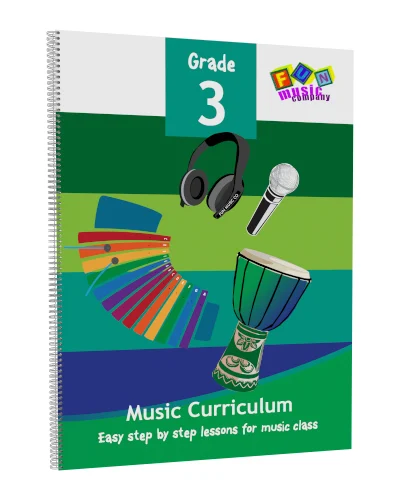
The Grade 3 Music Curriculum
The Grade 3 program builds directly on the Years 1 and 2 foundation with 40 weeks of fully planned lessons across all four strands—SKILLS, SING & PLAY, COMPOSE and CONNECT. Notation is introduced progressively, ensemble skills develop through a rich international repertoire with notation-based parts, and composition becomes genuinely intentional. Designed to be taught by any classroom teacher regardless of music background.
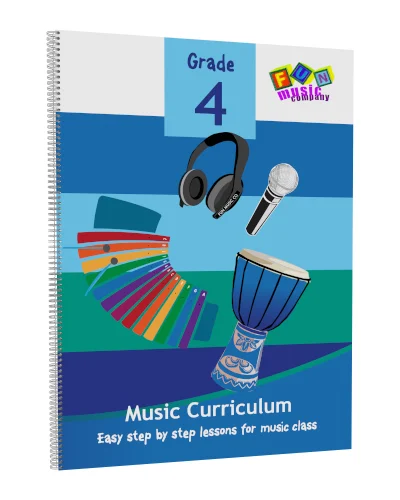
The Grade 4 Music Curriculum
The Grade 4 program deepens and extends everything established in Grade 3. Notation literacy grows, composition projects become more sustained and more musically complex, the SING & PLAY repertoire expands to new cultural traditions, and students’ listening and responding skills are stretched across a wider range of historical and cultural contexts. Every lesson is clear, step-by-step, and ready to use from the moment you open it.
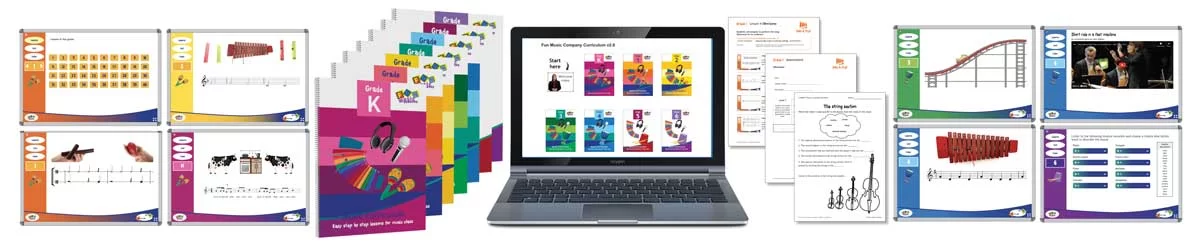
Or, if you’re looking to cover the full K–6 journey in one place, explore the complete Fun Music Company K–6 Curriculum Program—all seven grade levels, all four strands, fully planned and ready to teach.


Leave A Comment