


Australian Curriculum Music v9:
Years 5–6 Explained for Primary Teachers
Years 5 and 6 are the final band of the Australian Curriculum v9 for Music in primary school, and they represent a really exciting destination. By this stage, the curriculum has moved a long way from the foundational listening and exploring activities of the early years.
Students are now expected to perform music in formal as well as informal settings, to compose with compositional devices and document their work in notation or recordings, and to evaluate music from across cultures and times using musical terminology they have developed across the primary years.
For teachers, these two years are the payoff—where everything that has been built since Foundation Year comes together in music-making that is confident, ambitious and expressive.
The Australian Curriculum v9 groups Years 5 and 6 as a single band with shared content statements and a combined achievement standard, giving schools flexibility in how they sequence the two years while ensuring both are working toward the same set of outcomes.
For a full overview of how the curriculum progresses from Foundation through to Year 6, see our Australian Curriculum Music v9: Complete Guide for Primary Teachers.
What’s Different About the Years 5–6 Band
The step up from the Years 3–4 band to Years 5–6 is the most significant progression in the K–6 curriculum sequence. Across all four strands, the language of the content statements shifts in important ways. In the performing strand, students move from ‘informal settings’ to ‘informal and/or formal settings’—meaning performance for a real audience is now explicitly expected.
In the composition strand, students must now ‘notate, document and/or record’ their work, adding a layer of accountability to the creative process. In the skills strand, the focus sharpens to manipulating elements of music ‘to achieve expressive effects’—not just developing the skills, but deploying them with intentional artistic purpose.
In the exploring and responding strand, two new ideas appear: students explore how elements of music are ‘combined’ across musical contexts, and how First Nations Australians use music to ‘continue and revitalise’ culture—a meaningfully different emphasis from the Years 3–4 focus on Country/Place.
The Fun Music Company Years 5 and 6 programs are designed to meet students exactly where they are and take them all the way to these outcomes—whether they arrive with years of musical experience or are coming to a structured music program for the first time.
What Students Should Be Able to Do by the End of Year 6
The Australian Curriculum v9 achievement standard describes what students are expected to know and demonstrate by the end of Year 6:
By the end of Year 6, students explain how elements of music are combined and how compositional devices are used in music they compose, perform and/or experience. They explain how and why music from different cultural contexts is composed and/or performed.
Students demonstrate listening skills when performing and composing. They manipulate elements of music and use compositional devices to compose music that communicates ideas. They perform music in a range of forms they have learnt and/or composed in informal and/or formal settings.
Source: Australian Curriculum, Assessment and Reporting Authority (ACARA), Australian Curriculum v9.0 Music. Licensed under CC BY 4.0.
In plain language, by the end of Year 6 students should be able to explain—not just describe—how elements of music work together and how compositional devices create particular effects. They should be able to articulate something meaningful about why music from different cultural contexts sounds the way it does and why it exists. Their listening should actively shape the decisions they make as performers and composers. And they should be creating their own music that uses elements and devices with deliberate expressive intent, performing it in settings that include a real audience.
The shift from ‘describe’ in Year 4 to ‘explain’ in Year 6 is the curriculum’s clearest signal of the depth of musical understanding expected by the end of primary school—and it’s an achievable outcome when students have had well-structured musical experiences across the primary years.
The Four Strands of the Australian Curriculum v9 in Years 5 and 6
The same four interrelated strands continue from earlier years, but with content statements that now expect students to work at a sophisticated level across all four. Here is what each strand requires and how the Fun Music Company program addresses it.
Strand 1: Developing Practices and Skills (SKILLS)
Content statement:
Develop listening/aural skills and skills for manipulating elements of music to achieve expressive effects when composing, singing and playing instruments. (AC9AMU6D01)
Source: Australian Curriculum, Assessment and Reporting Authority (ACARA), Australian Curriculum v9.0 Music. Licensed under CC BY 4.0.
The Years 5–6 SKILLS content statement introduces two important additions from the Years 3–4 version. First, ‘aural skills’ is added explicitly alongside listening skills—recognising that by this stage students should be developing the ability to hear and identify musical elements by ear, not just respond to them. Second, and perhaps most significantly, the statement now specifies that skills are being developed ‘to achieve expressive effects’—adding a purposeful, artistic dimension that was absent from the earlier version. It’s not enough to manipulate elements of music; students should be doing so with a specific expressive outcome in mind. The statement also adds ‘when composing’ alongside singing and playing, formally linking aural and skill development to the compositional work of the COMPOSE strand.
In Year 5, the SKILLS unit covers complex rhythm patterns including hip-hop rhythmic styles and compound time, treble and bass clef pitch notation, dynamic markings and control, form in music, accents and articulation, and discrimination between straight and swung rhythmic feels. The solfège with pitch matching activities—which first appeared in Year 2—continue at increasing levels of sophistication, developing students’ ability to identify and reproduce pitch by ear.
Year 6 builds this further. Students work on scale and arpeggio recognition both aurally and in notation, accents and articulations, legato and staccato phrasing, triplets and compound time, and continued development of dynamic control. The ‘Don’t clap back’ games—asking students to distinguish between straight and swung rhythms—develop a subtlety of rhythmic discrimination that directly supports the more complex ensemble work of the SING & PLAY unit.
Throughout both years, the notation worksheets that were introduced in Years 3 and 4 are extended into new territory: scales and arpeggios, accents and other articulations, triplets, timbre, and song form. By the end of Year 6, students have a comprehensive toolkit of music reading and listening skills—enough to engage with almost any piece of age-appropriate music as an informed performer or listener.
Strand 2: Presenting and Performing (SING & PLAY)
Content statement:
Perform music in a range of forms they have learnt and/or composed in informal and/or formal settings. (AC9AMU6P01)
Source: Australian Curriculum, Assessment and Reporting Authority (ACARA), Australian Curriculum v9.0 Music. Licensed under CC BY 4.0.
The performing content statement for Years 5 and 6 introduces two significant changes from the Years 3–4 version. First, students must now perform music ‘in a range of forms’—not just the single genre or style of individual songs, but across genuinely different musical formats. Second, performance is now expected in ‘informal and/or formal settings’—meaning performing for a real audience is an explicit curriculum requirement, not an optional extension.
To meet these requirements, the Fun Music Company SING & PLAY unit in Years 5 and 6 makes a deliberate and exciting structural shift from the lower primary years. Rather than individual songs with percussion accompaniment, the unit is built around two ensemble formats: Marimba Band and Bucket Drumming. Each format provides a full sequence of four pieces across 20 lessons, with students learning bass, harmony and melody parts progressively before bringing them together as an ensemble.
Marimba Band develops students’ ability to read from notation, maintain independent parts within an ensemble, and perform pieces that span a range of musical styles—from calypso and jazz to contemporary and Latin-influenced works. Students develop genuine instrumental technique alongside ensemble skills: balance, dynamics, listening across the group, and the kind of musical responsiveness that comes from sustained ensemble rehearsal.
Bucket Drumming provides a rhythmically demanding ensemble experience that develops precision, groove, dynamic control, and the ability to maintain complex rhythmic patterns within a group. The pieces in Years 5 and 6 are genuinely exciting for students to play and for audiences to watch—making them ideal for the formal performance settings the curriculum now requires. Year 6 pieces build on the rhythmic vocabulary established in Year 5, adding improvisation sections and more complex rhythmic layering.
The two-format structure also means that students in Years 5 and 6 are performing in genuinely different musical forms—melodic ensemble and rhythmic ensemble—directly satisfying the curriculum’s requirement that performance spans ‘a range of forms.’ By the end of Year 6, students have experienced the full arc of ensemble performance: learning parts from notation, rehearsing together, refining for performance, and presenting to an audience.
Strand 3: Creating and Making (COMPOSE)
Content statement:
Manipulate elements of music and use compositional devices to communicate ideas, perspectives and/or meaning when composing and practising music for performance, and notate, document and/or record the music they compose. (AC9AMU6C01)
Source: Australian Curriculum, Assessment and Reporting Authority (ACARA), Australian Curriculum v9.0 Music. Licensed under CC BY 4.0.
This is the most demanding content statement in the primary music curriculum, and it introduces two important new requirements. First, students must now use ‘compositional devices’—not just elements of music. Compositional devices include things like repetition, contrast, ostinato, call and response, and variation: techniques that composers use to shape and structure musical ideas over time. Second, students must ‘notate, document and/or record’ their compositions. This accountability to a finished, documented work is a genuine shift from the more exploratory composition activities of the lower primary years.
The Fun Music Company COMPOSE unit in Years 5 and 6 addresses these requirements through a project-based structure—four distinct composition projects per year, each exploring a different starting point and set of compositional tools.
In Year 5, the four projects are: improvise to compose (using the pentatonic scale, with notation and sequencing software); musical ingredients (starting from a given rhythm, melody or chord progression and developing it into a complete composition); starting with words (creating a four-line chant, then building a backing beat and melody using digital tools); and musical emotions (composing a piece based on a specific emotion, using digital tools to expand and refine it). Each project culminates in a presentation to the class with self-evaluation—building the reflective practice the achievement standard describes.
Year 6 extends this with five projects: starting with a melodic fragment (developing it using contrast, repetition and balance, adding parts with digital tools); musical landscapes (using a landscape image as compositional inspiration, working collaboratively to add parts and create notation); improvise to compose (recording improvisations in a sequencing application and developing them into multi-track pieces); vocal raps (creating a four-line chant with a backing beat and recorded vocals); and creating a film score (choosing a public domain movie clip and composing music for it using software). The film score project in particular is a genuinely sophisticated undertaking that draws on everything students have learned about elements of music, compositional devices, and expressive intent across the primary years.
Across both years, the mix of technology and non-technology projects is deliberate. In Grade 5, Projects 1 and 3 use sequencing apps and recording software, while Projects 2 and 4 don’t require any technology at all. Whether your school has ready access to devices or not, there’s a pathway through the unit that works for your context — and either way, students are meeting the curriculum’s requirement to notate, document and/or record their compositions.
Strand 4: Exploring and Responding (CONNECT)
Content statements:
Explore ways that the elements of music are combined in music across cultures, times, places and/or other contexts. (AC9AMU6E01)
Explore ways First Nations Australians use music to continue and revitalise culture. (AC9AMU6E02)
Source: Australian Curriculum, Assessment and Reporting Authority (ACARA), Australian Curriculum v9.0 Music. Licensed under CC BY 4.0.
The exploring and responding strand in Years 5 and 6 makes two meaningful shifts from the Years 3–4 version. The first content statement now asks students to explore how elements of music are ‘combined’—a more analytical lens than the Years 3–4 focus on where and why music is composed and performed. Students are now expected to listen with enough sophistication to identify and describe how multiple elements interact to create a musical effect.
The second content statement makes an equally significant shift. Where Years 3 and 4 required students to explore how First Nations Australians use music to communicate their connection to and responsibility for Country/Place, Years 5 and 6 ask students to explore how First Nations Australians use music to ‘continue and revitalise’ culture. This is a forward-looking lens—it asks students to understand music as a living, evolving expression of cultural identity, not just a historical or spiritual practice.
The Fun Music Company CONNECT unit addresses both content statements through twenty guided listening activities in each of Year 5 and Year 6, drawing on a wide range of musical traditions, genres and cultural contexts. In both years, the unit opens with First Nations Australian music—exploring how music is being used to carry culture forward into the present—before moving through classical orchestral works, contemporary classical, jazz, rock, pop, and world music from across Africa, Asia, Latin America, Europe and the Pacific. Each activity is designed to develop students’ capacity to listen analytically as well as responsively, building the musical vocabulary and critical ear the achievement standard requires.
By the end of Year 6, students are equipped to engage with music from any tradition as informed, articulate listeners—which is exactly what the curriculum intends as the goal of primary music education.
What a Well-Structured Years 5–6 Music Program Looks Like
Years 5 and 6 are where primary music education gets to be a little bit ambitious—and genuinely fun. Students at this level are capable of real ensemble performance, sophisticated composition, and thoughtful musical analysis. A well-structured program gives them the opportunity to do all three, in a way that feels challenging and exciting rather than overwhelming.
The key hallmarks are: ensemble performance experience that includes formal performance for an audience; composition projects that use compositional devices with deliberate artistic intention and result in documented, finished works; listening activities that develop analytical skills alongside personal response; and First Nations Australian music explored as living, evolving culture rather than historical artefact. And all of it delivered in a way that any classroom teacher can lead with confidence, regardless of their musical background.
The Fun Music Company Years 5 and 6 programs are built around exactly this vision. Whether your students are arriving with years of rich musical experience or encountering a structured program for the first time, every lesson is designed to meet them where they are, develop their skills progressively, and give them musical experiences they’ll enjoy and remember.
Frequently Asked Questions
Absolutely. The Fun Music Company Years 5 and 6 programs are designed to be accessible for students at any starting point. The Marimba Band and Bucket Drumming pieces are scaffolded carefully—students learn bass parts first, then harmony, then melody, building confidence and ensemble skill progressively. The COMPOSE projects are structured so that students are always working from a concrete starting point rather than a blank page. And the SKILLS and CONNECT units develop musical vocabulary and listening skills from the ground up within each year. Students who are newer to music will move through the material at their own pace and still have genuinely rewarding musical experiences—the program meets them where they are.
In Years 3 and 4, the curriculum asks students to explore how First Nations Australians use music to communicate their connection to and responsibility for Country/Place. In Years 5 and 6, the focus shifts to how First Nations Australians use music to ‘continue and revitalise’ culture. This is a subtle but important difference: it asks students to understand music as a living, forward-looking expression of cultural identity—not just a traditional or historical practice. The Fun Music Company CONNECT unit opens each year with First Nations Australian music explored through this lens, setting the tone for a year of listening that is genuinely analytical, respectful and culturally informed.
The short answer is: it depends on what works for your school, and we’ve deliberately built it that way. The COMPOSE unit in Years 5 and 6 includes a mix of technology-based and non-technology projects, so you can choose what suits your context. In Grade 5, Projects 1 and 3 use technology such as sequencing apps and recording software, while Projects 2 and 4 don’t require it at all. Whether your school has a laptop trolley that’s always booked out or a class set of iPads that students are expected to use every lesson, there’s a pathway through the unit that works for you. You can run all four projects, or pick the ones that fit your situation — either way, students are meeting the curriculum’s requirement to notate, document and/or record their compositions.
Compositional devices are the techniques composers use to shape and structure musical ideas over time—things like repetition (using a musical idea more than once), contrast (introducing something different), ostinato (a repeating rhythmic or melodic pattern), call and response (a musical conversation between parts), and variation (taking a theme and changing elements of it). In the Fun Music Company COMPOSE unit, these devices are introduced practically through the composition projects rather than as abstract theory. Students encounter repetition and contrast when they work with their own melodic fragments in Year 6; they work with ostinato in the improvisation projects; they use call and response structures in their vocal rap and chant projects. The devices are tools for making music, not vocabulary to memorise.
The shift to Marimba Band and Bucket Drumming in Years 5 and 6 is a direct response to the curriculum’s requirement that students perform music ‘in a range of forms’ in ‘informal and/or formal settings.’ Individual songs with percussion accompaniment—the format that works beautifully in Years 1 through 4—doesn’t give students the ensemble depth, the formal performance experience, or the range of musical forms the upper primary curriculum requires. Marimba Band and Bucket Drumming do. They also happen to be formats that students find genuinely exciting to play and that make a real impression on audiences—which makes them ideal for the school concert or assembly performance the curriculum now explicitly expects.
Ready to Teach Years 5 and 6 Music with Confidence?
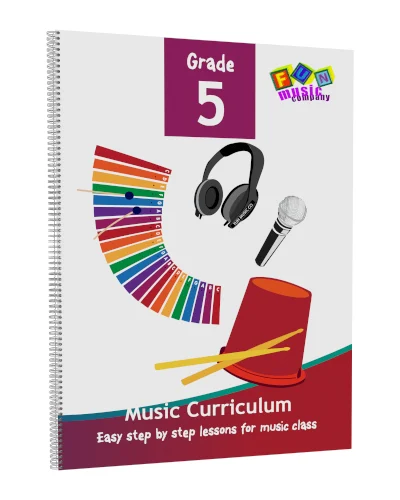
The Fun Music Company Grade 5 and Grade 6 curriculum programs are fully planned, ready-to-teach, and aligned to the Australian Curriculum v9. Each grade is available individually so you can start exactly where your students are.
The Grade 5 Music Curriculum
The Grade 5 program introduces Marimba Band and Bucket Drumming ensemble performance, four project-based composition units using digital tools, a full notation and listening skills sequence, and twenty guided CONNECT listening activities. Every lesson is clear, step-by-step, and designed to be delivered by any classroom teacher regardless of musical background.
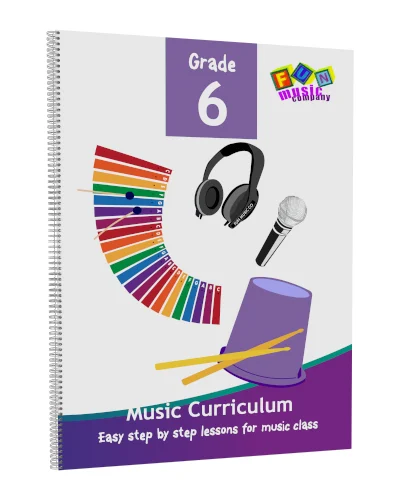
The Grade 6 Music Curriculum
The Grade 6 program builds on Year 5 with more complex ensemble pieces, five composition projects including film score composition, extended notation and analytical listening skills, and a CONNECT sequence that brings students’ musical understanding to its primary school peak. A fitting and exciting conclusion to the K–6 music journey.
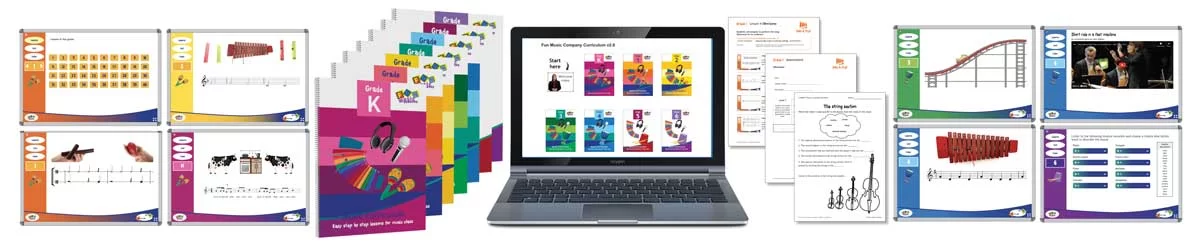
Or, if you’re looking to cover the full K–6 journey in one place, explore the complete Fun Music Company K–6 Curriculum Program—all seven grade levels, all four strands, fully planned and ready to teach.


Leave A Comment