


Boomwhackers for the Classroom – Everything You Need to Get Started
Boomwhackers are colour-coded hollow plastic tubes used in primary school music classrooms worldwide. Each tube produces a distinct musical pitch when struck — longer tubes for lower notes, shorter tubes for higher notes — with a colour-coding system that allows students and teachers with no prior musical background to play ensemble music together from the very first lesson.
Invented in the 1990s by Craig Ramsay, Boomwhackers are now one of the most widely used pitched percussion instruments in K–6 music education, valued for their accessibility, durability, and ability to teach genuine musical concepts including pitch, rhythm, notation, and ensemble playing.
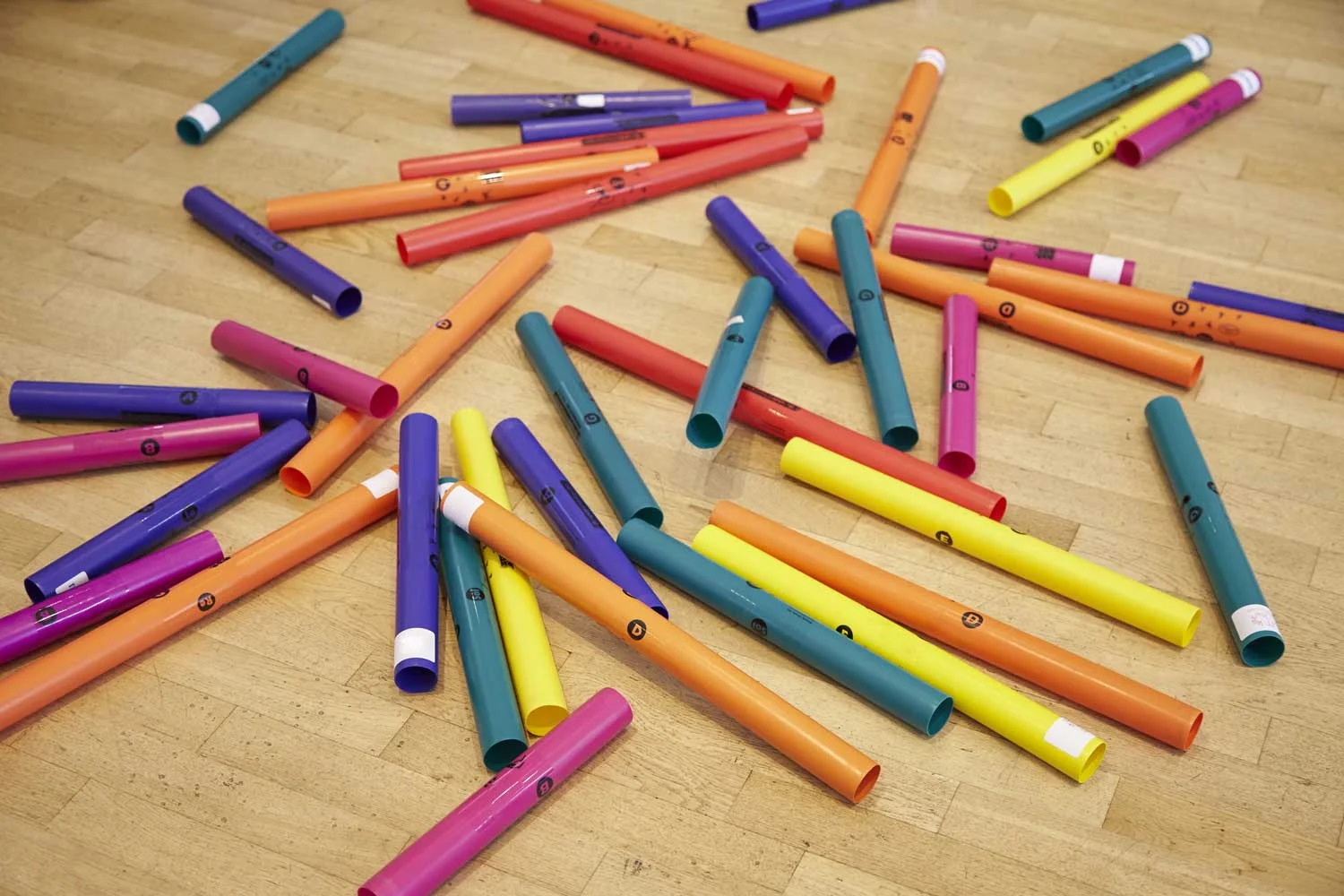
Got some of these plastic tubes lying around in your classroom?
Has someone helpfully suggested to you when looking for activities for primary school music.. why don’t you try Boomwhackers?
Whether you’ve never used Boomwhackers before or you’ve had a set gathering dust in the storeroom for years, this guide is going to give you everything you need to get started with confidence. We’re talking about what they are, how they work, how to play them correctly (yes, there are wrong ways — and they’ll cost you in damaged instruments!), and how to actually use them in a real classroom.
Plus, we’ll share some free Boomwhacker resources you can use tomorrow — and show you how the Fun Music Company Curriculum takes all the planning off your plate entirely.
Let’s dive in.
What Are Boomwhackers?
Boomwhackers are colour-coded, hollow plastic tubes that produce a musical pitch when struck. Each tube is a different length — longer tubes produce lower notes, shorter tubes produce higher notes. The magic is in the colours: every note in the musical scale is assigned its own colour, which means students (and teachers!) don’t need to know anything about music notation to start making music together.
They were invented in the 1990s by Craig Ramsay, a musician and educator who wanted to create an instrument that was genuinely accessible — something that could turn any group of people into an instant ensemble, regardless of musical background. He succeeded brilliantly.
Here’s why Boomwhackers work so well with children:
- No prior experience needed. Any child who can identify a colour can play a Boomwhacker part.
- They’re kinaesthetic. Children are physically making music — moving their bodies, hitting the tubes, responding to sound. It’s active learning at its best.
- They’re inclusive. Every student in the class gets a part. There’s no ‘I can’t do this’ with Boomwhackers.
- They scale from simple to complex. A kindergarten class can do basic colour-matching rhythms; a Grade 6 class can perform full ensemble arrangements. The same instrument, years of curriculum potential.
- They’re durable and affordable. A decent set of Boomwhackers can last years with proper care — making them one of the best value classroom music investments available.
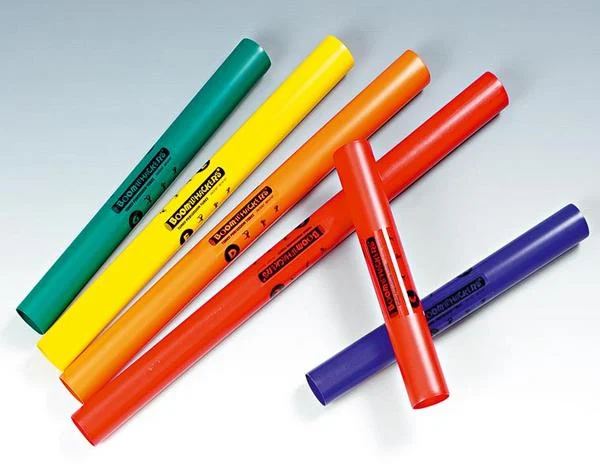
For teachers who feel nervous about music — whether that’s because you’re a generalist classroom teacher covering music, or a specialist who hasn’t used Boomwhackers before — this is the instrument that makes music teaching feel genuinely achievable.
Here at the Fun Music Company we have a full collection of Boomwhacker songs, Boomwhacker games and activities , and a complete boomwhacker lesson plan guide designed specifically for K–6 classroom use — so wherever you’re starting from, we’ve got you covered.”
The Boomwhacker Colours
With Boomwhackers, the colour is everything. Once your students are familiar with the Boomwhacker colours, they can read colour charts, follow colour-coded arrangements, and play ensemble music much more effectively.
Here’s the complete Boomwhacker colour chart for the standard diatonic set (C major scale):
The Standard Diatonic Set Colour Chart
| Colour | Note | Solfège | Hex Code * | |
|---|---|---|---|---|
| Red | C | Do | #EB2427 | |
| Orange | D | Re | #F6851F | |
| Yellow | E | Mi | #FBED1B | |
| Light Green | F | Fa | #6BBE46 | |
| Dark Green | G | Sol | #0C9648 | |
| Purple | A | La | #80539F | |
| Magenta | B | Ti | #E14197 | |
| Red | C | Do | #EB2427 |
* These are not “official” Boomwhacker Colour Hex Codes. You may have noticed these hex codes are hard to find online. That’s because, according to Rhythm Band Instruments (the manufacturers of Boomwhackers), there are no official digital hex codes — the plastic manufacturing process doesn’t translate directly to screen colour values. The codes in this chart are the closest we have found to a digital representations of the physical tubes, and are the best available reference for creating your own colour-coded materials.
Chromatic Set Colour Chart
| Colour | Note | Solfège | Hex Code * | |
|---|---|---|---|---|
| Red-Orange | C#/Db | Di/Ra | #EF4D27 | |
| Orange-Yellow | D#/Eb | Ri/Me | #FFC000 | |
| Mid-Green | F#/Gb | Fi/Se | #6BBE46 | |
| Blue | G#/Ab | Si/Le | #1500FF | |
| Violet-Purple | A#/Bb | Li/Te | #C800FF |
A Quick Note on the High C Boomwhacker
You’ll notice that high C is the same colour as low C — red. This is intentional! It reinforces the musical concept that notes with the same letter name belong together (octave equivalence). It can confuse students at first, but it’s actually a wonderful teaching moment: ‘same colour, same note name — but an octave apart.
Which leads to a fun teaching opportunity…
Boomwhackers and the Science of Sound: A Cross-Curriculum Opportunity
Here’s something most teachers don’t realise: Boomwhackers aren’t just a music tool. For older students, they’re a hands-on gateway into the science of sound — and the connection is built right into the instrument itself.
Try this activity with your class. Hold the low C (large red tube) and the high C (small red tube) up side by side, and ask students:
“What do you notice about these two tubes?”
They’ll immediately spot that one is longer than the other. Push it a little further:
“How much longer, do you think?”
Give students time to look, measure, and discuss. Eventually someone will notice — or you can reveal — that the high C tube is exactly half the length of the low C tube. That’s not a coincidence. That’s physics.
When a tube (or a string, or a column of air) is halved in length, it vibrates at exactly double the frequency — and double the frequency produces a note that is precisely one octave higher. This is one of the most elegant and consistent relationships in all of acoustics, and your students are holding the proof of it in their hands.
If you have access to a guitar, violin, or any other string instrument, you can take this even further. Show students how pressing a finger at the halfway point of a string — the 12th fret on a guitar — produces a note exactly one octave higher than the open string. The same principle, a different instrument, the same result.
Curriculum Connection with Science
This activity links naturally to science strands covering sound, vibration, and waves in upper primary. It’s a genuine cross-curriculum moment that gives music class academic weight — and gives science class a memorable, concrete example. For teachers who need to justify music time to school leadership, this kind of explicit curriculum connection is gold.
Recommended Boomwhackers for the Classroom
If you’re buying Boomwhackers for the first time — or advising your school on what to purchase — here’s the straightforward guide. There are several sets available, and it’s easy to over-invest in equipment you don’t actually need.
The standard diatonic set of Boomwhackers
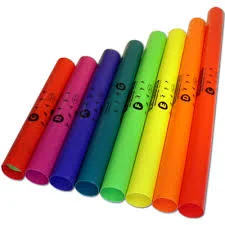
If you’re buying Boomwhackers for the first time — or advising your school on what to purchase — here’s the straightforward guide. There are several sets available, and it’s easy to over-invest in equipment you don’t actually need.
The standard diatonic set covers C–C (a full major scale).
The 8-Note C Major Diatonic Set is the one to buy first, and for most classroom teachers, it’s the only set you’ll ever need. It covers all eight notes of the C major scale (C, D, E, F, G, A, B, and high C) — the white keys on a piano — and it’s the set that every Boomwhacker song, activity, and curriculum resource is built around.
One set gives you eight pitches. For a class of 25–30 students, aim for five to six sets so that multiple students can share each pitch and the whole class can play simultaneously. The more you can have the better. We would recommend even getting up to eight up to ten sets of this set, prior to purchasing any chromatic or extension tubes.
The Chromatic Set: Useful, But Not Essential
The 5-Note Chromatics Set adds the sharps and flats — C#, D#, F#, G# and A# — which are the black keys on a piano. Combined with the diatonic set, you have a full chromatic octave if you add these.
This is a worthwhile addition if you want to expand your repertoire to songs that require sharps or flats, or if you’re working with more advanced students on harmony and chord work. But most schools don’t need it to start — the diatonic set covers the vast majority of classroom songs and activities, and it’s significantly easier to manage with a full class.
Buy the diatonic set first. Add the chromatic set ONLY later if the need arises.
Bass Boomwhackers: Amazing to See, But Not a Priority
The Bass Diatonic Set produces notes a full octave lower than the standard set — and when you see them played, they’re genuinely spectacular. The tubes are enormous (up to 50 inches long!) and the sound is rich and resonant. Students love them.
That said, they’re not required for the majority of classroom activities, and the cost and storage demands are significant. If you’re building a Boomwhacker program from scratch, bass tubes are a nice addition further down the track — not a day-one purchase.
A Better Way to Get Bass Notes: Octavator Caps
Here’s the tip that experienced Boomwhacker teachers know: if you want to add bass notes to your classroom without the expense and storage challenge of full bass tubes, get Octavator Caps instead.
Octavator Caps are black plastic caps that fit over the open end of a standard Boomwhacker tube. Capping a tube lowers the pitch by exactly one octave — so your standard C tube becomes a bass C, your G tube becomes a bass G, and so on. They’re inexpensive, easy to store, and they turn your existing diatonic set into a two-octave instrument in seconds.
Quick summary — what to buy: Start with 5-6 diatonic sets. Add Octavator Caps for bass notes. Add the chromatic set if and when your program grows. Bass tubes are a bonus, not a necessity.
Where to Buy Boomwhackers
A quick note on this: we have professional relationships with the suppliers listed below, but we receive no commissions or referral fees from them. We mention them simply because they’re the most reliable options we know, and we want to save you the hassle of searching.
In Australia: We recommend Optimum Percussion. They’re the most well-known and reputable supplier of percussion instruments for Australian schools, and they ship to every state. If you’re a school purchasing officer, they’re the easiest and most reliable place to start.
In the USA: Go straight to Rhythm Band Instruments — the manufacturers of Boomwhackers. Buy direct from them if you can, or alternatively through one of their many retail partners. Buying direct from the manufacturer means you’re getting the genuine article, and their school ordering process is well established.
Internationally and elsewhere: Boomwhackers are also widely available through Amazon.com and most music education retailers. If you’re outside Australia or the USA, check with your local school music supplier first — Boomwhackers are stocked widely enough that you likely won’t need to import them.
How to Play Boomwhackers: The 3 Main Methods
This is the section most teachers don’t think to look up — until they’ve got a class full of bent, dented tubes and students complaining their hands hurt!
Here’s a direct answer: Boomwhackers are light plastic tubes, and they can be damaged surprisingly easily by students playing them too hard. Before you hand out a single tube, take five minutes to teach these playing methods properly. Your Boomwhackers will last years instead of months.
Here is a description of how to play boomwhackers on video:
Method 1: Play-in-the-Hand (The Standard Method)
Hold the Boomwhacker in one hand and tap it gently into the open palm of your other hand. This is the most common classroom method — it’s easy to teach, easy to control, and works well for seated activities.
The most common issue? Students hitting too hard.
When students say ‘my hand hurts!’ — you’ll know they’re hitting too hard!
That should be obvious, but sometimes it isn’t to nine year old school students!
Remind students that the goal is always to produce a clear, musical tone, not the loudest possible sound. Remind them: a gentle strike produces a lovely, resonant tone. A hard strike produces a thud — and eventually a dent.
What about playing on knees, thighs or other body parts?
You do what works for your classroom. Students can sit in chairs and play on their knees, or stand and hit their thighs. Likely, you’ll get the same issue… “My knees hurt!” Which, of course needs the same response “Don’t play so loud!”
Boomwhacker Playing Method #1
Playing into the other hand

Method 2: Playing Boomwhackers on the Carpet
Sitting on the floor and striking the Boomwhacker against the carpet is a great option for younger students or activities where everyone needs to be at the same level.
There are actually two variations of this carpet method:
1. Tap the end of the tube onto the carpet (the more obvious approach).
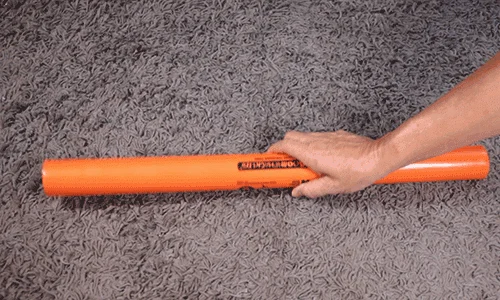
2. Place the back edge of the tube in contact with the carpet and strike the full length of the tube flat against the carpet (the lever method).
The lever method is actually much better for the longevity of your Boomwhackers — students physically cannot bend the tubes this way. The trade-off is that it’s a trickier technique to teach younger children, so you may choose the simpler tap method and compensate by being strict about not hitting too hard.
One important warning: avoid hard floors. Carpet absorbs impact — hard floors don’t, and repeated striking on hard surfaces will dent and warp your Boomwhackers quickly.
Boomwhacker Playing Method #2
Playing on carpet
Hitting the end on the carpet
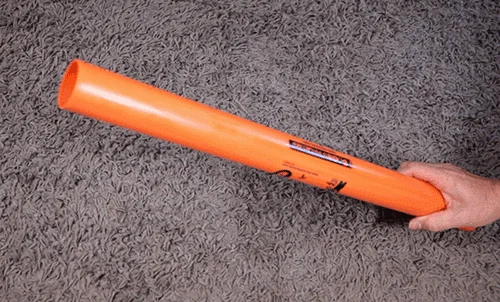
Hitting the entire edge on the carpet
(The lever method)
Method 3: Over a Chair Back
For performances and ensemble work, students can stand behind chairs and strike the Boomwhacker against the top of the chair back. This looks fantastic in a performance setting — you get a neat row of students, each in position, with their tube ready to play.
This method only works if your chairs have the right kind of padded or rounded back rest (hard plastic chair backs aren’t ideal). And as with every method: be strict about hitting too hard. Light plastic tubes struck against a hard surface repeatedly will dent and lose their tone over time. But played carefully and musically? They sound great this way.
Boomwhacker Playing Method #3
Playing on a chair back

How to Use Boomwhackers in Your Classroom
Now that you know how they work and how to play them, let’s talk about the practical side of actually running a Boomwhacker class. This is where a lot of teachers get overwhelmed — but with a clear system, it’s very manageable.
Organising Students by Colour Group
The most effective classroom setup is to assign students to a colour group. Each group is responsible for one pitch. When their colour appears in the music, they play. We advise having students playing the same pitch to sit together. As well as making it easier to manage, it’s also easier to hand out and collect the boomwhackers if the students are sitting together in groups.
Most boomwhacker songs will use between 4 and 6 pitches. That means you’ll want to have 4 to 6 groups in your class, with 5 to 8 students in each group.
Establishing Classroom Management Rules with Boomwhackers
Safety First!
Establish your rules before a single tube leaves the storage area:
- Boomwhackers are musical instruments, not weapons. They are never to be swung, thrown, or used to hit another person.
- We play gently — our goal is a musical tone, not a loud bang.
- Boomwhackers stay in your hands until the teacher says to put them down.
- When we’re not playing, the Boomwhacker rests on our lap or on the floor in front of us.
Most experienced Boomwhacker teachers spend the first few minutes of the very first lesson explicitly teaching and practising these rules. It pays dividends for every lesson that follows.
If you’d like to see how all of these elements come together in practice, we’ve put together a complete boomwhacker lesson plan that walks you through a full K–6 lesson from start to finish.
Boomwhackers and the Australian Curriculum
Boomwhackers are one of the most practical instruments available to Australian primary teachers for delivering the requirements of the Australian Curriculum v9: The Arts (Music). Across all year-level bands from Foundation to Year 6, the curriculum requires students to develop skills in making and responding to music — and Boomwhackers support both strands in ways that are accessible to specialist and generalist teachers alike.
Foundation and Years 1–2
At Foundation level, the Australian Curriculum requires students to explore and express musical ideas through play and structured activity. Boomwhackers are ideally suited to this stage — the colour-coding system removes the barrier of music notation entirely, allowing even the youngest students to participate in ensemble music-making immediately. Students experience pitch relationships, steady beat, and simple melodic patterns through direct physical engagement, which aligns with the curriculum’s emphasis on kinaesthetic and aural learning in the early years.
In Years 1 and 2, as students begin developing more structured musical understanding, Boomwhackers support the introduction of colour-coded notation alongside traditional staff notation — building the bridge between sound and symbol that underpins music literacy development throughout the primary years.
Years 3–4 and Years 5–6
As students progress into the middle and upper primary years, the Australian Curriculum expects increasing sophistication in music-making, including ensemble performance, rhythmic complexity, and an understanding of musical structure and form. Boomwhackers remain a valuable tool at these levels — particularly for ensemble work, cross-curricular science connections (the physics of sound and tube length), and as a bridge instrument while students develop skills on more complex tuned percussion.
The Fun Music Company Curriculum sequences Boomwhacker use deliberately across all six year levels, ensuring that each stage of the Australian Curriculum is addressed with age-appropriate activities and progressively more demanding musical content.
For Generalist Classroom Teachers
One of the most significant advantages of Boomwhackers in the Australian primary context is that they are genuinely teachable by non-specialist teachers. The colour-coded system means that a classroom teacher without a music background can deliver a structured, curriculum-aligned music lesson without needing to read music or play an instrument. For many Australian primary schools — where music is taught by generalist classroom teachers rather than music specialists — this makes Boomwhackers one of the most practical curriculum delivery tools available.
Do Boomwhackers Actually Work? What Teachers and Research Tell Us
It’s a fair question. Boomwhackers look like fun — but do they deliver real musical learning outcomes?
The evidence from classroom practice and music education research consistently says yes, when they are used as part of a structured, sequenced program rather than as a novelty activity.
Pitch and tonal awareness
Because every Boomwhacker is tuned to a specific pitch, students are constantly hearing and producing accurate intervals and melodic relationships. Research into colour-coded pitched percussion instruments consistently shows improvements in pitch discrimination and tonal memory in early primary students — outcomes that carry over into singing accuracy and instrumental music learning.
Rhythmic development
Ensemble Boomwhacker playing requires students to listen, count, and respond in time with others. This active rhythmic engagement — particularly when combined with movement and conducting cues — has been shown to improve steady beat internalisation, which is one of the strongest predictors of broader music literacy development.
Music notation literacy
The Fun Music Company’s approach of displaying colour-coded notation alongside traditional staff notation from Kindergarten onwards creates an exposure-based pathway to music reading. Students who have spent two to three years tracking colour-coded scores are measurably better prepared to transition to traditional notation than students who have had no structured notation exposure.
Engagement and inclusion
In Australian primary classrooms, where students arrive with widely varying musical backgrounds and experiences, Boomwhackers consistently produce high levels of engagement across ability levels. Every student has a part. No student is excluded by inability to read music or play a technically demanding instrument. This inclusive quality is not incidental — it is one of the primary reasons Boomwhackers have become a fixture in K–6 music programs worldwide.
Free Boomwhacker Resources and Activities
The best way to understand what Boomwhackers can do in a classroom is to see them in action. We’ve put together two free complete lessons — one for Kindergarten and one for Grade 2 — so you can try this with your own students right away.
Each one includes a video you can watch to fully understand the activity, plus everything you need to teach this in the classroom.
Free Activity #1: ‘A Sailor Went to Sea’ — Kindergarten
What if you could teach young children to read music without them even realising they’re learning?
That’s exactly what this Kindergarten activity does.
When we work with Kindergarten students, we want them playing instruments and making music right away. But here’s the challenge — they can’t read music yet. So how do we get a whole class playing together in an ensemble?
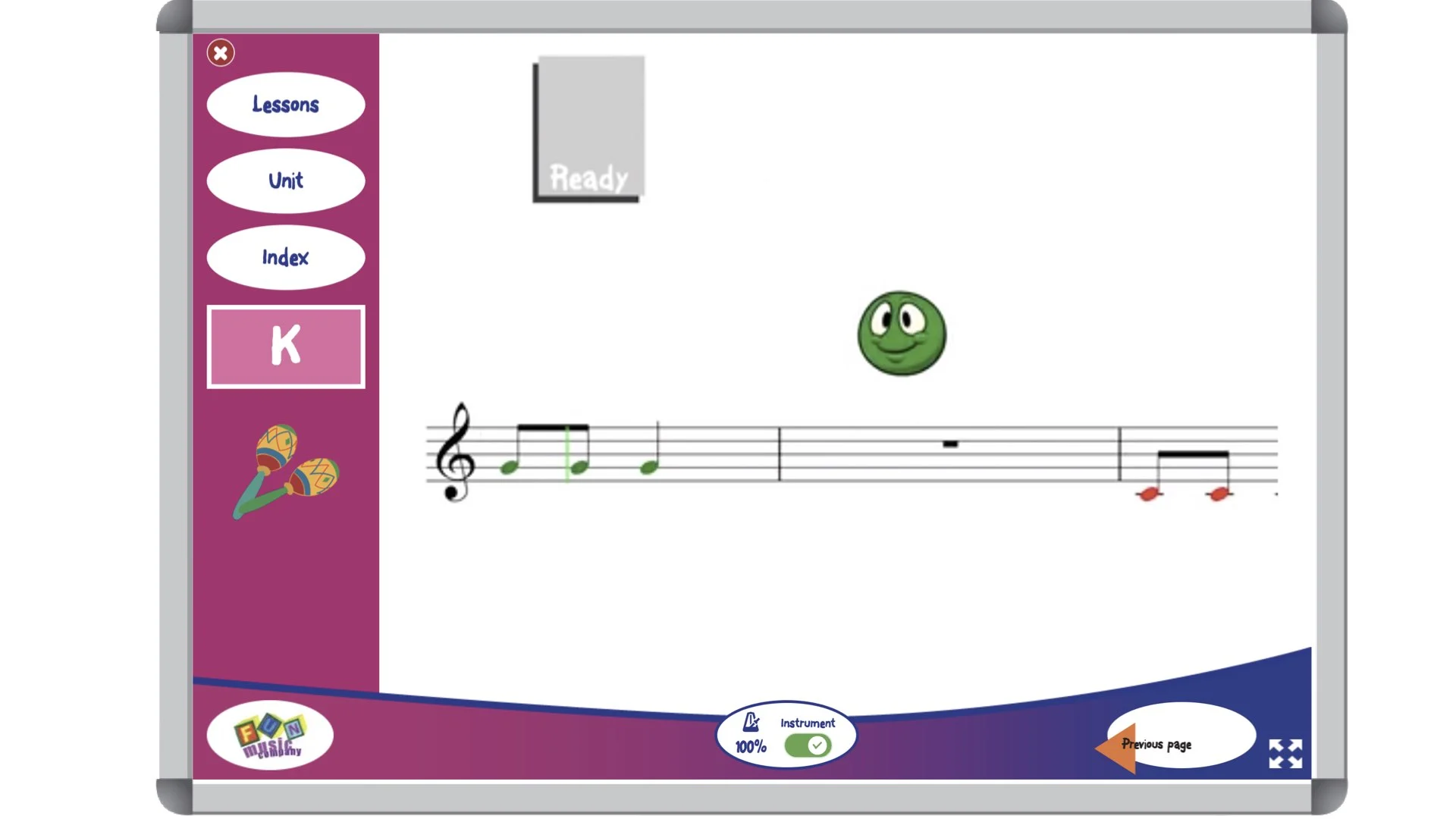
This is where our Fun Music Company ‘Boomwhacker Beatz’ come in. These are fun animated faces that bounce on screen at exactly the moment each child needs to play their note. Students watch the screen, and when they see their colour bounce — they play. It’s that simple.
But here’s what makes it genuinely clever: we don’t just show the animation. We also display traditional music notation alongside it, with colour-coded notes that match the Boomwhackers.
So while your Kindergarten students are watching those bouncing faces and having a wonderful time, they are simultaneously being exposed to real music notation. They’re seeing notes on a staff. They’re seeing how rhythms work. They’re beginning to make connections between what they hear, what they see on screen, and what they play — all without any pressure, and without even realising they’re learning to read music.
This is what educators call exposure-based learning. Kindergarten students aren’t expected to decode sheet music — but those neural pathways are forming, and that early exposure pays dividends as they move through the program.
‘A Sailor Went to Sea’ is a fun traditional song that Kindergarten students love. The free resource includes the complete lesson plan, the introduction video, and the full performance video with Boomwhacker Beatz — everything you need to run this lesson tomorrow.
Resources for the Sailor Went to Sea Lesson
Please find the resources required for this music lesson below.
Download the PDF lesson plan guide, then bookmark the link for use in your classroom.


Free Activity #2: ‘La Cucaracha’ — Grade 2
What if just two notes is all you need to get your Grade 2 students playing in a real ensemble?
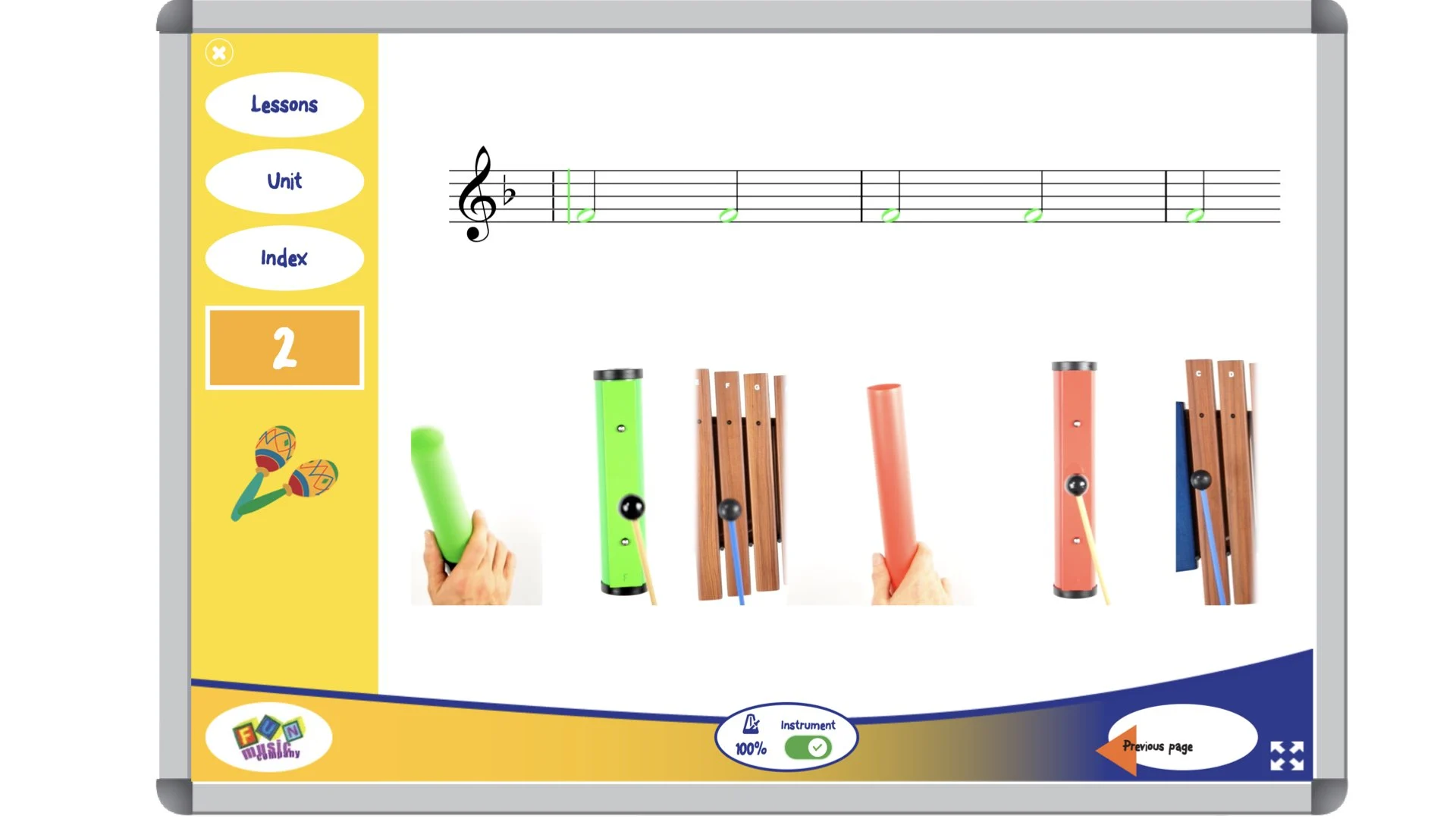
Once students move beyond Kindergarten, the approach to Boomwhackers evolves with them. Grade 2 students no longer rely on the animated Beatz to know when to play — they’re ready to read the actual colour-coded notation on the staff. And ‘La Cucaracha’ is a perfect example of how to challenge them at exactly the right level.
The tuned percussion part for this arrangement uses just two notes. On the surface, that sounds very simple — and that’s entirely intentional. Here’s why it works so well at Grade 2:
- The two-note part is accessible for every student in the class, including those who find music difficult or lack confidence. No one gets left behind.
- The way students are learning it is more sophisticated than it looks. They’re reading colour-coded notation on a staff. They’re tracking rhythm. They’re playing alongside singing parts and other percussion, which means they’re listening, responding, and contributing to a full ensemble sound
- They’re experiencing what it genuinely feels like to be a musician — not just tapping a tube, but making music with other people.
This is the beauty of a well-sequenced program. The parts are manageable, but the experience is rich. Students build confidence through success, while the musical and cognitive demands grow steadily with each year level.
The free resource for ‘La Cucaracha’ includes the complete lesson plan and instructional videos for the tuned percussion part — ready to use with your class straight away.
Resources for the La Cucaracha Lesson
Please find the resources required for this music lesson below.
Download the PDF lesson plan guide, then bookmark the link for use in your classroom.
These two lessons give you a real feel for how Boomwhacker music works across year levels — from the Kindergarten introduction right through to independent ensemble playing in the junior years. If you love what you see and want that same quality and sequencing for every year level from Kindergarten through to Grade 6, read on.
Take Your Boomwhacker Teaching Further with the Fun Music Company Curriculum
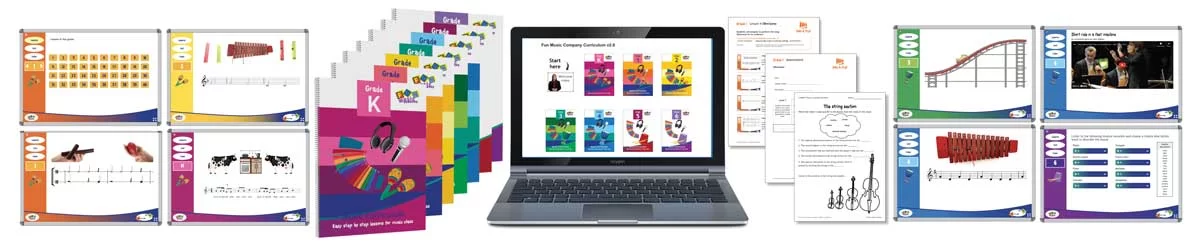
What you’ve seen in this article is just a glimpse of what’s possible. The Fun Music Company Curriculum has Boomwhackers woven through the entire K–6 sequence — and the thinking behind it goes much deeper than simply picking songs and playing them.
Every Pitched Percussion Part is in Boomwhacker Colours
Every single piece of tuned percussion music in the curriculum from Kindergarten to Grade 2 — is written in Boomwhacker colours. That means your students always have a visual reference they recognise, whether they’re playing Boomwhackers, resonator bells, xylophones, or any other pitched instrument. The colour system isn’t just a Boomwhacker feature — it’s woven through the entire program as a consistent musical language.
A Genuine Sequence — One Note at a Time
Here’s what sets the Fun Music Company approach apart from simply handing students a set of tubes and hoping for the best: we have really thought about sequencing.
- Kindergarten students start with just one note. One colour. One pitch. That’s all — and it’s exactly right for that age and stage.
- Grade 1 students build to two notes, then three.
- By Grade 2, students are reading colour-coded notation on a staff and playing as part of a full ensemble, as you’ve seen with La Cucaracha.
- Grades 3, 4, 5 and 6 continue to build — more pitches, more complex rhythms, more sophisticated ensemble arrangements — all the way through upper primary. Throughout Grades 3-6 students will start to move away from the Boomwhackers to more complex instruments, but can still come back to the Boomwhackers at different times.
- Every step is intentional. Every song is chosen because it achieves something specific at that year level. Nothing is random, and nothing is thrown in just to fill space.
Get a Feel for It First — Free Boomwhacker Activity Sample Pack
If you’d like to explore the curriculum before committing, we’ve put together a free Boomwhacker Activity Sample Pack — a carefully selected collection of activities drawn from across the K–6 program so you can see the sequencing and quality for yourself.
Ready for the Full Program?
The Boomwhacker content is just one part of a comprehensive K–6 music curriculum that covers singing, movement, composition, listening, and ensemble performance — all sequenced and ready to teach.
Whether you’re a music specialist or a generalist classroom teacher, the curriculum gives you everything you need to deliver confident, engaging music lessons every single week.
Explore the Fun Music Company Curriculum Program →
“The Fun Music Co is the GOLD STANDARD in music education! I look forward to teaching with these programs and can’t wait to see what you create next!”
— Fun Music Company Teacher
Frequently Asked Questions About Boomwhackers
Boomwhackers are ideal for Kindergarten to Grade 2 students. With the right activities, even preschoolers can enjoy simple colour-matching rhythms, but they find their sweet spot in early primary or elementary school.
Older primary or elementary students (Grades 3-6) certainly can use boomwhackers, and we do incorporate them within the SING & PLAY and COMPOSE elements of the Fun Music Company programs at this age. However, they should be supplemented with other instruments and activities at those age groups, and not over-used.
Absolutely not! That’s one of the biggest advantages of Boomwhackers. The colour-coded system means students follow along with their colour, rather than needing to decode traditional notation. If you can identify colours, you can teach with Boomwhackers.
For a class of 30, you’ll ideally want at least five to six sets of the diatonic set (8 tubes, C–C). That way groups of six students can play one pitch simultaneously.
This is every Boomwhacker teacher’s number one challenge! The key is framing it musically from the very start: tell students their job is to create a beautiful sound, not a loud one. Practising soft vs. loud together as a class helps. The carpet method also naturally reduces the likelihood of hard hits.
Yes — and this is one of the most important things to explain to students. Boomwhackers produce their pitch based on their exact tube length. Dents, bends, and damage change the tube shape and alter the pitch over time. Looking after them carefully means they’ll stay in tune for years.
Store Boomwhackers in buckets or containers or hanging vertically in a designated spot. Avoid storing them squashed in a box where they can bend. Many teachers use a large open container or hang them on hooks sorted by colour, which also makes them quicker to distribute in class.
Yes! The Fun Music Company Curriculum Boomwhacker Materials are designed specifically with generalist and non-specialist teachers in mind. Every lesson plan is fully scripted and colour-coded, so no music reading experience is needed.
Yes. Boomwhackers support the requirements of the Australian Curriculum v9: The Arts (Music) across all year-level bands from Foundation to Year 6. They are particularly well suited to the curriculum’s emphasis on ensemble music-making, aural skill development, and the progressive introduction of music notation. The colour-coded system provides a practical and accessible pathway to the music literacy outcomes required by the curriculum at each stage.
Yes — this is one of their greatest strengths in the Australian primary school context. The colour-coding system means that a teacher who cannot read music or play an instrument can still deliver a structured, curriculum-aligned Boomwhacker lesson. A clear lesson plan and access to colour-coded resources is all that is needed to get started.
When colour-coded Boomwhacker notation is displayed alongside traditional staff notation from an early age, students begin building the connection between sound and written symbol before they are formally taught to read music. This exposure-based approach — used throughout the Fun Music Company Curriculum from Kindergarten onwards — means students arrive at formal music reading with significantly more familiarity with how notation works than students who have had no structured notation experience.
Ready to Bring Boomwhacker Music to Your Classroom?
Boomwhackers are one of those rare classroom instruments that work for absolutely everyone — students love them, teachers love them, and they produce genuinely musical results even in the very first lesson.
Start with the free resources above, get familiar with the colour chart and the three playing techniques, and you’ll be amazed at what your class can create. And when you’re ready for a full, sequenced program that takes all the planning work off your hands?
Explore how you can make Boomwhacker teaching easy and fun with the Fun Music Company Curriculum →

Leave A Comment